
Ask when the fold happened
The important question is the sequence of events. Was the metal folded by the striking action, or did someone bend a normally struck coin afterward? A useful first inspection gathers evidence for that question. It does not start by matching a curved outline to an expensive listing.
What the certified example shows
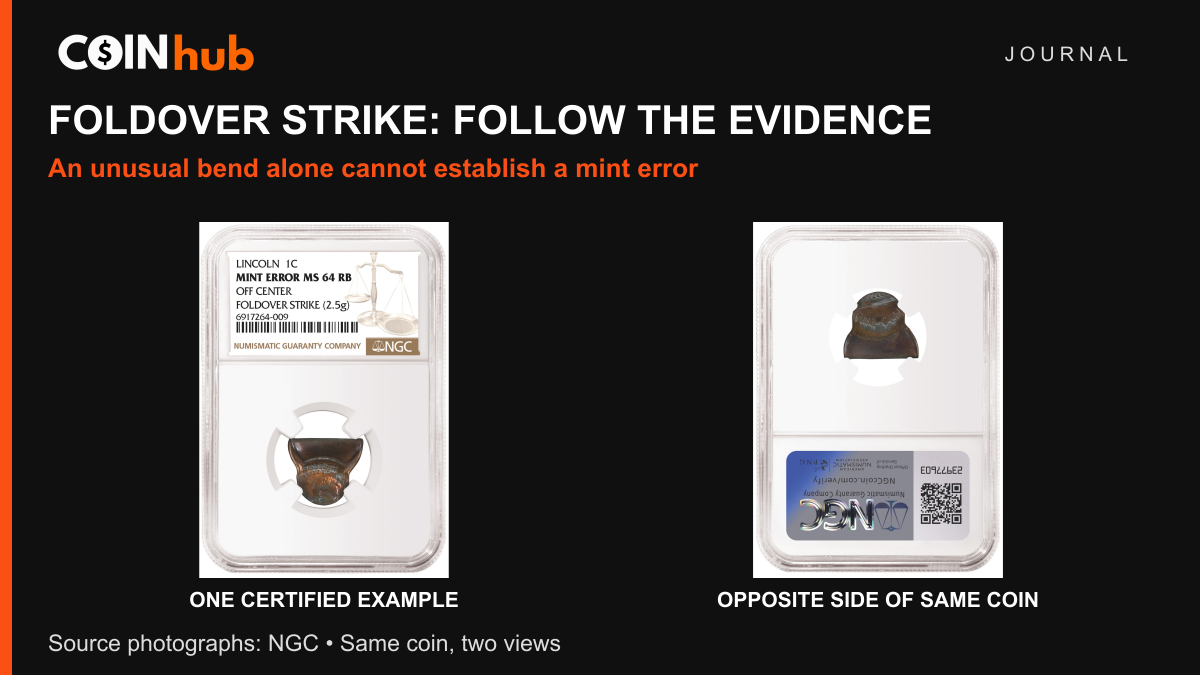
The two photographs above show the same Lincoln cent, NGC certification 6917264-009. In its December 2024 study, NGC identifies both a foldover strike and an off-center strike. Only part of the folded metal received the design, and the date is not visible. The holder records MS64 RB and a weight of 2.5 grams.
This is a documented example of combined errors, not a template that every genuine foldover must match. The label belongs to this specimen alone. Another coin with a similar curve does not inherit its certification, condition or attribution. Nor should a missing date be filled in from the appearance of an unrelated example.
How the striking action changes the shape
Error-Ref's diagnostic research describes several ways a planchet or coin can end up on edge in the press. Its position when the dies meet influences where and how the metal folds. A fold can pass near the center or closer to an end. The resulting object need not be a neat semicircle.
The outward-fold example also illustrates why a small die-struck area and an open loop can occur. Those details make more sense as the result of a mechanical sequence than as a checklist of shapes. An examiner considers the struck surfaces, fold, edges and displaced metal together.
Three things that are easy to confuse
| Description | Question to resolve | What the name does not prove |
|---|---|---|
| Foldover strike | Did an on-edge piece fold during the strike? | That every genuine example has the same silhouette |
| Other folded-metal or planchet problem | Was the metal already folded or defective before a later strike? | That any Mint-made fold belongs to this particular error class |
| Post-mint bend or alteration | Was a normally struck coin bent afterward? | That an unusual appearance creates a mint-error premium |
Mike Diamond's discussion of folded planchets makes the terminology distinction explicit: not all folded-planchet errors are foldover strikes. Preserve the broader description “folded coin, attribution unconfirmed” until the mechanism is established. That wording avoids turning a preliminary observation into a claim.
Preserve the evidence before asking for help
- Leave the shape alone. Do not flatten, unfold, squeeze or pry apart the metal to see more of the design.
- Photograph both sides. Include the whole object, not just its most dramatic feature.
- Add safe side views. Show the fold and visible edge without forcing the coin into a new position.
- Keep the context. Record where it came from, any visible date or denomination, and the wording on an existing holder.
- Separate facts from guesses. Write “date not visible” or “weight not measured” when that is the actual state of the evidence.
Keep the original photographs as well as any enlarged copies. Do not digitally reconstruct missing letters or remove marks from an image used for identification. If the coin is certified, retain its holder and certification information; opening the holder to obtain a measurement introduces unnecessary risk.
Get the attribution before discussing price
A foldover label on a sales listing is a claim to evaluate. Ask for the evidence supporting it and seek a qualified mint-error examination if the answer affects a purchase or sale. NGC's grading FAQ describes authentication as an expert judgment using multiple forms of evidence, with inconclusive outcomes possible.
Once an error is authenticated, comparisons still need to match the denomination, visible date, condition and character of the error. An asking price is not a completed sale. This guide therefore does not assign a universal foldover value. For other penny-error categories, continue with our penny error reference; for a different striking problem, see the broadstrike guide.
Should I straighten the coin to read the date?
No. Keep it in its current condition and record that the date is obscured. A clearer date is not worth destroying evidence of the fold.
Research and source photographs checked September 19, 2026. The illustrated NGC coin is an identified historical example, not a newly discovered error or an appraisal of the reader's coin.