
Broadstrike Lookalikes Collectors Should Avoid
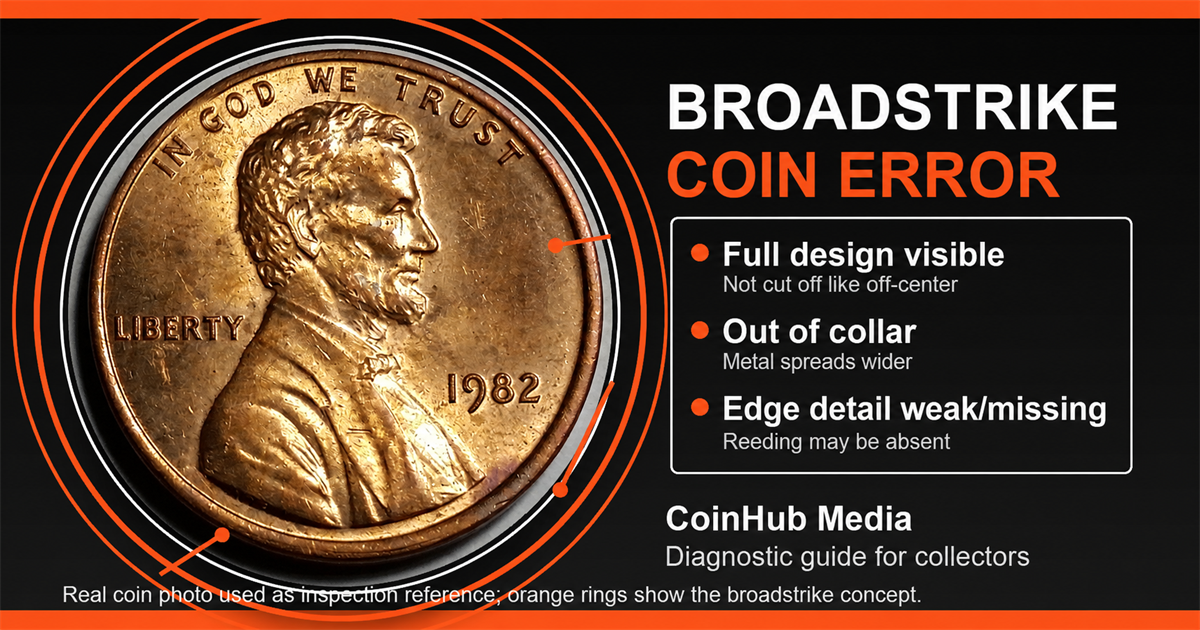
A broadstrike coin error happens when a coin is struck outside the collar, so the metal spreads wider than normal. The key diagnostic is simple: the design should still be complete on both sides. If part of the design is missing because the planchet was not centered, you are usually looking at an off-center strike instead.
How a Broadstrike Error Happens
During a normal strike, the collar holds the planchet in place and helps set the coin's final diameter and edge. On a reeded coin, the collar helps form the reeded edge. On a plain-edge coin, it still keeps the metal from spreading too far.
When the collar is missing, retracted, jammed, or too low at the moment of striking, the planchet is not fully contained. The dies still press the design into the coin, but the metal can flow outward. That is why a genuine broadstrike often looks larger, flatter around the rim, or less sharply contained than a normal coin of the same denomination.
Broadstrike vs. Off-Center Strike
| Feature | Broadstrike | Off-center strike | Damage lookalike |
|---|---|---|---|
| Design position | Usually centered or nearly centered. | Design is shifted away from center. | Design may be normal, but the edge or rim is altered after minting. |
| Full design visible? | Yes. The full design should be present on both faces. | No. Part of the design is cut off. | Usually yes, unless the coin was physically cut, ground, or bent. |
| Diameter | Often wider than normal because metal spread outside the collar. | May have an irregular blank area and incomplete design. | Often normal or uneven in a way that shows scraping, flattening, or tooling. |
| Edge detail | Reeding or normal edge definition can be weak or missing. | Edge behavior varies with the strike position. | Filed, spooned, or dryer coins can have rounded or smeared edges. |
What To Check Before Calling It a Broadstrike
- Compare diameter: place the coin next to a normal coin of the same denomination. A broadstrike should look meaningfully wider, not just worn.
- Check both sides: the date, legends, portrait, and reverse design should be fully present. Missing design usually means off-center, not broadstrike.
- Inspect the edge: reeded coins may show weak or absent reeding when struck outside the collar. Plain-edge coins can still show unusual spread.
- Look for damage signs: circular edge smoothing, heat discoloration, dents, grinding marks, and flattened rims can point to post-mint damage.
- Weigh the coin: a broadstrike should still be the correct denomination and planchet type unless another error is also involved.
- Photograph it straight on: take clear obverse, reverse, and edge photos beside a normal coin. That makes comparison easier before grading or selling.
Are Broadstrike Errors Valuable?
Broadstrike value depends on the denomination, date, metal, eye appeal, how dramatic the spread is, whether the coin is damaged, and whether the error is certified by PCGS, NGC, ANACS, or another respected service. A common minor broadstrike can be modest, while a dramatic broadstrike on a popular series can bring stronger collector interest.
Do not price a coin from one online listing. Error coins vary widely, and many seller descriptions are optimistic. If the coin is high value, unusual, or easy to fake, authentication matters more than a social-media opinion.
- Dryer coins: repeated tumbling can round the edge and make a coin look swollen or odd.
- Spooned coins: tapping the edge can push metal inward and create a raised, rounded rim.
- Filed or ground edges: tool marks and exposed metal can mimic missing edge detail.
- Heavy circulation wear: old worn coins can have weak rims without being mint errors.
- Off-center strikes: these are real errors too, but they are not broadstrikes when design is missing.
For related diagnostics, compare CoinHub's clipped planchet error vs damage guide, grease-filled die error guide, die cud error guide, and coin alignment vs medal alignment guide. Broad denomination pages such as the penny error list and quarter error list are useful next stops, but this guide is focused only on broadstrike diagnostics.
Broadstrike Coin Error FAQ
Is a broadstrike the same as an off-center strike?
No. A broadstrike should have the full design visible on both sides. An off-center strike has part of the design missing because the planchet was not centered under the dies.
Can a broadstrike have no reeded edge?
Yes. If a normally reeded coin is struck outside the collar, the normal reeded edge may be weak, incomplete, or missing because the collar did not form it correctly.
Does a broadstrike coin need grading?
Not always. Low-value examples may not justify grading fees. Consider authentication when the coin is dramatic, valuable, disputed, or likely to be sold online.
Can damage look like a broadstrike?
Yes. Dryer coins, spooned edges, filing, grinding, and heavy wear can all make a coin look wider or flatter than normal. Compare diameter, edge texture, surface damage, and full design before assuming it is a mint error.