
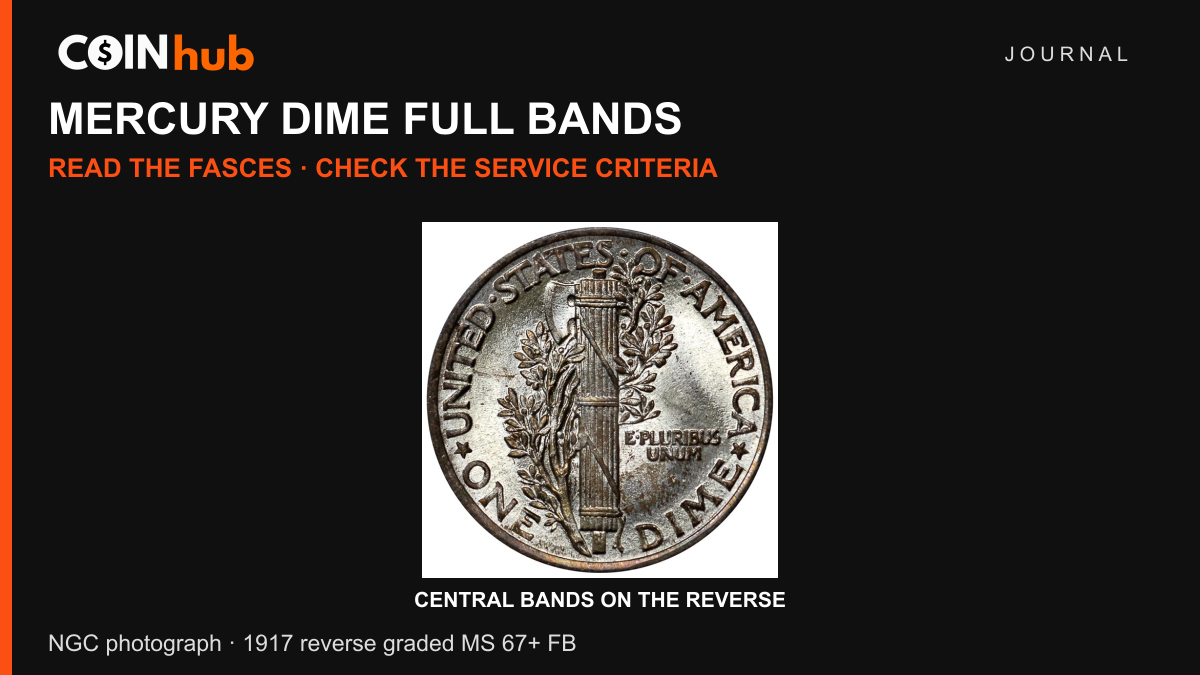
Find the central bands before reading the label
The fasces is the bundle-of-rods design. Find its center, where the horizontal bands cross it, before judging a photograph. The portrait, the coin’s shine and the number on a holder do not answer whether those small details satisfy a service’s rule.
The published criteria side by side
| Service | Band requirement | Grade and issue limits |
|---|---|---|
| PCGS | Complete, uninterrupted separation across the central bands; full roundness is not required | Normally MS60 or higher. Published exceptions allow qualifying 1916-D, 1942/1 and 1942/1-D examples as low as AU50. |
| NGC | Full central separation with a recessed area between the bands, plus separation in the top and bottom groups | Mint State is not required. NGC does not use FB for Proof dimes. |
Read the full PCGS qualification explanation, its central-band definition, and NGC’s dime criteria when preparing a submission or checking a description. An interruption in the relevant separation matters; a merely strong overall impression does not settle the designation.
The table is not a prediction of a crossover. Each service must examine the actual coin. A correct quotation from one service cannot promise what another will put on a holder.
What the reference photograph establishes
The main image is NGC’s reverse photograph of a 1917 Mercury dime graded MS 67+ FB. Look at the central horizontal bands, then move upward and downward along the bundle to find the other band groups. The photograph helps orient an inspection; its assigned grade and designation apply only to that pictured specimen.
For a useful comparison, view the original large photograph linked from NGC’s page. The article header fits the full coin into a smaller display. A page image should not be treated as enough evidence to grade a separate coin, especially when reflections conceal small marks.
Record three things separately
- The issue. Copy the date and mintmark from the coin or verified certification record.
- The attribution. Record the service, numerical grade and printed designation exactly. “Seller says FB” and “holder says FB” are different entries.
- Your observations. Note which band areas are clearly visible and which need another photograph. Preserve a complete reverse view alongside close-ups.
For example: “NGC holder reports MS 67+ FB; central and upper bands visible in photo; lower group obscured by reflection.” That note does not dispute or independently confirm the grade. It describes what your evidence file contains and what another image would resolve.
For a raw dime, keep the proposed designation provisional. Ask for multiple light angles and both full faces. Do not draw a line into a photo to make separation look more convincing, and never try to improve the bands on the coin.
Why a sharp line needs context
PCGS warns that altered bands can imitate the required split. A striking-looking groove therefore deserves scrutiny rather than an automatic FB conclusion. If the claimed attribution materially affects a purchase, obtain an appropriate examination and verify any certification details through the service.
The practical question is not simply “Can I see a line?” It is “Do the original surface, the complete coin and the service’s examination support this claim?” Keep the coin in its certified holder during ordinary comparison and documentation.
Use matching sales, not a universal multiplier
A useful comparison keeps date, mint, grade, service and designation together. Inspect the individual coin and record the sale date and terms. This guide does not convert FB into a fixed percentage premium, and it does not reuse old source prices or population counts as current market data.
For another dime series, see Roosevelt Full Bands and Full Torch: its reverse has a torch, so the inspection area differs. Our PCGS and NGC label guide explains how to preserve the full holder description.
Can a circulated Mercury dime receive FB?
Sometimes. NGC does not require Mint State. PCGS lists specific AU exceptions, so a blanket “never below MS60” rule leaves out important cases.
Does MS67 automatically mean Full Bands?
No. The numerical grade and the designation answer different questions. Read the complete label and inspect the appropriate reverse detail.
Primary references and Google/Bing results checked September 16, 2026. Photo-record examples are CoinHub editorial guidance. No authentication, grade or current price is assigned to a reader’s coin.