
Start with the service, then examine the torch
A listing can make two coins sound interchangeable: same date, same mintmark, same numerical grade, and a description that says “full bands/full torch.” Before comparing them, read the actual holder or attribution record. A seller’s combined phrase does not tell you which service assessed the coin or which designation it received.
PCGS FB and NGC FT compared
| Question | PCGS Roosevelt FB | NGC Roosevelt FT |
|---|---|---|
| Horizontal bands | Full separation within both upper and lower pairs | Full separation within both pairs |
| Additional published detail | No significant cuts or marks across the horizontal bands | Vertical lines of the torch must be defined |
| Grade eligibility | MS60 or better in the cited PCGS definition | NGC says a dime need not be Mint State to qualify |
| Proofs | A circulation-strike designation | NGC expressly excludes Proof dimes |
The definitions come from PCGS’s Full Bands explanation and NGC’s dime strike-character guide, checked September 13, 2026. Do not transfer one company’s wording to another company’s holder.
There is a second naming trap: NGC also uses “FB,” but its cited guide assigns that name to Mercury dimes. A Mercury dime has a fasces on the reverse; a Roosevelt dime has a torch. Read the coin type as well as the abbreviation.
Make three observations instead of one guess
With permission to handle a raw coin, hold it by the edge over a safe surface. For an encapsulated coin, leave the holder closed. Use a steady loupe view or a sharp photograph, then write down three separate observations:
- Upper pair: Can you follow the dividing line across the bands, or does it merge, disappear or become obscured?
- Lower pair: Repeat the check independently. A convincing upper pair does not answer the lower-pair question.
- Vertical lines: If considering NGC FT, inspect the lines running along the torch rather than stopping at the horizontal bands.
“Upper clear; lower uncertain; vertical detail visible” is a useful record. “Looks sharp, probably FT” hides the exact uncertainty that a better image or professional examination needs to resolve.
What the photograph can and cannot tell you
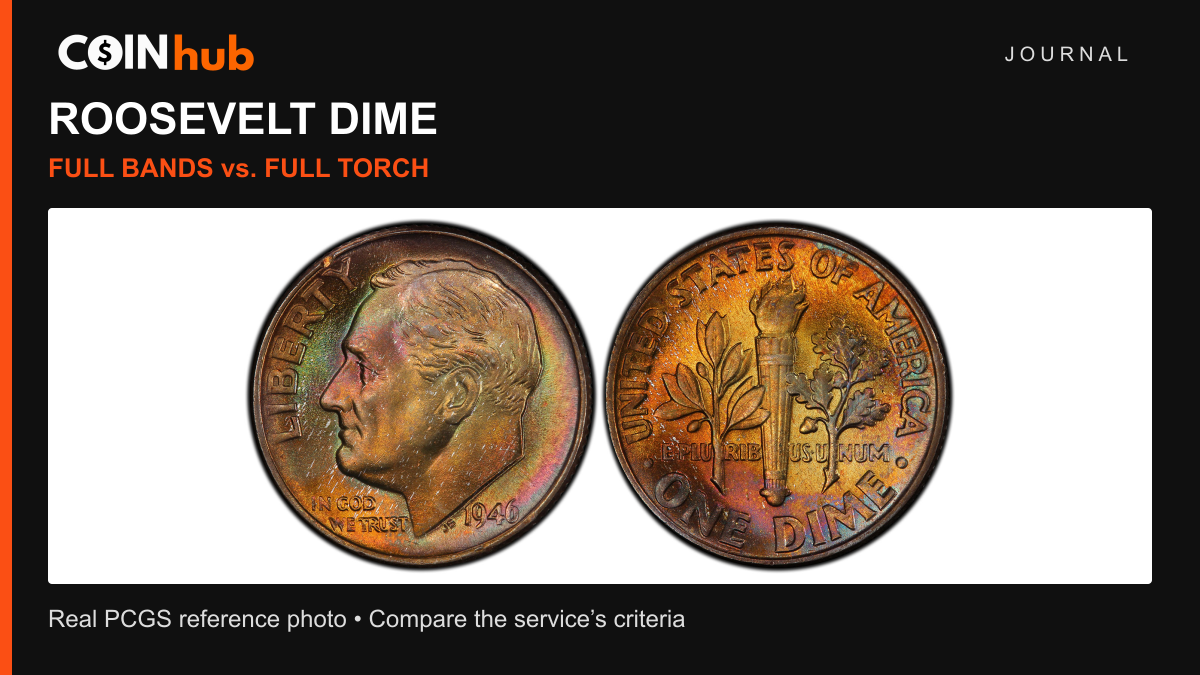
The main image here is a real 1946 Roosevelt dime identified by its PCGS source as MS68. It is a type reference, not an example we have independently designated FB or FT. Use the enlarged comparisons in the linked authority pages to study the relevant areas.
On a sale listing, ask for the whole reverse and a focused torch close-up. Try a second lighting direction when glare hides the dividing line. A dark line in one photograph could be shadow; a bright patch could conceal a mark. Digital sharpening cannot recover a feature that was never recorded clearly.
Do not clean the coin or scratch between the bands to make them look separate. If the evidence remains unclear, leave the designation unconfirmed. Our coin-photography guide explains how to improve the record without altering the surface.
A strike designation does not replace the grade
A numerical grade and a strike designation answer different questions. An MS66 FB label should be recorded as a complete description, rather than shortened to “better than MS67.” The overall coin still has surfaces, marks, luster and eye appeal to evaluate. A small area of unusually complete detail cannot stand in for that wider assessment.
Likewise, an attractive reverse with incomplete bands is not automatically a mint error. Ordinary differences in strike detail occur. If the broader distinction between weak detail and circulation wear is the problem, use our weak strike versus wear guide.
Compare like with like before comparing prices
Create a comparison line with the date, mintmark, grading service, numerical grade, designation and any qualifications. Keep a PCGS FB comparison separate from an NGC FT comparison, and keep uncertified seller opinions separate from certified results. Read the service’s certificate record directly; our holder-label guide explains the fields.
A dated auction result for a different grade or designation cannot establish the value of your dime. Nor should an old population number become a current rarity claim. This guide intentionally gives no blanket FB/FT premium. For wider series context, see Roosevelt dimes worth checking, then research closely matched completed sales.
Can I guarantee FT by finding full horizontal bands?
No. NGC’s published definition also includes vertical torch detail, and an actual designation depends on the grading service’s examination. A collector’s preliminary inspection is useful evidence, not a guaranteed outcome.
Definitions and source captions checked September 13, 2026. No current price, grading fee, population total or guaranteed grade is asserted. Photographic attribution appears beneath the hero.