
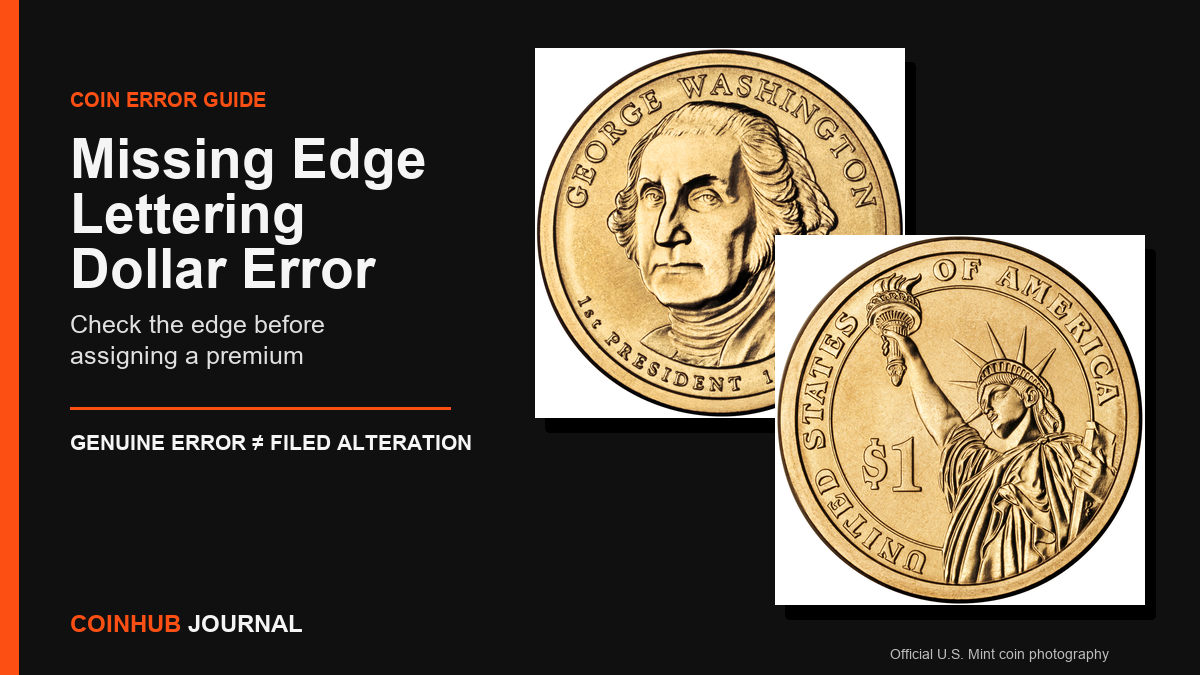
Why some dollar coins have lettering on the edge
The U.S. Mint’s page for the 2007 George Washington Presidential dollar lists its normal edge inscriptions: the year, E PLURIBUS UNUM, IN GOD WE TRUST, and a mint mark. Those inscriptions were not part of the obverse or reverse design on that issue.
NGC explains that these small dollars were struck with plain edges and then passed through a separate edge-lettering operation. A coin that bypassed that later step could leave the Mint with a blank edge. That is a real production error—but only for a coin that was supposed to receive lettering in the first place.
Which coins should you check?
Start with Presidential dollars and other specific small-dollar issues known to use edge inscriptions. Do not apply the test to every golden-colored dollar. The 2026 Trump dollar, for example, has a plain edge by design; a blank edge on that coin is not the same error. Likewise, ordinary wear cannot remove incuse lettering cleanly across an otherwise original edge without leaving evidence.
A safer five-step check
- Identify the date and design. Confirm the denomination and exact issue before looking for an error.
- Find the normal edge standard. Use the Mint, PCGS, or NGC—not a marketplace caption—to determine whether lettering belongs there.
- Inspect the full edge in good light. A genuine missing-lettering piece should be consistently blank, not merely worn in one patch.
- Look for alteration clues. Filing, flattening, changed color, disrupted rims, or unnatural texture are warning signs.
- Seek attribution before paying a premium. A major grading service can separate a real error from a damaged or altered coin.
Why “Godless dollar” is not a value grade
Early media coverage called the 2007 error a “Godless dollar” because the motto was then normally on the edge. PCGS uses the more precise “Missing Edge Lettering” label. The nickname does not guarantee rarity, grade, or value. PCGS and NGC records show that the Washington issue became widely known and that condition and certification still matter.
Where this fits in an error hunt
Missing edge lettering is a narrow, process-based error. It is not the same as a broadstrike, a clipped planchet, or a common edge mark. For wider context, see CoinHub’s overview of coin errors worth money and its guide to why coins have ridges. Keep the 2026 dollar programs separate from older Presidential-dollar standards.
Frequently asked questions
Are all smooth-edge Presidential dollars errors?
No. First verify whether that exact issue should carry edge lettering. A smooth edge is only meaningful when lettering was part of its normal design.
What is the famous missing-edge-lettering dollar?
The 2007 George Washington Presidential dollar is the best-known example. PCGS and NGC both document it.
Can a missing-edge-lettering dollar be valuable?
It can have collector demand, but value depends on the issue, authenticity, grade, and actual completed transactions. It is not automatic.
Should I get one certified?
For a coin offered at a meaningful premium, professional authentication and attribution are the safer path.
Source and update note: Error-process details were checked against NGC and PCGS, and normal coin specifications/photography against the U.S. Mint, on August 14, 2026. Official coin photos are used as documentary context; CoinHub’s layout does not imply U.S. Mint endorsement.