
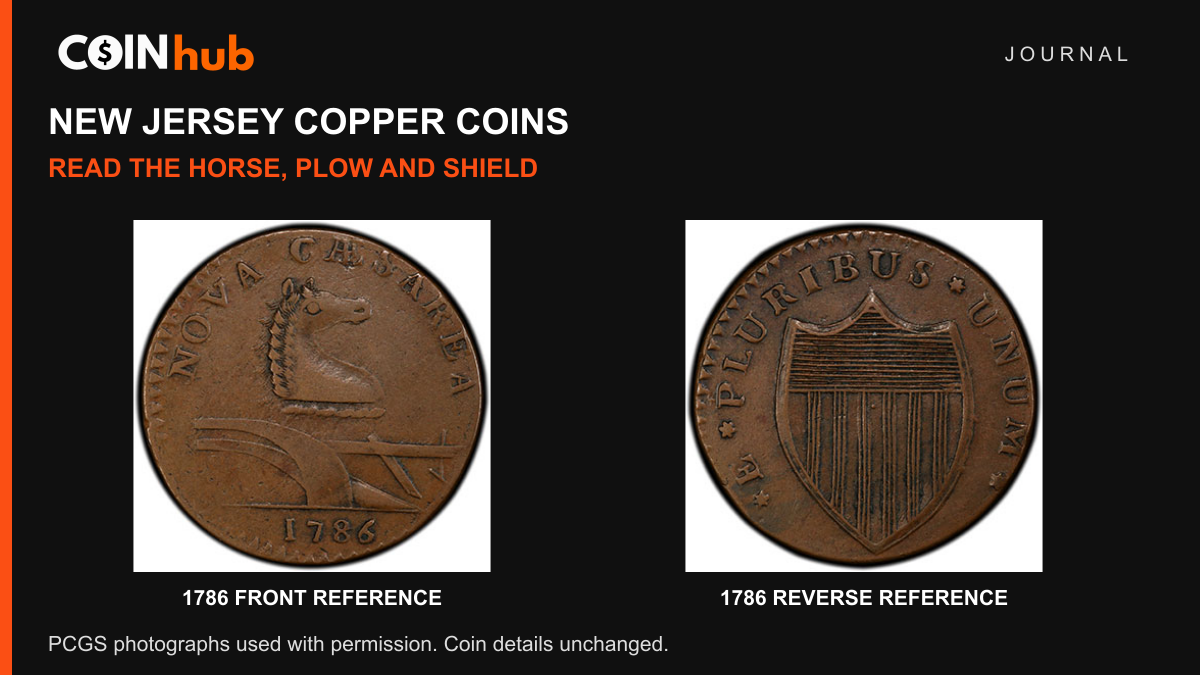
A horse's head above a plow, with NOVA CAESAREA around it, is the starting clue for a New Jersey copper. Turn it over to look for a shield and E PLURIBUS UNUM. The original series carries dates from 1786 through 1788. Read both faces before choosing a catalog entry.
These are early American state copper coins. Their horse-and-plow design belongs to a different issue from the 1999 New Jersey quarter. A familiar state name or an old-looking date alone does not establish what a piece is.
Read the horse side first
The real PCGS reference above is dated 1786. Its horse faces right, with a short twisted band under the head and a plow below. NOVA CAESAREA is the Latin name for New Jersey. The date sits near the lower edge.
The Smithsonian's 1787 New Jersey copper record describes the same basic horse, plow and inscription arrangement. That helps identify the series across more than one date. It does not mean every horse, letter or plow was engraved in exactly the same way.
The twisted band has a name: a torse. In heraldry, it sits between a crest and a helmet. The PCGS Horses and Torses essay connects the coin's motif with New Jersey's coat of arms. A small design detail becomes easier to recognize when you know what it represents.
The shield completes the identification
The reverse, or back, carries a shield surrounded by E PLURIBUS UNUM, meaning “out of many, one.” Look at the shield's outline, its internal lines and the positions of the nearby letters. Keep the entire rim in the photograph so a cropped word does not become a supposed missing-letter variety.
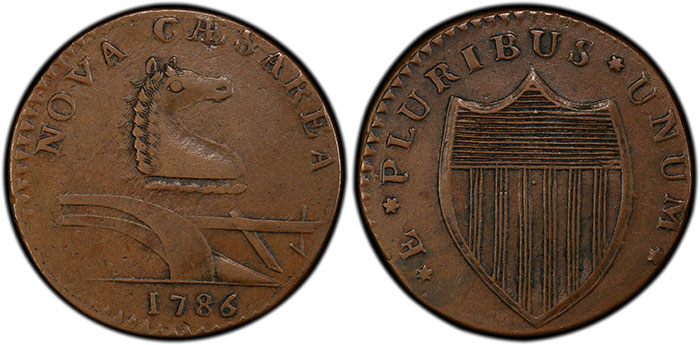
The main graphic preserves both faces of one reference coin. You can also open the original paired photograph. It is a 1786 example, not an illustration of every New Jersey copper or a claim about the grade of a reader's piece.
State authority, private coiners
New Jersey authorized private contractors to supply copper small change. In its history of Walter Mould, PCGS dates the original three-million-coin agreement to June 1, 1786. A later division gave Mould responsibility for one million pieces, with the other partners responsible for the rest.
This is why a New Jersey copper should not be described simply as a Philadelphia Mint penny. The state contract and the later federal Mint belong to different systems. Nor should a date on an early coin be treated as a complete production log. The date identifies a design; it does not supply the exact day a particular piece was struck.
What a Maris number tells you
A die is a steel tool that stamps a design into a coin. A die marriage is one particular front die paired with one particular back die. Edward Maris's catalog system numbers the front dies and letters the back dies.
For example, Maris 7-C and 7-E describe the same numbered front paired with different backs. Uppercase and lowercase letters can identify different reverse dies, so preserve the catalog's capitalization. A Maris designation is neither a grade nor a dollar value.
Nicknames such as Camel Head or Serpent Head help collectors discuss visible styles. They are a starting point for comparison, not a substitute for checking the exact die pair. Do not choose a rare attribution from one vague resemblance in a dark photograph.
Build a record someone else can check
- Save full front and back photos, with the date upright.
- Transcribe the visible words without filling in unreadable letters.
- Note the horse direction, plow details and shield shape.
- Keep the holder label and any trustworthy ownership records with the images.
- Leave the exact Maris pair open until both sides match a documented reference.
Wear, weak striking and surface damage can obscure a useful feature. Preserve the coin as found; rubbing it to reveal a letter can damage the evidence. A complete design match still does not prove authenticity. Have an early American copper specialist examine a piece when an important purchase or attribution depends on the answer.
For another early copper message that needs both faces, see the Fugio cent's sun, sundial and linked rings. It is a separate issue with its own history, rather than another New Jersey variety.
Sources and photograph checked October 20, 2026. Photograph: PCGS, used with permission, from the Walter Mould article's first 1786 reference image. Complete pair proportionally resized; no coin details changed. Historical auction results are not used as current prices.