
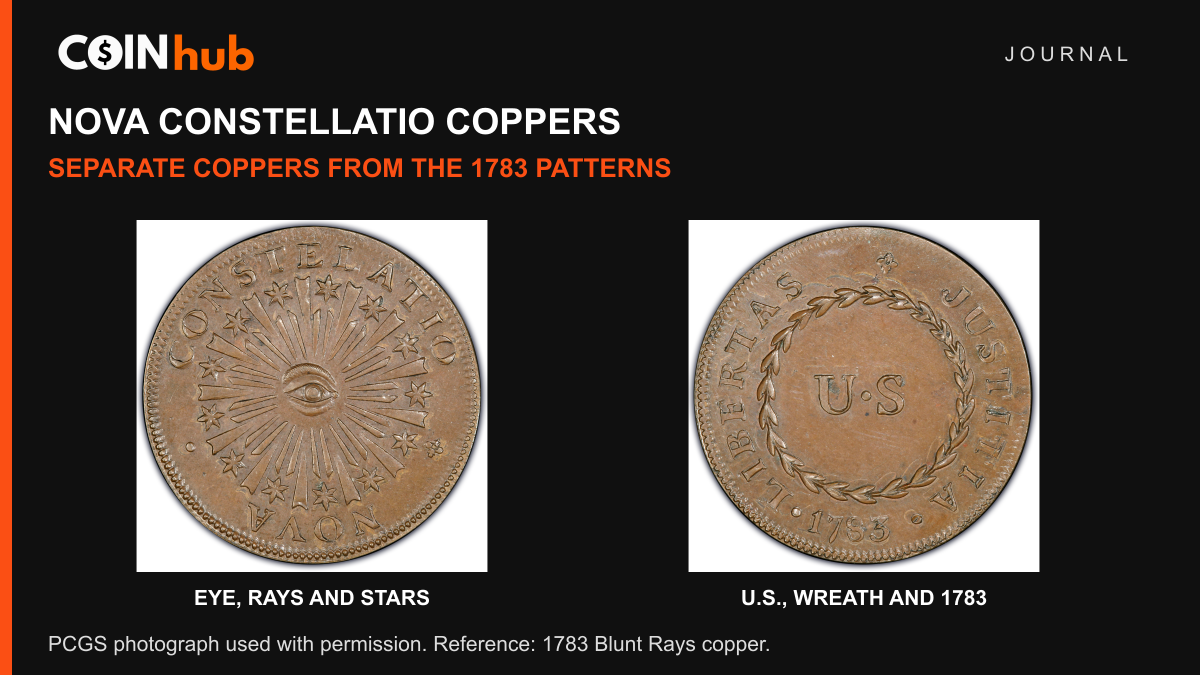
Are Nova Constellatio coppers the same as the 1783 patterns?
No. Private Nova Constellatio coppers and the 1783 pattern coins marked with values are two groups. Both use an eye, rays, stars and much of the same wording. This can mix their stories in search results. A date of 1783 alone does not prove that a copper is one of the national coin trials.
The genuine 1783 Blunt Rays copper pictured above gives a useful place to start. Read both faces: one has an eye among rays and stars; the other has U.S. inside a wreath, with 1783 below. The photograph shows a particular copper reference, not one of the silver denominated patterns.
Look for a denomination, not just familiar symbols
A denomination is a unit or value. The pattern project proposed a national system with coins marked in units. A pattern is a trial piece used to test an idea. This plan did not become regular U.S. coinage.
Ron Guth's account of the 1783 patterns explains the plan. Robert Morris proposed it; Benjamin Dudley made trial pieces. That story does not by itself identify one of the later private coppers with a similar design.
On the pictured copper, the wreath surrounds U.S., with no numerical denomination beneath those letters. Do not read the letters as “one U.S. cent.” A modern catalog's halfpenny-style label also needs context; it does not turn the piece into a regular federal cent.
What the private coppers were for
Q. David Bowers calls these halfpenny-size coppers a private venture in his Garrett Collection history. He places their making in Birmingham, England. His account of who ordered and made them is qualified as a belief. The date on a coin does not prove that account.
Bowers also says the coppers were used in trade. They had a use beyond testing the proposed national coin plan. The two groups can share an idea without being the same coins.
Bowers discusses coppers dated 1783 and 1785, along with a smaller group of contemporary imitations dated 1786. Keep the date as one piece of identification. It does not, on its own, prove the year an individual piece was struck, its maker or its authenticity.
Read the reference coin in two passes
First, follow the side with the eye. NOVA CONSTELLATIO appears around its border. The phrase refers to a new constellation, an image associated with the states. Notice the stars between the rays rather than judging the design from the eye alone.
Next, turn to the wreath side. Read LIBERTAS JUSTITIA around the outside, U.S. at the center and the date below. Record what is visible on your coin before using a sales listing's title. A worn letter can be unclear even when the date is easy to read.
The PCGS copper catalog separates Pointed Rays, Blunt Rays and other varieties. Its 1783 Blunt Rays entry is the photographic reference used here. A label for one entry should not be applied to every copper with the same date.
Why a search result can point to the wrong group
A search by the shared name can show rare trial coins, private coppers, modern copies and sales pages together. A high asking price may be for a different type. So may a claim about the first plan for national coinage.
Match the exact type and both photos before comparing money. Check the units, metal, design, date and variety. Does a sales page show a copper but tell the story of a silver pattern marked with a value? That claim needs more proof.
Keep a record that another collector can review
- Photograph both complete faces and any edge detail you can capture safely.
- Record the visible wording, date and whether a numerical denomination is present.
- Save the exact reference entry, rather than only the broad series name.
- Keep condition, authenticity, detailed attribution and value as separate questions.
Early American coins came from more than one kind of issuer. The Vermont landscape copper guide tells the story of another type. Its sun, plow and stars belong to that design. They do not make it another variety of the copper shown here.
The useful first step is to place the object in the right group. That prevents a familiar date or symbol from carrying a historical claim, catalog number or price that belongs to a different coin.