
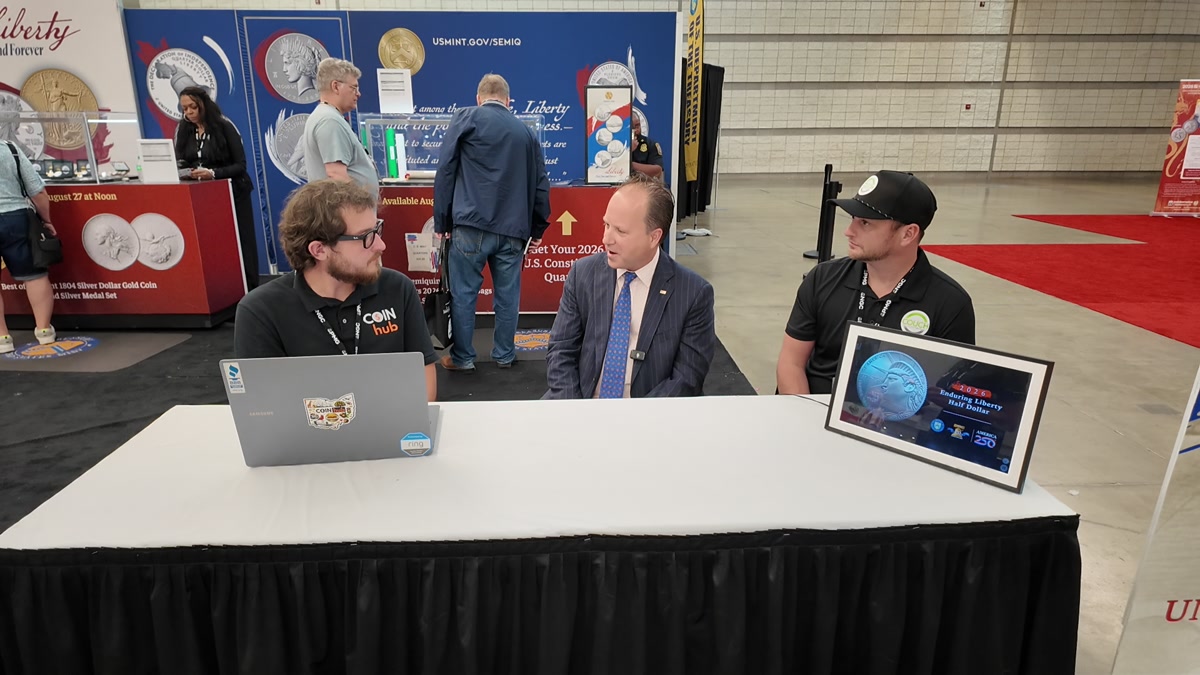
U.S. Mint Director Paul Hollis would like quarters to help Americans learn the names of the Declaration of Independence’s 56 signers. He raised that idea in his CoinHub interview with Blake Alma and Justin Couch. He did not announce an approved signer series, a release date or finished coin designs.
His reason was about memory: a coin could bring a new name to someone’s attention. The clip below explains that goal. It also raises two points to keep apart: the past a coin could teach, and the steps needed to turn an idea into a real coin.
Watch the captioned clip above or open it on YouTube. Justin Couch of Couch Collectibles joined Hollis and Blake Alma for the full CoinHub interview.
Why Hollis chose the 56 signers
“One of the things, as of late, that I think would be really awesome to do is to honor the 56 signers of the Declaration of Independence,” Hollis said. His wording describes something he would like to do. It does not present a firm plan.
He spoke about the courage it took to put a name to the document. Later in the clip, he explained the gap he hoped coins could help fill: “I would love it if Americans could rattle off a list other than John Hancock, you know, with the big signature.”
That is a different collecting goal from finding the rarest coin. The reward he describes is learning a person’s story. You could start with a name you know, then learn one you have not heard before. Near the end of the clip, Hollis points to the quarter as a good coin for the idea.
What the number 56 actually counts
The National Archives’ account of the Declaration says 56 men signed it in all. They were not 56 presidents. They were the men who put their names to this founding text.
The dates also matter. Congress adopted the Declaration on July 4, 1776. Most signed the formal copy on August 2, and others signed later. A set about the signers would need to tell more than a single-day story. Saying all 56 signed on July 4 would miss that point.
The Archives offers a signer fact sheet with names, states and facts about their lives. Try choosing a name you do not know. Find the state that person served, then read the entry. This is a way to try Hollis’s idea now. There is no need to wait for a coin to learn a new name.
A Philadelphia recollection needs context
Hollis connects his idea with the historic sites near the Philadelphia Mint. He recalls a walk through a graveyard, where markers named men who signed the Declaration. It helps explain why he wants more people to know those names.
One detail in the clip needs a closer look. Hollis refers to four signers in a graveyard, without naming it. The nearby Christ Church Burial Ground lists five: Benjamin Franklin, Joseph Hewes, Francis Hopkinson, George Ross and Benjamin Rush. The clip does not tell us which graves he saw.
The National Park Service also records those five names. Those records give us a count to check alongside his memory. His wider point is about learning who the signers were.
How this differs from quarters already planned
As of this October 12, 2026 source check, the Mint’s published plan still identifies youth-sports quarters for 2027–2030. The sources reviewed for this report do not announce a separate 56-signer quarter series.
The Mint’s Youth Sports program page describes a four-year quarter program beginning in 2027. Hollis’s interest in the signers does not mean that this plan has changed. Our 2027 quarters and design-proposals guide covers that separate plan and the artwork under review.
There is also a 2026 Declaration of Independence quarter. The Mint’s 2026 coin media kit shows Thomas Jefferson on its front and the Liberty Bell on its back. One coin about the Declaration is not a whole set of coins about its signers. The two ideas share a subject, but they are not the same plan.
Use the idea as a reading list, not a buying deadline
A useful way to follow this talk is to keep two lists. One can hold questions about the past: who signed, which state each person served, and what else they did. The other can hold firm coin details from the Mint. Leave release dates, designs and product details blank for an unannounced idea.
You can enjoy the history without treating a spoken idea as an offer to buy. This clip gives no coin count, price, sale date or promise of future value. It gives a reason Hollis would like the subject on a coin: helping people remember more of the names.
The clip was published September 28, 2026. The interview’s filming date has not been confirmed. The sources above were checked October 12. They add context to the clip; this is not a new Mint launch.