
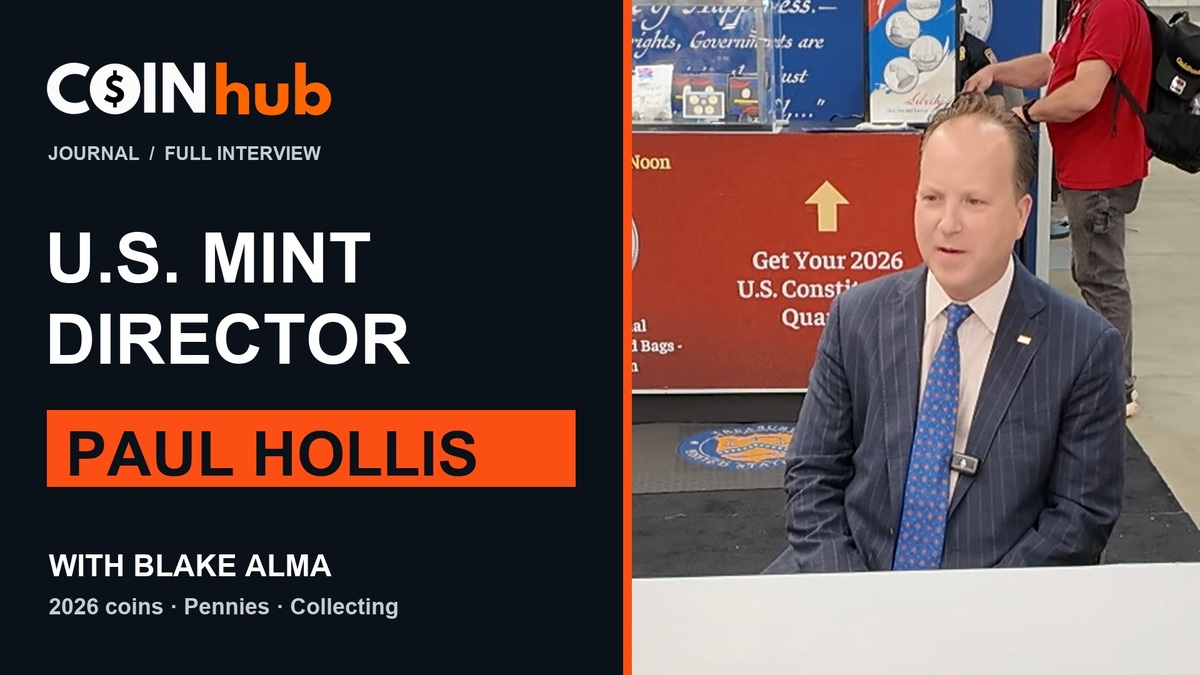
Watch the 41st Mint director answer collectors’ questions
Will Lincoln cents remain in collector sets? Why put special quarters into circulation at face value? And how can the U.S. Mint reach people discovering coins on their phones? U.S. Mint Director Paul Hollis addresses those questions in this full CoinHub Journal interview with Blake Alma and Justin Couch of Couch Collectibles.
28-minute interview · Watch on YouTube. References to upcoming events reflect the time of the recorded conversation.
Jump to a question
These links open the full video at the relevant discussion.
- The Peace dollar that started it all
- What collectors want from the Mint
- Connecting America through coins
- Why offer a privy-mark coin hunt?
- Ideas for the future of quarters
- Sellouts, ordering limits and bots
- The Mint’s funding and collectors
- Lincoln cents in proof and mint sets
- Pennies to the moon and back?
- Reaching the next generation
A collector’s perspective at the Mint
Hollis traces his interest in coins to a Peace dollar his grandmother placed in his hand when he was seven. Decades later, he describes the same excitement in the stories, designs and physical objects that first drew him into the hobby.
That personal history matters to the conversation. Rather than treating collectors only as customers, Hollis describes them as a source of ideas and a way to understand which designs might connect with the wider public. He also directs attention to the Mint’s designers, engravers and craftsmanship.
Hollis became the 41st director on January 5, 2026, according to the Mint’s official biography. His background includes more than 30 years as a professional numismatist.
What he says about pennies in collector sets
Justin Couch asks a question many collectors with annual sets want answered: will the Lincoln cent continue in proof sets and mint sets after the anniversary year?
“Oh, no. We’ll continue.”Paul Hollis, responding to whether 2026 would be the last year for cents in those sets · 19:28
Hollis goes on to discuss the affection collectors have for the cent and the prospect of leaving empty spaces in penny boards. Later in the conversation, he distinguishes collector products sold at a premium from the economics of producing cents for circulation.
These are his comments in the interview, not a product listing for a particular future set. For the practical differences between the two formats, see CoinHub’s proof set versus mint set checklist.
A coin hunt that begins at face value
The privy-mark discussion offers another way into collecting. Hollis explains that special coins placed into circulation can reach people at a very different starting price from gold and silver products. He describes the intention to give collectors around the country a chance to find them.
That is a discussion of access and discovery, not a promise that every bank will have the coins or that a find will bring a particular resale price. Our July 4 privy quarter report provides the separate program background.
Sellouts, fairness and the limits of demand forecasting
Alma asks about quick sellouts, website traffic and ordering limits. Hollis describes a balance between making enough to meet demand and avoiding unsold inventory. He acknowledges the frustration of collectors who miss a release, discusses the website waiting room and says a team is focused on the problem of bots acquiring coins for resale.
Listen to the complete exchange for the distinction between his view that sellouts can be healthy for the market and the experience of a collector who cannot buy a wanted product. The interview does not announce an end to bots or guarantee access to future releases. CoinHub’s guide to Mint limits explains why mintage, product and household limits mean different things.
What could come next for quarters—and collectors
Asked about future quarter themes, Hollis raises the possibility of honoring the 56 signers of the Declaration of Independence. He presents it as something he would like to see. We are reporting that idea as expressed, without treating it as a scheduled or authorized coin program.
The conversation ends with the people who may collect whatever comes next. Alma asks about livestream shopping, social media and digital education. Hollis welcomes the platforms introducing younger people to numismatics and describes how access to information has changed since collectors had to seek out printed books.
Across those subjects runs a consistent theme: coins can open a conversation about history, and the people sharing those stories can help someone else begin collecting.
Watch the complete interview above, explore CoinHub Journal for more reporting, and follow CoinHub and Couch Collectibles for more conversations from the hobby.
Sources: CoinHub’s recorded interview with Paul Hollis, Blake Alma and Justin Couch; U.S. Mint director biography, checked September 26, 2026. Interview photograph: CoinHub. Coin images and event photographs appearing within the video are credited to the U.S. Mint.