
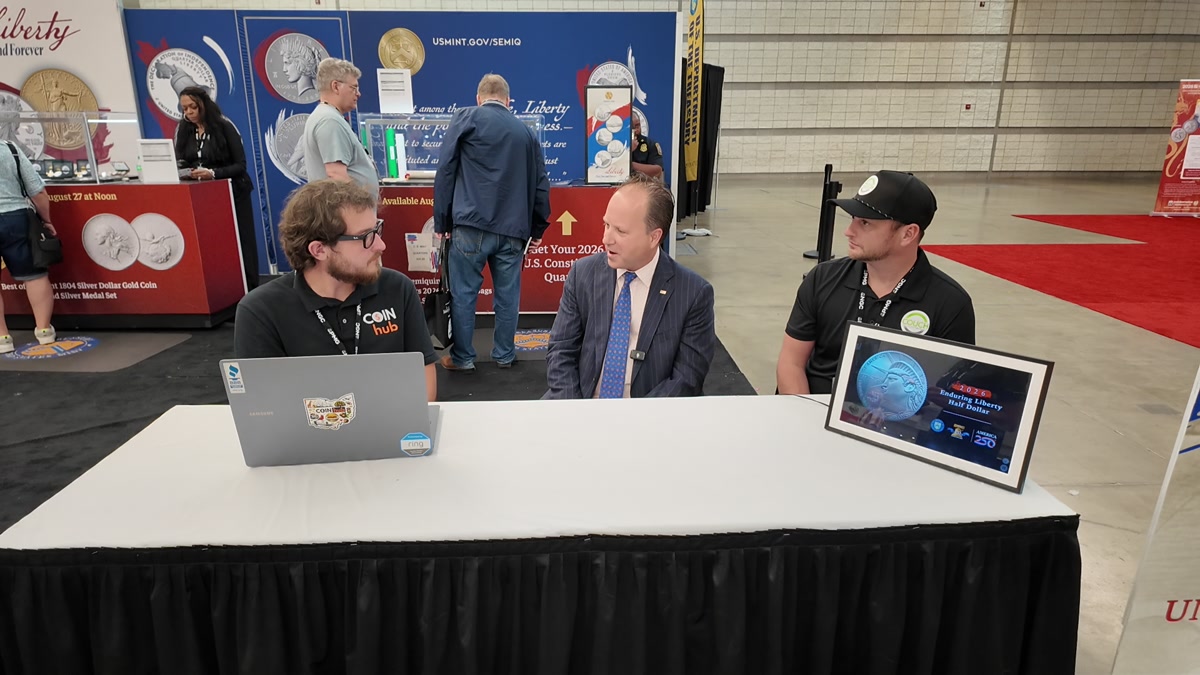
The U.S. Mint pays for its work through coin sales under a special Treasury fund. It does not rely on a yearly sum set aside by Congress. U.S. Mint Director Paul Hollis explains that model in his CoinHub interview. For collectors, a key point is that a self-funded Mint can still lose money on one kind of coin.
Hollis spoke with Blake Alma and Justin Couch of Couch Collectibles about sales, coin costs and money returned to Treasury. His short answer is a starting point. The Mint’s official accounts help separate three things that can sound alike: sales revenue, the amount left after costs, and an actual transfer to Treasury.
How coin sales fund the U.S. Mint
In this captioned CoinHub interview excerpt, Hollis describes selling circulating coins to Federal Reserve Banks at their face value. Face value is the amount stamped on a coin, such as 25 cents on a quarter. He then explains the goal of making those coins for less than that amount.
“And so we basically sell our coins to the Federal Reserve Banks at face value. And our hope is that we can produce them at much less than face value.”
— Paul Hollis, CoinHub interview
He also describes the Mint as self-sufficient through sales of numismatic products and seigniorage. Numismatic products are items sold for collecting, such as proof coins and sets. Seigniorage is the difference between the face-value revenue from circulating coins and the costs assigned to making and distributing them.
Three sales routes feed the same fund
The Mint’s 2025 Annual Report, printed page 6, says it has used the Public Enterprise Fund since fiscal year 1996. Think of this as the Mint’s operating fund: sales receipts go in, and the costs of running the bureau come out. The fund lets it work without an annual appropriation, the money Congress sets aside each year.
| Mint activity | Who buys from the Mint? | What to keep separate |
|---|---|---|
| Circulating coins | Federal Reserve Banks, at face value | Face-value receipts and the costs of supplying the coins |
| Collector products | The public, through numismatic sales | The selling price and the cost of the product |
| Bullion coins | Authorized purchasers | The metal’s price, the Mint’s premium and later dealer prices |
Bullion coins are bought chiefly for their precious metal content. The report says the Mint sells these coins to those approved buyers at the price it paid for the metal. It adds a premium to cover the program’s costs. That is a different sales route from buying a collector proof coin directly. It is also different from getting ordinary change through a bank.
A large sales figure alone does not tell you how much money is left. A bullion sale, for example, includes the cost of the precious metal itself. Counting the whole selling price as profit would leave out that large expense. The report therefore lists revenue and net income separately.
A quarter and a penny show why costs matter
The report’s fiscal 2025 cost table, printed page 12, gives an average total unit cost of 14.53 cents for a quarter. Subtract that from its 25-cent face value and the difference is 10.47 cents. This is a simple comparison using the reported yearly average. It is not a claim that each quarter sends that sum straight to Treasury.
For a penny, the same table gives a total unit cost of 3.02 cents. Against a one-cent face value, that is a shortfall of 2.02 cents. Both examples include the table’s production, overhead and distribution costs. They show why self-funding across the agency does not mean each coin pays its own way.
Hollis links penny costs to the end of circulating-cent production in the clip. Keep that point separate from coins made for collectors. Our report on his collector-set answer to Justin Couch covers that other question. Neither a production cost nor a face value establishes what a particular coin is worth to a collector.
Money returned to Treasury is a separate result
Hollis says the Mint returns money to Treasury “on occasion.” The report explains that money above what the Public Enterprise Fund needs is transferred to the Treasury General Fund. It also states that the Mint made no such transfer in fiscal 2025. That dated result matters: an agency can have sales and positive results in some programs without making a transfer that year.
For a useful reading of Mint finances, ask three questions. Which fiscal year does the number cover? Does it describe sales or the amount left after costs? Does it show a transfer that actually happened? These checks help keep an interview explanation from becoming a claim about every coin, every product or every year.
Reporting note: Quotations follow the approved CoinHub clip; the filming date is unconfirmed. The newest annual report listed by the Mint when checked on October 29, 2026 covers fiscal 2025, not 2026 results. Printed pages 6, 9, 12, 16 and 44 explain the fund, transfers, costs and sales routes. See the official report index and full interview. Justin Couch appears with Alma and Hollis in the full conversation; find Couch Collectibles on YouTube and Facebook.