
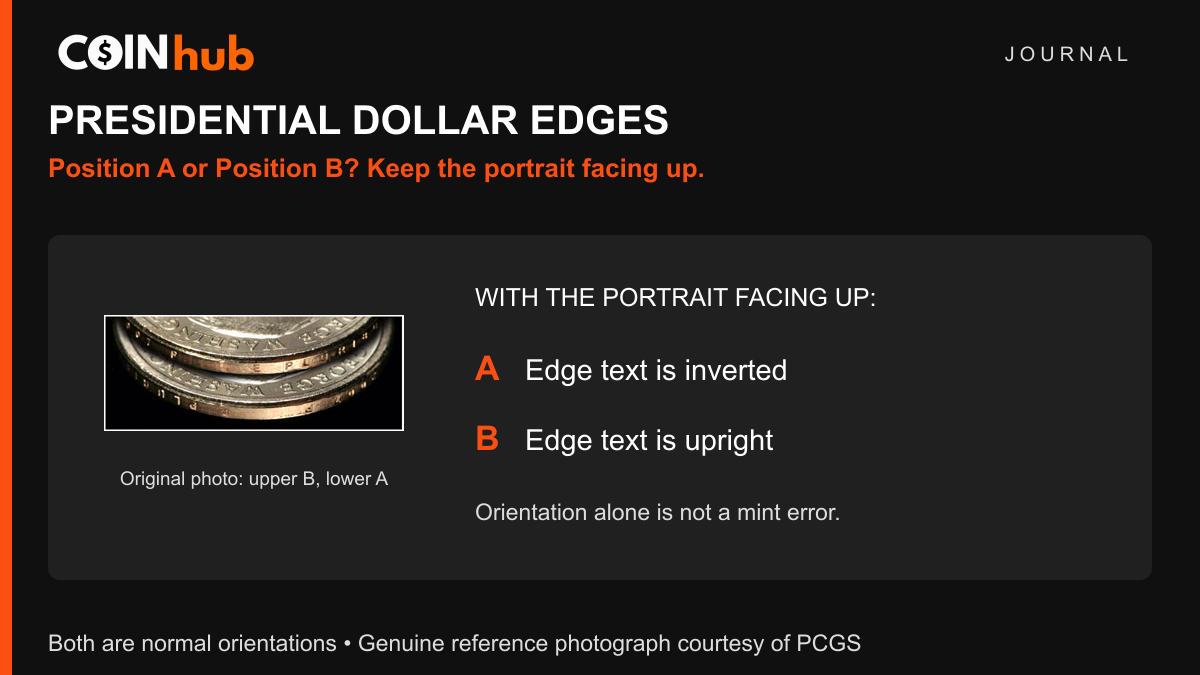
Keep the portrait up and the labels become straightforward
On a Presidential dollar, Position A versus Position B describes the direction of the edge lettering relative to the president's portrait. Using PCGS terminology, hold the coin with the portrait side facing up. If the edge inscription is upside down from that reference, it is Position A. If the inscription is upright, it is Position B.
Both orientations are normal on circulation-strike Presidential dollars. Upside-down edge lettering alone is not a mint error, and the A or B label is not a grade or a guarantee of a premium.
A careful way to check your coin
- Identify the portrait side and keep it uppermost. Work over a soft, clean surface.
- Hold the coin securely by its rim and lower your viewpoint enough to see the edge. Avoid touching or rubbing the faces.
- Read a clear section of the inscription while preserving the portrait-up reference.
- Turn the coin around its vertical axis to find more edge text if needed, without flipping it face over face.
- Record A or B only after confirming the same orientation in a second clear section.
The common mistake is to tilt or flip the dollar until the letters become easy to read, then forget which face is now uppermost. Either inscription can be made to look upright by changing the coin's position. The designation depends on its relationship to the portrait, not whether you eventually manage to read it.
What the reference photograph shows
PCGS identifies the upper coin in the original photograph as Position B and the lower coin as Position A. The photograph is a small historical reference, reproduced without retouching.
| With the portrait facing up | PCGS designation | What it tells you |
|---|---|---|
| Edge inscription appears inverted | Position A | The direction of otherwise normal edge lettering. |
| Edge inscription appears upright | Position B | The other normal direction of edge lettering. |
| Letters are absent, doubled or unclear | A separate identification question | Do not use A/B as a substitute for examining a possible error, damage or obstruction. |
Why both directions are normal
For ordinary circulation-strike Presidential dollars, edge lettering is applied in a separate operation after the two faces are struck. The coin's orientation as it enters that operation determines the direction of the inscription.
NGC explained this random orientation when misleading upside-down-lettering error claims appeared after the 2007 Washington dollar release. PCGS's later A/B guide likewise describes both orientations as mint-made and correct.
Random does not mean a particular roll must contain exactly equal numbers. Nor does a small handful of coins establish a meaningful rarity difference for an entire issue. Keep this ordinary-strike explanation separate from claims about specialized proof production or a specific attributed mint error.
Does Position A or Position B make it valuable?
The designation can matter to someone organizing a collection or seeking both orientations. It does not establish exceptional rarity by itself. PCGS says neither orientation is generally the rarer one.
A useful comparison still requires the same president, year, mint, format and condition. Certification, exceptional preservation and a separately attributed variety can affect a particular market comparison. An expensive listing that happens to include “Position A” is not evidence that every Position A dollar deserves that price.
Use the grading service's own terminology when reading a holder. This guide explains PCGS A/B usage; it does not imply that every service, catalog or dealer describes edge orientation in exactly the same way.
Normal orientation is different from missing lettering
A dollar with its complete edge inscription in the opposite direction is not the same thing as a coin that missed the edge-lettering operation. A claimed missing-lettering coin needs examination of the full edge and surfaces, with attention to possible alteration.
NGC documented Washington dollars whose edges had been filed to imitate the genuine missing-lettering error. Do not scrape, polish or file a coin as a test. Our separate missing edge lettering dollar guide covers that identification problem in more detail.
Likewise, a question about how the front and back designs line up is a different measurement from edge-lettering direction. For broader recognized dollar issues, use the dollar coin error list after establishing what feature you are actually looking at.
How to describe a coin clearly
Record the president, date, mintmark and the orientation you observed with the portrait uppermost. If the coin is certified, copy the holder wording accurately. For an online question, include both faces and several edge views, and state which face was up when the edge photographs were taken.
If a holder blocks the edge, do not force it open just to make the check. Use the existing attribution cautiously or have the coin examined through an appropriate service. A partial view is a limitation to report, not a reason to invent missing evidence.
Common questions
Is upside-down Presidential dollar lettering an error?
Not by itself. It is the normal Position A orientation under PCGS terminology when the portrait is up.
Is Position B a better grade?
No. A and B describe orientation, not wear, preservation or a numerical grade.
Should every roll contain half A and half B?
No exact split is guaranteed. A random process does not require equal counts in an individual sample.
Do these labels apply to other modern dollars?
PCGS also uses the terminology for edge-lettered Native American and American Innovation dollars. Identify the issue and follow its catalog reference rather than applying the labels to every dollar coin indiscriminately.
Sources: PCGS, What Do Positions A & B Mean On Dollar Coins? and NGC, Altered Washington Dollars Surface, consulted September 26, 2026. Original edge photograph courtesy of PCGS; CoinHub layout.