
Historic coins, banknote artwork and a practical plan for a Washington visit.
A coin is the end of a design process. A museum can let you look backward, from the small object in a display case to the artist’s larger work. That is the collector appeal of Shaping American Identity: The Art of the US Department of the Treasury, now open at the Milken Center for Advancing the American Dream in Washington, DC.
The official exhibition page lists September 19, 2026, through January 18, 2027. This is coverage of a newly opened exhibition, announced in a September 18 release, rather than an announcement that it opened today. For collectors planning a trip, the useful question is what to examine once you arrive.
What coin and currency collectors can look for
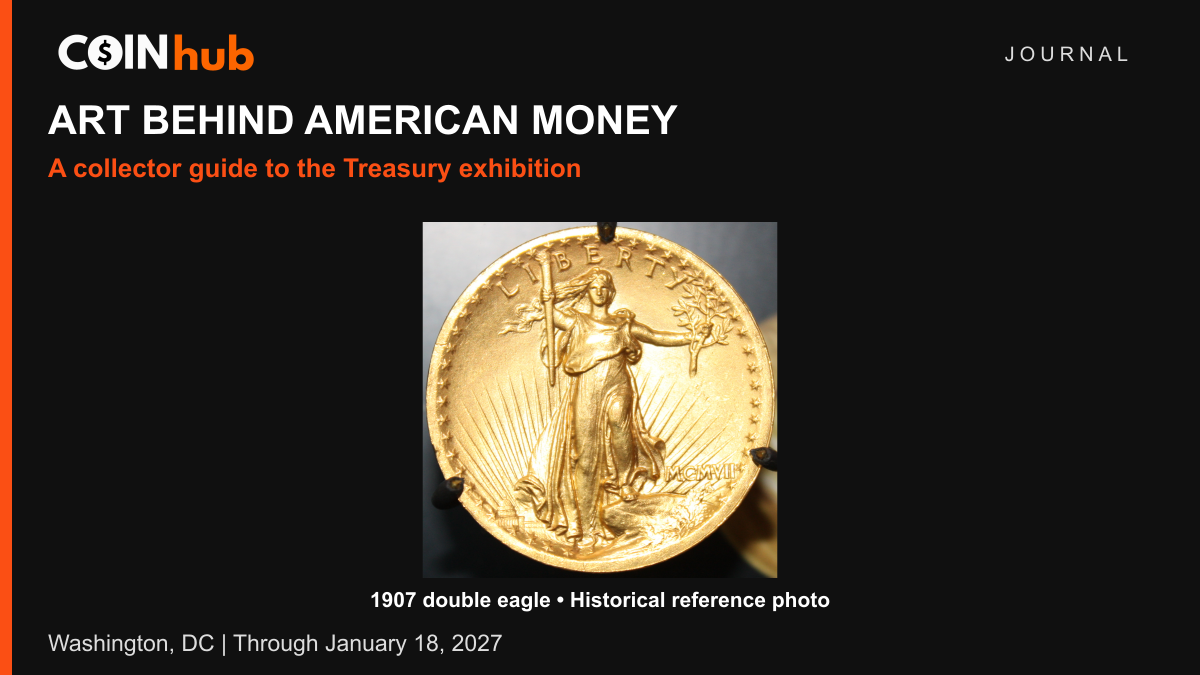
The Milken Institute’s announcement identifies a 1907 $20 Double Eagle and a 1935 Buffalo nickel among the objects, alongside plaster and metal casts associated with Augustus Saint-Gaudens and James Earle Fraser. It also identifies 1896 Educational Series silver certificates and related paintings by Will H. Low, Edwin H. Blashfield and Walter Shirlaw.
That mix gives a visitor two useful comparisons: sculpture translated into a coin, and pictorial artwork translated into a banknote. The announcement does not establish a numerical grade or an auction value for every object. A collector should read the individual case label before identifying an exhibited coin’s exact variety or ownership history.
For background before you go, our 1907 Saint-Gaudens high-relief guide explains the historic coin. The photograph accompanying this article is a separate historical reference image; it is not a photograph of the new gallery or proof that this particular specimen is on display.
A three-step viewing checklist
1. Read the label before the design
Start with the object’s name, date, artist and material. Write those details together in your notes. A coin, a cast and a preparatory artwork may show a related design while serving very different purposes. Keeping those categories separate makes your photographs and notes much more useful later.
Ask a narrow question: “What does this label actually identify?” If it says a date and denomination, record those. If it does not name a variety, do not fill in the blank from the nearest familiar auction listing. The same habit helps when researching a coin at home: an attractive resemblance is a starting point for identification, not the final evidence.
2. Follow one feature across the objects
Choose something manageable: lettering, the outline of a figure, a bird’s wing or the space around a portrait. Compare how that feature occupies the larger artwork and the finished money. Does your eye travel in the same direction? Which details remain legible when the design is small? You do not need to decide whether one version is better; the value is in noticing the choices.
A collector who usually studies dates and mintmarks can use this exercise to slow down. Instead of trying to remember every case, leave with one well-documented comparison. If objects are in different displays, note their labels rather than assuming that physical proximity establishes a production relationship.
3. Separate observations from questions
Make two short columns in your notes. In the first, write what you saw or read on the label. In the second, write what you want to investigate: the order of the design stages, the intended use of a model, or why a detail changed. This keeps a museum visit from turning a plausible interpretation into an unsupported fact.
For Buffalo nickel context, our Type 1 versus Type 2 guide shows why small design differences matter to collectors. Use that as background reading, while identifying the exhibition’s 1935 coin from its own label.
Dates, tickets and location
The Center’s visitor page is the place to check current logistics and reserve tickets. As checked September 22, its regular schedule is:
| Visit detail | Current information |
|---|---|
| Exhibition dates | September 19, 2026–January 18, 2027 |
| Address | 1503 Pennsylvania Avenue NW, Washington, DC 20005 |
| Regular opening days | Thursday through Monday, 10 a.m.–5:30 p.m. |
| Regular closed days | Tuesday and Wednesday |
| Admission | Free timed exhibition tickets; reserve through the Center |
| Holiday closures listed | Thanksgiving Day, Christmas Day and New Year’s Day |
The separately listed Holodeck Experience costs $15. Do not confuse that optional experience with the free exhibition ticket. Check the live calendar before traveling, especially around holidays; a date inside the exhibition’s overall run is not automatically an open day.
A curator-led option on September 24
The Center lists an In Focus program for Thursday, September 24, at noon. The scheduled 30-minute session is led by curator Jason Vaughan and meets at the Tree of Generations. Its subject includes the coins, bills and art in the exhibition. Check that event page for current booking information and any changes before arranging your visit around it.
If you attend, bring one specific question from your viewing notes. “Which object helps explain this design change?” is easier to pursue than trying to cover the entire history of American money in one conversation.
What this exhibition does—and does not—tell you about your collection
A museum comparison can sharpen your eye for design and improve the questions you ask about a coin. It does not establish the authenticity, condition or market price of a similar-looking piece you own. Keep those tasks separate. Record the reference, then examine your own coin through the usual attribution and grading process.
The most useful souvenir may be a short set of notes: one accurately identified object, one design comparison and one question to follow up. That is a practical way to connect the art in the gallery with the next coin or banknote you study.
Reporting and visitor details checked September 22, 2026, against the Milken Institute announcement and the Center’s exhibition, visit and program pages linked above. Schedules can change; use the official ticket calendar before traveling. The lead image is a credited historical reference photograph, not an installation view.