
Conder tokens are privately issued British and Irish tokens associated with the late 1700s. Many helped people make small payments when official change was scarce. Others were made for collectors. They are also called eighteenth-century provincial tokens. The name comes from James Conder, who published a catalog in 1798.
To identify one, record the place, the words and designs on both faces, and the edge. A picture of one side can suggest a match. It cannot settle every variety or tell you what the piece is worth.
Why private tokens filled a need
Factories and local trade needed small change. Private businesses supplied tokens that could carry a merchant's name, a local landmark or a political message. The Parys Mining Company in Anglesey issued tokens in 1787, an important early part of this story.
As PCGS's history of Conder tokens explains, acceptance could be local or wider. Collecting also grew while the tokens were being made. Some issues were sold to collectors, so an old date alone does not prove that a particular piece spent years in daily trade.
What a D&H number means
D&H, sometimes written DH, refers to the catalog by R. Dalton and S. H. Hamer. Keep the county or area with the number. It forms part of the identification. A bare number copied from a sales listing leaves out useful context.
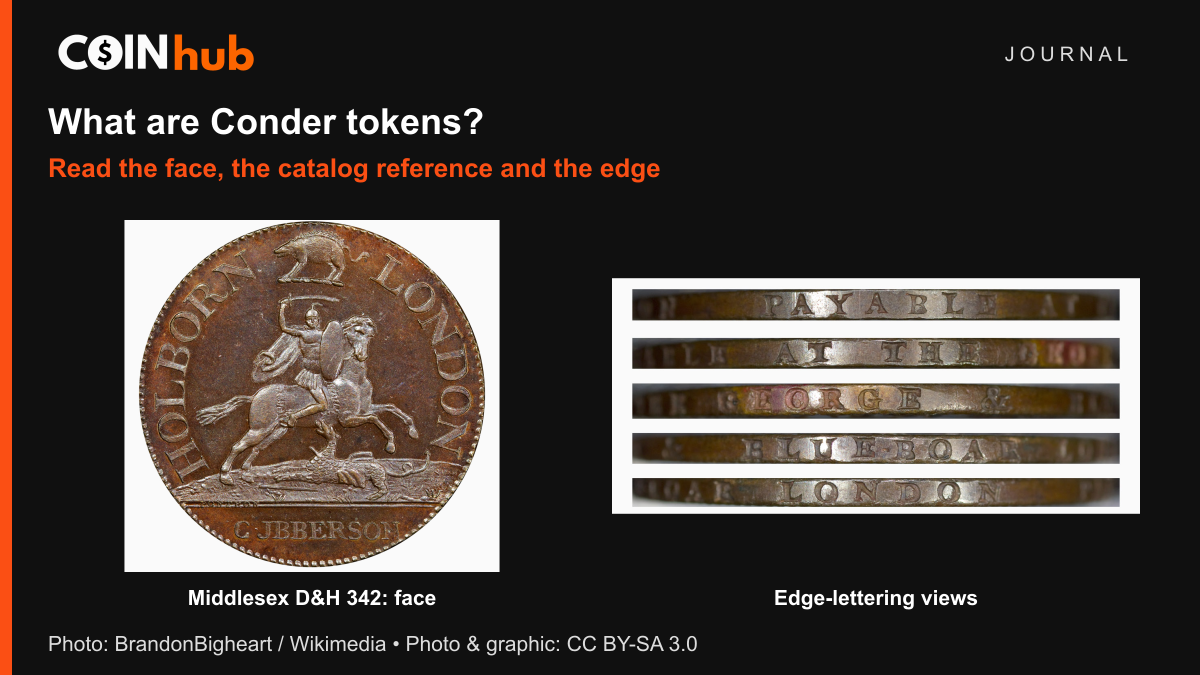
For example, the source of the photo above identifies its token as Middlesex D&H 342. The larger photograph shows a face of the token. The narrow strips show its edge lettering. They are not pictures of several different tokens.

Keep the edge in the record. The photo's edge reads “PAYABLE AT THE GEORGE & BLUE BOAR LONDON”. That is another feature to compare, alongside the face design and catalog entry. Do not assign every similar-looking token the photo's number.
A simple identification note
| Record | What to save | Why it helps |
|---|---|---|
| Place and catalog | Full area name, reference and number | Keeps the attribution specific |
| Both faces | Clear photos and readable words | Checks the whole design pairing |
| Edge | Lettering, marks or a clear photo | Adds a feature a face-only listing misses |
| Condition and source | Visible wear or damage; seller or collection record | Makes later comparisons more useful |
Leave a field open when the evidence is missing. “Edge not shown” is a better note than an edge description borrowed from a similar token. If a sealed holder hides part of the coin, use its record or ask for expert help. Do not break the holder or scrape the edge to complete a checklist.
Compare the same token before comparing prices
A listing headed “rare Conder token” is a starting point, not a valuation. Match the full attribution, then compare condition and actual sale records. Keep an asking price separate from a completed sale. A polished surface or a damaged edge also deserves a note; do not clean the token to improve the photograph.
These pieces belong to a different collecting series from American Civil War tokens. The shortage of change is a useful connection, but the dates, issuers and catalogs differ. Start with the exact object in front of you, and preserve enough detail for someone else to check your identification.