
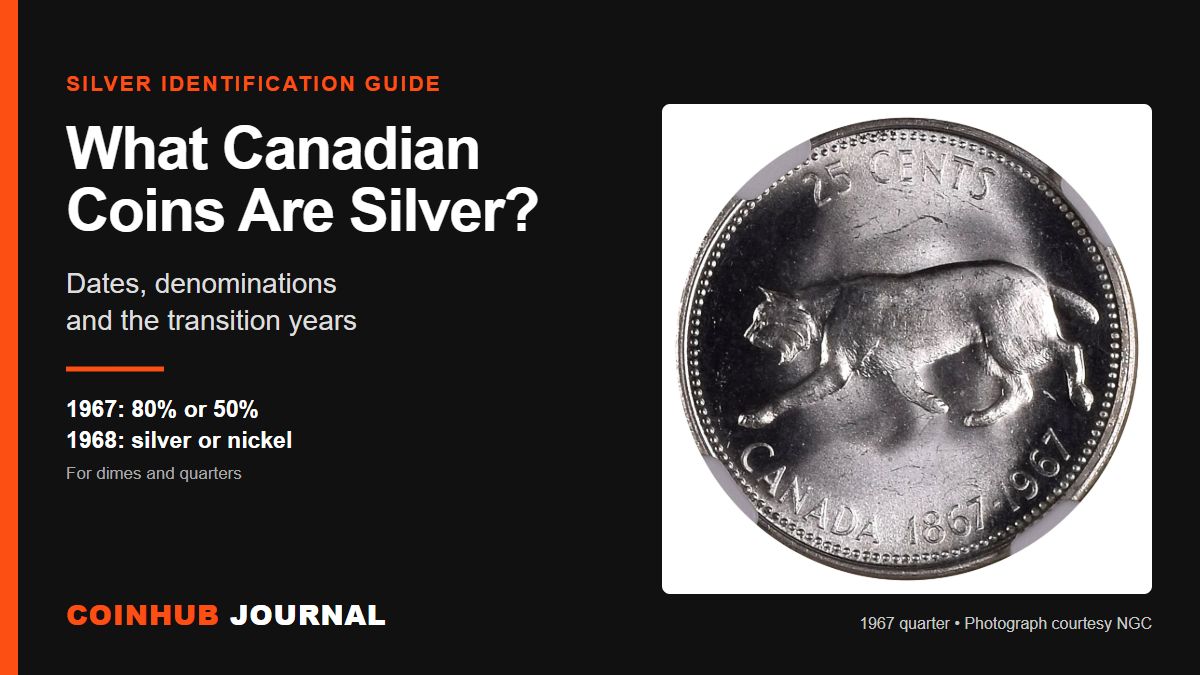
Canadian dimes and quarters dated 1966 or earlier contain silver. In 1967, they can be 80% or 50% silver; in 1968, they can be 50% silver or nickel. Canadian half dollars and dollars stayed 80% silver through 1967, then changed to nickel in 1968. The denomination matters as much as the date.
A Canadian coin can look silver without containing silver. The familiar five-cent piece is a good example: the large nickel introduced in 1922 is different from Canada's earlier, much smaller silver five-cent coin. A date-only rule such as “everything before 1969 is silver” will misidentify several coins in a mixed collection.
Start by separating the denominations. Then use the dates below to decide which pieces need a closer check. This guide covers standard historical Canadian circulation issues; bullion, commemoratives, patterns and unusual errors require their own specifications.
Canadian silver coins by denomination and year
| Denomination | Earlier silver issues | 1967 | 1968 |
|---|---|---|---|
| Small silver five-cent piece | 1858–1919: 92.5%; 1920–1921: 80% | The ordinary five-cent coin is nickel, not silver | The ordinary five-cent coin is nickel, not silver |
| Dime / 10 cents | 1858–1919: 92.5%; 1920–1966: 80% | 80% or 50% silver | 50% silver or nickel |
| Quarter / 25 cents | 1870–1919: 92.5%; 1920–1966: 80% | 80% or 50% silver | 50% silver or nickel |
| Half dollar / 50 cents | 1870–1919: 92.5%; 1920–1966: 80% | 80% silver | Nickel |
| Dollar | 1935–1966: 80% | 80% silver | Nickel |
The percentages describe the silver portion of the alloy by weight. An 80% silver coin is not a pure-silver coin. NGC's world silver reference lists the historical date groups and metal specifications, including both silver compositions for 1967 dimes and quarters.
These date ranges identify coin types, not a promise that every denomination was minted every year. Canada's ordinary cents do not belong in a silver pile. Newfoundland's earlier coinage and other colonial issues also deserve separate identification rather than being forced into this table.
Why 1967 and 1968 need different checks
1967 dimes and quarters: silver, with uncertain purity
The centennial dime has a fish reverse, and the quarter has a bobcat reverse. Both denominations were made in 80% and 50% silver during 1967. The animal design and dual date identify the centennial issue; they do not tell you which silver alloy your individual coin uses.
A magnet does not resolve that 80%-versus-50% question. Neither ordinary silver-copper composition should stick to it. Nor should a weight around 5.83 grams be treated as proof of an 80% quarter: NGC also lists the 50% 1967 quarter at 5.8319 grams.
Keep an unresolved coin labeled “1967 silver; fineness unconfirmed.” For an important purchase or sale, ask a qualified numismatic professional to identify the composition with an appropriate non-destructive method. Do not turn a seller's assumption, an attractive surface or a coin's ring into a confirmed purity result.
1968 dimes and quarters: silver or nickel
For these two denominations, 1968 introduces a different problem. Some are 50% silver; others are nickel. A genuine ordinary nickel example is attracted to a magnet, while the ordinary silver-copper issue is not. Bring the magnet close without dragging it across the surface, and protect the coin from contact.
This is a sorting aid for the known 1968 types, not a universal authenticity test. A nonmagnetic object is not automatically silver: many other metals also fail to stick. Confirm the denomination, date, design and specifications before making a value claim, especially for a questionable or altered coin.
The silver 1968 quarter is cataloged at 50% silver and 5.8319 grams. A scale can support identification, but wear, measurement error and overlapping specifications mean weight alone does not settle every case.
Canadian silver five-cent coins ended much earlier
Small Canadian five-cent pieces contained 92.5% silver through 1919, then 80% silver in 1920 and 1921. The larger nickel coin arrived in 1922. The Bank of Canada Museum explains that change and the melting of most 1921 silver five-cent pieces.
That is why a 1967 rabbit five-cent piece should not be counted with the silver centennial dime, quarter, half dollar and dollar. If you encounter a purported 1921 silver five-cent coin, slow down for specialist authentication and date research before treating it as routine scrap silver.
Calculate silver content before estimating melt value
Melt value estimates the contained metal. It does not establish collector value or a dealer's buying offer. First identify the coin's composition, then calculate its silver content in troy ounces. Keep the silver price and the resulting estimate in the same currency.
Silver troy ounces = number of coins × weight in grams × silver fraction ÷ 31.1034768
Then multiply the silver troy ounces by the silver price per troy ounce.
For example, 20 confirmed 50% Canadian silver quarters, using the catalog weight of 5.8319 grams each, contain approximately 1.875 troy ounces of silver. At a hypothetical price of US$40 per troy ounce, the calculated silver value is about US$75. This is a worked example, not a current spot quotation.
The same quantity at 80% silver contains about 3 troy ounces, producing a US$120 estimate at that same hypothetical price. That US$45 difference shows why unresolved 1967 fineness matters. Record an assumption or a range when appropriate; do not quietly assign every uncertain quarter to the higher-purity row.
Catalog weights describe the reference coin. Circulation wear can reduce the metal actually present. Rarity, condition, varieties, damage and transaction costs can also make an actual price differ from a metal calculation. Check potentially collectible coins individually before selling a mixed group for its silver.
Keep Canadian and U.S. silver calculations separate
U.S. and Canadian silver coins use different date cutoffs and compositions. CoinHub's U.S. silver dime guide and U.S. silver quarter guide cover the American issues.
For supported U.S. coins, the CoinHub Labs silver melt calculator lets you work with coin quantities and save an Excel-compatible export. Its U.S. 90% silver entries are not Canadian 80% or 50% presets. Do not enter Canadian coins in those rows as a substitute for the calculation above.
Keep separate quantity records for confirmed 80%, confirmed 50% and unresolved pieces. Save the source, date checked, metal-price currency and assumptions alongside the result. CoinHub's collection-records checklist explains how to keep identification, photographs and supporting evidence attached to the right coin.
Specifications checked September 29, 2026: NGC's World Coin Price Guide and silver-content reference, the Royal Canadian Mint's denomination histories, and the Bank of Canada Museum, linked beside the relevant facts. Sorting and recordkeeping guidance and the hypothetical calculation are CoinHub's editorial explanation.
Header photograph: genuine 1967 Canadian centennial quarter reverse, courtesy NGC, used under CoinHub's standing permission. Resized in a CoinHub Journal layout; specimen details have not been altered. The photograph illustrates the design and does not independently establish the coin's fineness, grade or value.