
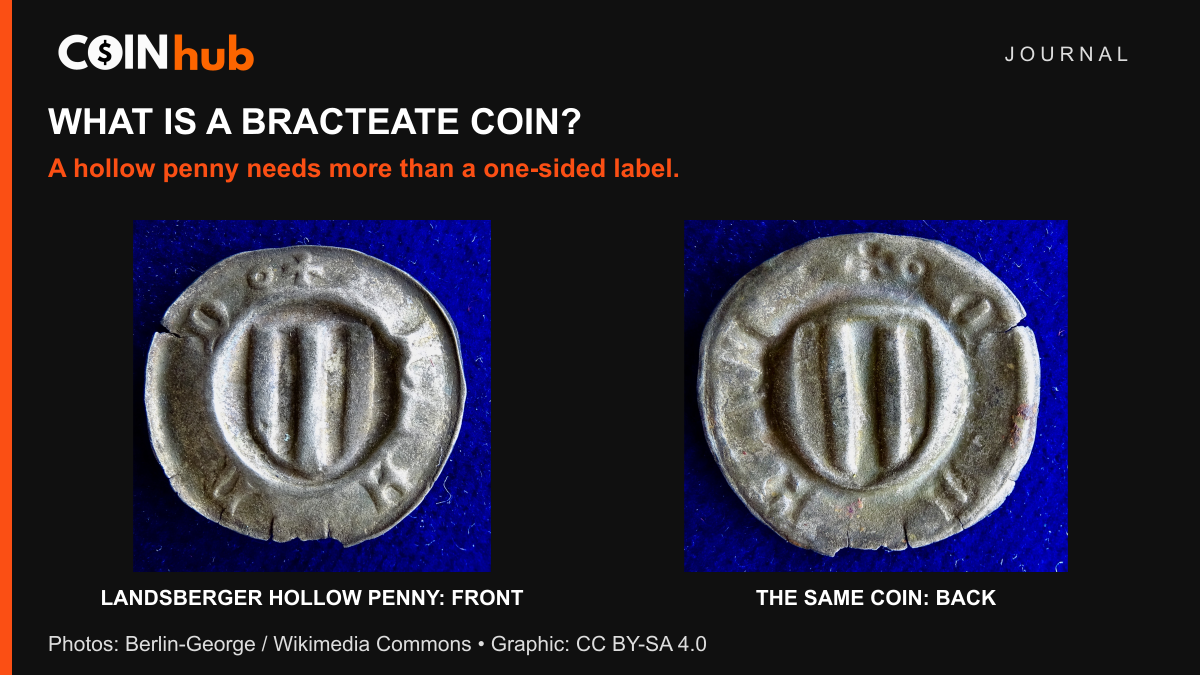
A medieval bracteate is a very thin silver coin made with one engraved die. Its raised design leaves a hollow impression on the back. That hollow back is part of the way the coin was made; it does not, by itself, show a mint error.
The name needs care. Museums also use bracteate for earlier ornaments, often made to hang from a chain or cord. Before you identify a piece, ask which kind of object the source describes: money or jewelry.
Start with both sides. Record the design, any letters, the diameter and the weight. A seller's label or one front-facing photo is not enough to identify a thin medieval coin.
Why a bracteate has a hollow back
A die is the tool that carries a coin's design. For a bracteate, the maker struck a thin silver blank over a soft support. The metal took the shape of the design, with a raised front and a recessed mirror image behind it.
Numismatist Roger Svensson describes this method in his study of medieval bracteates. He also warns that not every one-sided coin belongs to this group. The method matters as well as the appearance.
That gives you a useful first question: does the back follow the front design in reverse, or is it simply smooth? The answer helps you describe what you see. It still does not prove who made the piece, when it was made or whether it is genuine.
A real hollow penny to compare
The main photograph shows both sides of a Landsberger Hohlpfennig, a hollow penny from Saxony. The photographer identifies it as a fifteenth-century issue of Frederick II. Notice the shield, the surrounding marks and the cracks at the edge. The photos preserve those details; they are not diagrams of an ideal coin.
A separate Landsberger example in Berlin's Münzkabinett is cataloged to Zwickau, 1444–1451. That museum specimen weighs 0.30 grams and measures 20 millimeters across. Those figures belong to that recorded piece, not every bracteate and not the coin in our main photo.
This distinction matters when you compare a listing with a museum record. A similar shield can point you toward a type. It cannot transfer one object's weight, mint or precise date to another object without further evidence.
The same word can describe jewelry
The Metropolitan Museum of Art has a Vendel bracteate pendant dated 700–800. It is made from gilded copper alloy and has a suspension loop. The museum classifies it as metalwork, not as a silver penny.
So a gold-colored disk with a loop and a small silver hollow penny can appear under the same search term. Read the object's date, material and use before you borrow its label. Color alone cannot establish the metal, and a loop alone cannot settle an object's full history.
| What a record says | What to check next |
|---|---|
| Medieval silver bracteate or Hohlpfennig | Both sides, design, region, date range and measurements |
| Bracteate pendant | Material, suspension fitting and the museum's description of its use |
| One-sided coin or blank reverse | How it was made; one-sided does not automatically mean bracteate |
| Rare mint error | Evidence for an unintended production fault, separate from the normal coin type |
How to make a useful identification record
Start with clear photos of the whole front and back. Keep the light at an angle that shows the shallow details. Do not press, bend or flatten a fragile piece to make it look more like a catalog image.
- Copy what you can read. Write down letters and symbols without guessing at missing strokes.
- Keep measurements tied to the object. Record the unit and the scale's precision. A number copied from a similar online coin is not a measurement of yours.
- Save the source of the attribution. Keep the old ticket, invoice or catalog reference with the coin. Record which claims are certain and which are tentative.
- Compare more than the central picture. Look at the border, letter forms and arrangement of smaller marks. A shared cross or shield is a starting point.
- Leave uncertain details open. Ask a specialist in the region's medieval coinage before assigning a narrow date or paying for a claimed rare variety.
Svensson's research uses regional weight and size standards alongside designs and other evidence. Many of these coins have little or no writing, which makes a single-symbol identification risky. A careful record is more useful than a confident guess.
Why there are so many designs
Medieval coinage was divided among many local authorities. Some areas also replaced old coins with new issues at set intervals. Svensson links those local systems and repeated coin renewals to the great variety of bracteate types.
For a collector, that is a reason to keep the region and period in view. Do not treat all hollow pennies as one issue with one standard weight, one rarity level or one price.
A hollow back is not a value estimate
The shape can help identify the kind of coin. It cannot give you a sale price. First establish the type, condition and strength of the attribution. Then compare documented sales of closely matching pieces, keeping damaged, repaired or uncertain examples separate.
If your question concerns an unintended one-sided strike on a modern coin, our guide to uniface strike errors covers that different problem. The medieval hollow penny should first be judged against the way its own type was meant to be made.
Sources and photograph credits
Research: Roger Svensson, Regional Monetary Standards and Medieval Bracteates (2020); Münzkabinett, Staatliche Museen zu Berlin, object 18215589; and The Metropolitan Museum of Art, object 1984.300. The linked records support the separate coin and pendant examples above.
Photographs: obverse and reverse by Berlin-George via Wikimedia Commons, CC BY-SA 4.0. Complete photographs resized in a new layout; no coin details changed. The adapted graphic uses the same license. CoinHub trademark rights remain separate. Images are enlarged, not actual size.

