
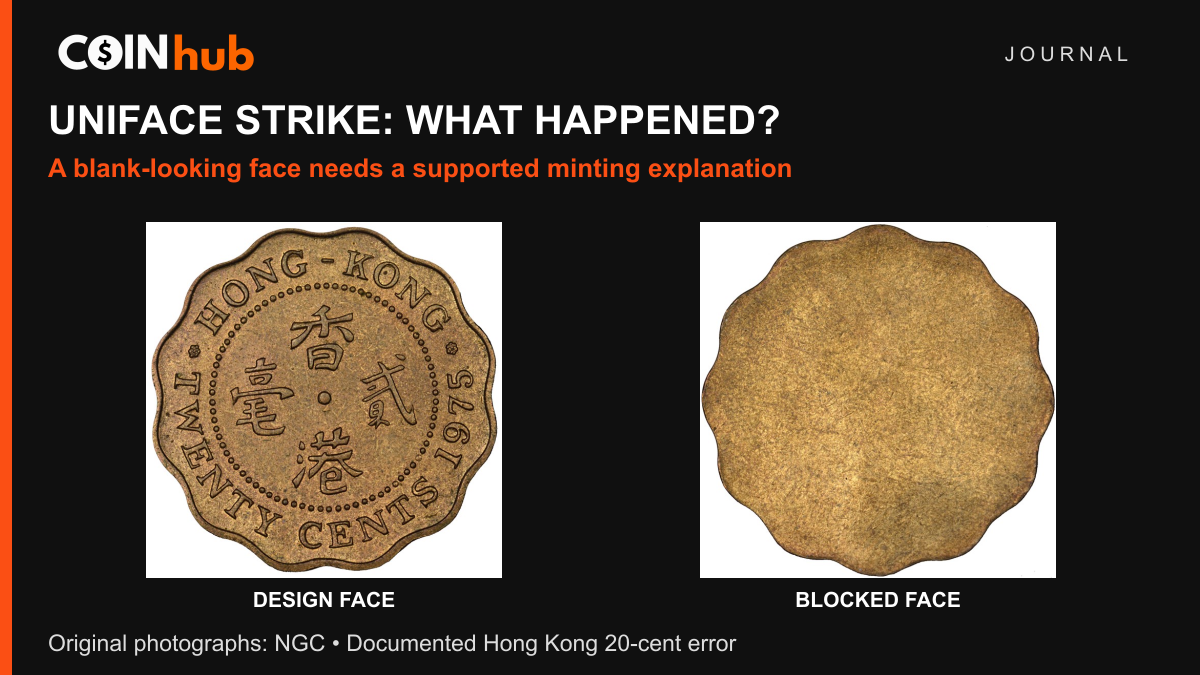
A missing design is the observation, not the diagnosis
The first useful question is what physically prevented the design from forming. That is different from asking why a design is missing now. The distinction matters whenever an unfamiliar coin arrives in a collection, especially when a seller has already attached an error name and a large price.
What the two-planchet explanation means
A planchet is the prepared metal piece intended to become a coin. In the basic uniface scenario, two occupy the striking area together. The exposed outer faces can receive die designs, while the surfaces touching each other are blocked. NGC’s mint-error lesson illustrates this with the 1975 Hong Kong 20-cent piece pictured above.
NGC identifies that specimen as MS 66, “Reverse Half of Two Coins Struck Together.” The photographs show its design face and blocked face. That attribution belongs to the documented example; it is not a grade or authentication for a different coin that merely looks similar.
Full uniface, partial indent and brockage are different descriptions
ErrorRef’s specialist entry uses full uniface, also called a full indent, for complete coverage during the strike. Partial overlap can instead leave an indent over part of the design. A blank area on an off-center piece needs its own explanation, because a portion outside the dies may simply never have received their design.
| Observation | Question it raises | What it does not establish alone |
|---|---|---|
| One face lacks a normal design | Was die contact blocked? | That the surface is untouched since minting |
| A limited depressed area | Was there partial overlap or another obstruction? | A full uniface strike |
| Incuse, reversed design detail | Could a struck coin have transferred an impression? | A blank-planchet explanation |
| A cupped shape | How did metal move during the strike? | That the piece was necessarily a die cap |
For the transferred-design distinction, see our brockage identification guide. Keep the terms attached to the evidence they describe. “One-sided coin” is a broad visual description; it is not a substitute for an error attribution.
Why the edge and remaining design matter
A close-up of only the blank face withholds much of the useful evidence. Record the opposite face, its surviving devices, the rim and the full edge. Note whether the blank area appears flat, depressed, uneven or visibly abraded, without treating any one feature as a decisive test.
If weight or diameter is measured, record the actual measurement and how it was taken. Those observations can support a specialist’s examination, but matching a normal specification does not authenticate the error. An unusual number also needs explanation rather than an immediate conclusion.
Do not smooth a rough patch or polish away discoloration to make the coin “easier to identify.” Preserve the surface and take clearer photographs instead. The evidence needed to distinguish manufacturing from later alteration may be in exactly the area that looks untidy.
More than one striking event can complicate the label
The word uniface can also describe blocked contact during a later strike on a coin that already carries design. PCGS’s discussion of doublestruck errors shows why a specialist may need several terms to describe one piece. A later blocked strike does not necessarily erase every trace of an earlier design.
That is why a short listing title cannot replace a complete explanation. Our double-struck versus doubled-die guide separates an extra striking event from doubling associated with a die. Use related articles to understand the mechanism, then return to the specific evidence on the coin in hand.
A practical record before asking for an opinion
Save uncropped photographs of both sides and the edge. Record the readable denomination, country, date, measured dimensions if available, and whether the coin is raw or in a holder. For a certified piece, copy the complete attribution and certification number rather than only its numerical grade.
Describe what you see neutrally: “blank-looking reverse; edge photographed; attribution uncertain.” A qualified error specialist can then assess whether the surfaces and metal movement support the proposed striking sequence. Price research becomes useful after that identity is established, not as a way to establish it.
Sources and photograph attribution checked September 21, 2026. This guide uses a documented example to explain the mechanism; photographs of an unfamiliar piece may not be enough for authentication.