
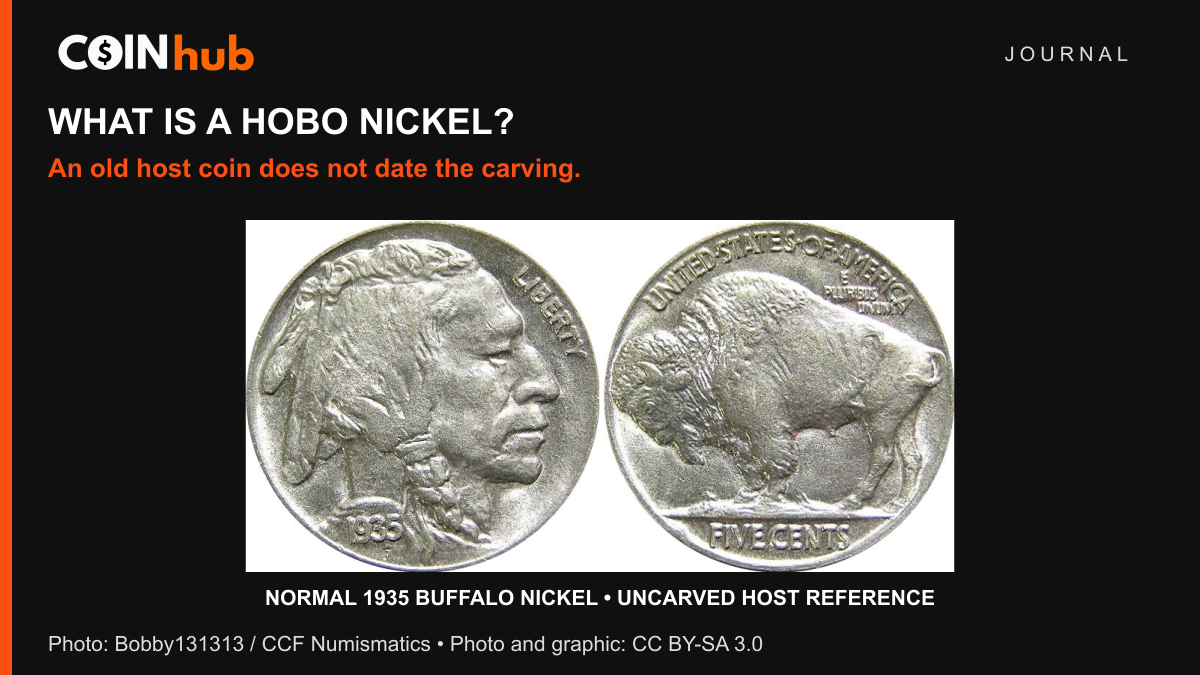
A hobo nickel is a coin that someone has carved into a small work of art. The classic host is a Buffalo nickel, with its portrait or bison changed into a new subject. The carving happened after the coin left the Mint. It is not a mint error simply because the design looks unusual.
The date on the nickel tells you about the original coin. It does not tell you when the artist carved it. A modern artist can work on an old coin. That is the key point to keep in mind when a listing calls a piece an “original hobo nickel.”
About the photograph: The image above shows an uncarved 1935 Buffalo nickel, front and back. It is a reference for the host coin, not an example of a hobo carving. Compare its normal design with the documented carvings linked below.
What changed on the coin?
The Original Hobo Nickel Society describes carving that removes or pushes metal to form a small raised sculpture. A hat, beard, changed nose or new background can replace parts of the original portrait. The society notes that the Buffalo nickel offered a large portrait and an affordable base for this work. Some artists also changed the reverse, the side with the bison.
Look first for the artist's new design, then for the surviving parts of the host. Does the word LIBERTY remain? Can you still read the date? Is the bison intact? These are observations you can record from clear photographs. They do not, on their own, identify the artist.
A scratch or a dent is not enough to show that someone meant to carve it. Not all carved work has the same appeal. Describe the actual changes before choosing a label.
Old coin, old carving, or modern work?
A John C. Campbell Folk School interview with engraver Tom Patterson shows both older work and work by living artists. Patterson explains that artists can change either the portrait or the bison. The continuing craft is a reason to separate a coin's age from the age of its artwork.
For example, imagine two carvings made on nickels dated 1935. One comes with an old collection record; the other comes with a dated invoice from a living artist. The same host date appears on both. The records answer different questions about who made the artwork and when. This is a hypothetical comparison, not a claim about the photographed coin.
| Information in a listing | What it can establish |
|---|---|
| A readable date on the host | The date shown on the original coin, not the carving date |
| An artist's name or initials | A claim to investigate against documented work |
| A prior collection ticket or invoice | A record of how the piece was described at that time |
| A specialist's written opinion | The stated assessment, with its scope and limits |
Keep attribution separate from appearance
Attribution means assigning a work to an artist or a recognized group. A similar hat or beard is a useful comparison point. It is not a signature. Ask what supports the name in a listing: a specialist report, an artist's own record, a prior catalog entry or only the seller's impression.
Keep the wording of that claim. “Attributed to” and “made by” express different levels of certainty. If the evidence is missing, record the artist as uncertain. You can appreciate a carving without turning a guess into a fact.
What a quality report does—and does not—say
The society's Quality Designation service describes a two-examiner process. The first examiner studies the coin and photographs it; the second makes a separate review from those photos. The resulting report records their judgments. OHNS expressly says those opinions are not a guarantee of value or authenticity.
Read the report itself when one is offered with a coin. Match the pictured object and key details to the piece in the sale. A reference to a report is less useful than the report's actual findings. Check the society's current instructions before considering a submission; this guide is not a submission form or a price quote.
Build a record before comparing prices
There is no single price for all hobo nickels. OHNS emphasizes the quality of the carving, including depth, treatment of the face and the finish of the background. A host coin's ordinary date-and-grade value does not describe those features.
- Save both sides. Use clear whole-coin photos, plus close views of the carving.
- Copy the attribution exactly. Keep uncertainty and the source of the opinion.
- Keep the paperwork. Save an invoice, old ticket and any specialist report together.
- Compare like with like. Separate documented old work, named modern work and unattributed carvings when reviewing completed sales.
Our love-token guide covers another form of altered coin: engraved keepsakes. For a hobo nickel, begin with the carving and its evidence. An unusual portrait is an invitation to look closer, not proof of an error, a famous artist or a high price.
Sources and photograph credit
Research: the Original Hobo Nickel Society's definition and Quality Designation pages, and the Folk School's 2017 interview with Tom Patterson. Photograph: Bobby131313, image courtesy of CCF Numismatics, via Wikimedia Commons, CC BY-SA 3.0. The complete photograph is resized in a new layout; no coin details changed. The adapted graphic uses the same license. CoinHub trademark rights remain separate. Not actual size.
