
A small piece used to keep track of numbers
A jeton, also spelled jetton, is a token used for counting or other tasks. People moved counting jetons on a ruled board to work out sums. They can look like coins, but a portrait, date or round metal shape does not prove that a piece was issued as money.
The word covers more than one collecting story. A worn Nuremberg counter and an ornate French presentation piece may both be called jetons. Start with the job that piece was made to do. Its look is a clue. It does not tell you the whole story.
How a counter helped with arithmetic
The American Numismatic Association's introduction describes counting boards as tools for household and business calculations. Moving counters across marked spots helped people add, subtract and do other sums. The layout showed the numbers. Each counter did not need its own face value.
Think of the difference between the money in an account and the tools used to total that account. A calculator can help you count dollars without itself being a dollar. A counting jeton served a similar practical purpose, though the method used a board and movable pieces.
That comparison has a limit. It explains counting, but not every later use of a jeton. The ANA also describes pieces that became gifts, signs of favor and displays of political or religious ideas. The category developed beyond a simple arithmetic tool.
Read a real Nuremberg example
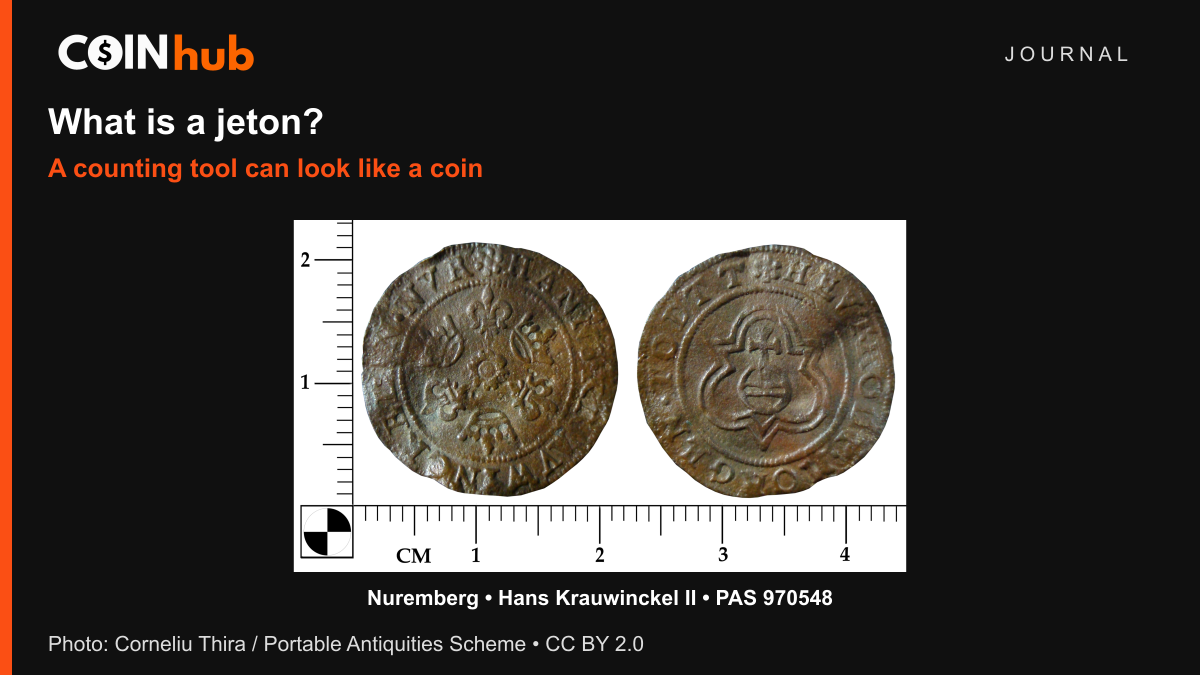
The photograph shows a copper-alloy jeton recorded by the Portable Antiquities Scheme, find 970548. Its record attributes it to Hans Krauwinckel II of Nuremberg, who worked from 1586 to 1635. That span is the maker's date range. It is not the exact year this piece was struck.

One face has a central rose surrounded by crowns and fleur-de-lis, the stylized lily shapes. The other shows an orb topped by a cross inside a three-arched border. Letters around the edge identify the maker and carry a motto. These clues tell you much more than the fact that the piece is small and brown.
The record gives a diameter of 21.02 millimeters and a weight of 0.7 gram. Those are measurements of this recorded object. They are not a rule that every Krauwinckel jeton must match exactly. The photographed surface and edge also show why a reference image should be studied as an individual example.
Could jetons ever pass as money?
A blanket “never” goes too far. London Museum's record of a Nuremberg jetton says such pieces may sometimes have served as substitute coins. It also explains their normal reckoning use. Evidence for one possible use should not turn every counting counter into an officially issued coin.
The museum's example came from excavations at London's Rose Theatre. Its account suggests that staff used jettons to calculate the theatre's accounts, partly because few were found in audience areas. That is the museum's view of the finds. It does not prove that each jeton bought a theatre ticket.
This helps when you read a dealer's label. “Token,” “counter” and “coin” can sound interchangeable in casual descriptions. Ask which function the evidence supports. CoinHub's guide to Conder tokens explores a different token tradition; the same broad label does not give the two groups the same history.
Build a useful identification record
| Record this | What it can help establish | What it cannot settle alone |
|---|---|---|
| Both designs and all visible letters | A possible maker or catalog match | Authenticity or an exact year |
| Diameter, weight and edge photographs | Comparison with a documented object | One universal specification for all jetons |
| Source, reference number and attribution | Which evidence supports the description | The personal history of an unrecorded piece |
| Wear, holes, bends and other visible changes | The present condition of your example | Who used it or why it was altered |
If part of the inscription is unclear, mark it as unread rather than filling in what you expect. Compare both faces with the same reference. Two pieces with a rose design can still differ in their maker's name, motto or arrangement of details.
A useful label might say “Nuremberg rose-and-orb jeton; maker attribution to be checked,” followed by your measurements and reference. That keeps what you see apart from what you think it means. An exact date with no proof can make a label look precise but less trustworthy.
Keep the reference with the object
Save the source page and its object number with your photographs. When asking a specialist for help, provide both sides and explain which letters or details remain uncertain. A clear question is more useful than a guess about a rare date or an assumed value.
The first step is to learn what a jeton did. A small metal disc may tell a story about arithmetic, a maker or a presentation tradition. Getting that role right gives you a sound starting point for further study.
Sources checked October 6, 2026: ANA, London Museum and the Portable Antiquities Scheme record linked above. Photo: Corneliu Thira / The Portable Antiquities Scheme, via Wikimedia Commons, CC BY 2.0. Complete photograph resized in a CoinHub layout; object details unchanged.