
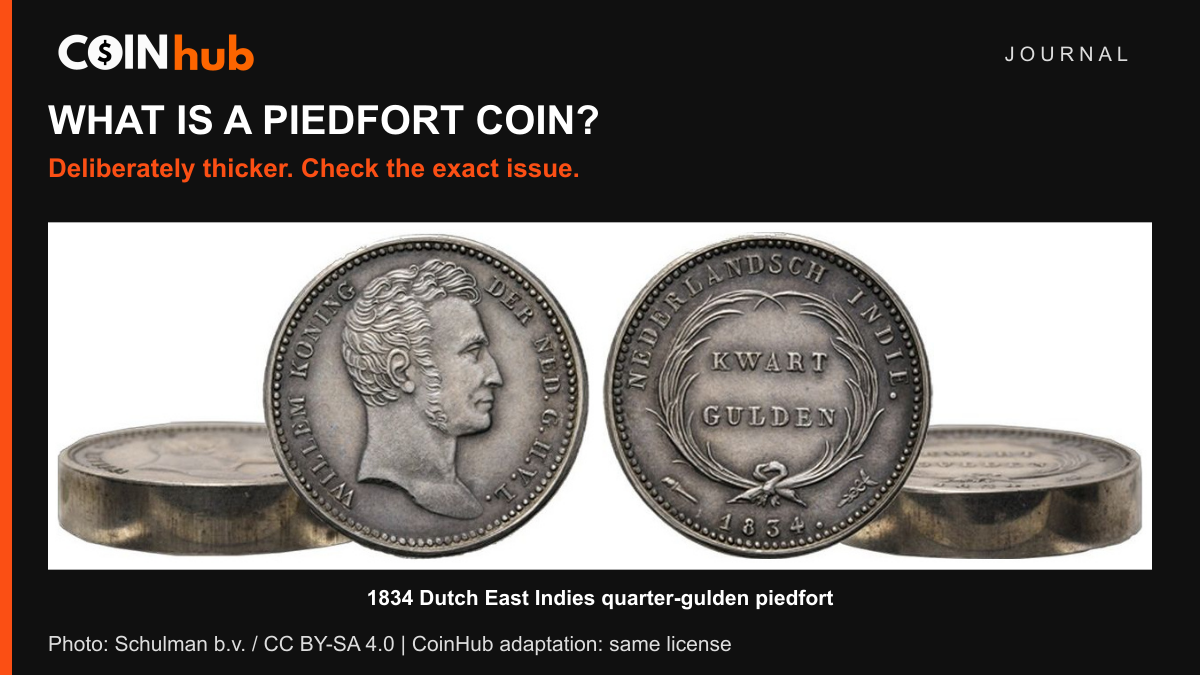
A piedfort is a coin made deliberately thicker
A piedfort coin is an intentionally thick version of a coin, often about twice the usual weight and thickness. Its width across the face may stay the same. Modern mints make piedforts for collectors. The extra metal is part of the planned issue, so it does not by itself make the coin a mint error.
The name is usually said “pee-ay-fore.” You may also see the spelling “piefort” in coin listings. When you find either word on a label, start by checking which issue the label describes. The name alone does not tell you the metal, finish, date or value.
Think of two coins that look the same from the front. One can contain more metal by being thicker, rather than wider. That is the idea behind many modern piedforts. A face-on photo can hide the feature that makes them different.
What changes, and what the name does not promise
The Royal Mint’s guide describes piedforts as typically twice as thick and heavy as standard coins. “Typically” matters. It is a useful starting point, not a rule to apply to every coin from every country and century.
| Detail | What to check | What not to assume |
|---|---|---|
| Weight | The mint’s stated weight for that exact issue | Every piedfort weighs exactly twice as much |
| Diameter | The width across the coin’s face | A heavier coin must also be wider |
| Metal | The listed alloy or purity | All piedforts are pure silver |
| Finish | Proof, reverse proof or another stated finish | Thickness alone proves a proof finish |
| Value | Comparable sales for the same issue and condition | Double the metal means double the sale price |
Keep the terms separate when reading a listing. Piedfort describes the thick format. Proof describes how a coin was made and finished for collectors. A coin can be both, but the words answer different questions. Neither is a promise that a particular example has no scratches or damage.
A Canadian example shows why the comparison matters
The Royal Canadian Mint’s 2010 Piedfort Maple Leaf archive gives a helpful example. Its silver coin has the same diameter as a half-ounce Silver Maple Leaf, but contains twice the pure silver. The mint lists a weight of 31.39 grams, a diameter of 34 millimeters and a thickness of 3.84 millimeters.
The listed silver purity is 99.99%, and the finish is reverse proof. These are specifications for that 2010 silver issue. They are not a checklist for every Canadian piedfort, nor do they describe the historic coin in this article’s photograph.
The key question is “twice as much as which coin?” In this case, the mint compares it with a half-ounce coin of the same diameter. Comparing it with any one-ounce coin you happen to own would miss that point. Read the mint’s comparison before making your own.
Why thick coins were made in the first place
Piedforts have a long history. The Royal Mint traces French examples to the 12th century and English examples to the reign of Edward I. It says thick coins were likely used as patterns: models that showed engravers the intended design. Their extra thickness helped set them apart from coins for everyday use.
The Perth Mint also describes presentation pieces given to important visitors. Later collector issues carried the thick format into a different setting. The Royal Mint began offering its modern UK piedforts to the public in 1982.
The photograph above shows an 1834 Dutch East Indies quarter-gulden piedfort. Schulman b.v.’s original photo record identifies the silver piece at 13.52 grams. The angled views show its thick edge. They show additional views of the same piece, not a standard coin beside a piedfort.

How to check a coin sold as a piedfort
Start with the country, year, face value and design. Then find the exact issue in the mint’s archive or a reliable coin reference. Compare like with like. A normal proof and a piedfort proof can share a design while having different weights.
- Read the full description. Match the metal and finish as well as the date.
- Look for official specifications. Record weight, diameter and thickness where the mint provides them.
- Ask for clear views of both faces and the edge. A front view alone may hide the extra thickness.
- Check the coin’s condition and holder. Do not open a sealed holder just to weigh a coin.
- Compare the exact issue when checking a price. A sale of a standard version is not a direct match.
A loose coin’s weight can help test a description, but it cannot prove the coin is genuine on its own. Our guide to weighing coins explains the limits of that check. A thick or heavy piece without a documented identity still needs closer study. Do not label an odd coin a rare piedfort or mint error from its weight alone.
For a modern issue, the most useful combination is simple: a clear mint description, matching specifications and photos of the actual coin. Those details explain much more than the word “piedfort” by itself.
Sources and image: Royal Mint piedfort guide; Perth Mint, “What is a Piedfort?”; Royal Canadian Mint 2010 product archive; Schulman b.v.’s original photograph and description, checked September 30, 2026. Photo by Schulman b.v., via Wikimedia Commons, CC BY-SA 4.0. Photo resized in a CoinHub layout; coin details unchanged. The adapted graphic is available under the same license. CoinHub branding does not imply the photographer’s endorsement.