
A sestertius was a Roman coin unit; the plural is sestertii. It began as a small silver coin and later became a much larger coin made from a mix of copper and other metals. In the early imperial system, one sestertius represented four asses, and four sestertii equaled one silver denarius. Those old rates are not values in today's dollars.
If you have seen a large Roman coin with a worn emperor's portrait, you may have encountered a sestertius. Size is a clue, but it is not a full match. Check the ruler, words and back design. The size, weight and age matter too.
The name covers more than one form
Macquarie University's coin guide shows the shift from a silver sestertius to a bronze one during the Principate, the age of emperors that began with Augustus. That is why a description limited to “a big bronze coin” misses part of the coin's history.
Many coins from the early Empire were made of orichalcum, a copper-and-zinc alloy we call brass. Coin guides may group these under bronze or use the letters AE for coins made from copper alloys. Do not read a catalog's broad metal label as a test of its exact metal content.
CoinWeek's illustrated history follows the shift to large brass issues and later changes in size and alloy. It is a useful reminder that the coin changed over time. One diameter or weight cannot identify every type.
How a sestertius related to the denarius
Macquarie's table for the late Republic and beginning of the Principate gives these rates. An as was the basic bronze unit; asses is its plural.
- One dupondius represented two asses.
- One sestertius represented four asses.
- One denarius represented sixteen asses, or four sestertii.
For a simple sum at those rates, eight sestertii equal two denarii. This tells you the stated relationship between units. It does not tell you what a meal cost, what a worker earned or what an ancient coin would sell for today.
The period matters because Rome changed its coin system. Macquarie notes that the denarius itself shifted from ten asses to sixteen in the Republic. Keep a table of coin values tied to its period rather than applying it to every Roman century. Our denarius guide covers that silver denomination separately.
A documented coin can still be hard to read
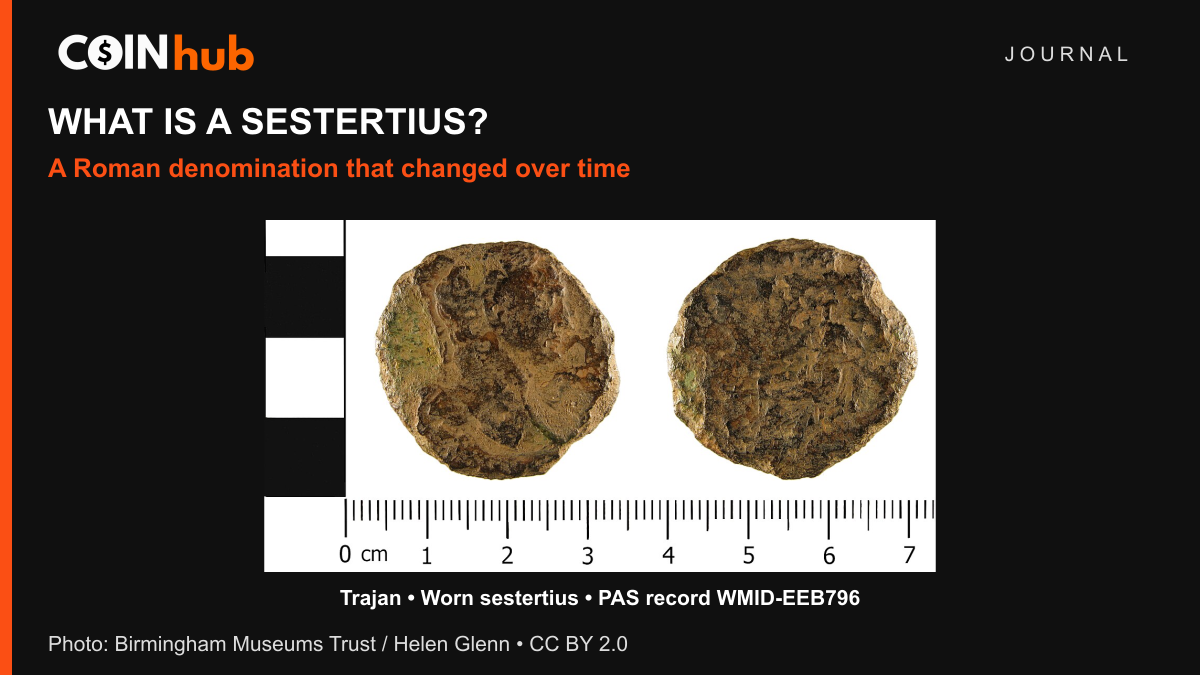
The real photograph above comes from Birmingham Museums Trust through the Portable Antiquities Scheme and Wikimedia Commons. The record calls it a sestertius of Trajan, who ruled in AD 98–117. It is listed as 28.4 millimeters across and 14.5 grams in weight.
The face is worn, and the record says the words cannot be read. On the back, it describes a seated woman but leaves the exact type unclear. Keep that doubt with the photo. A worn shape is not enough to give every detail a name.
The scale in the source photograph helps show the object's size. The published image has been resized, so measuring its width on your screen would not measure the coin. Do not use that weight or size as if it came from your own coin.
SC and a portrait need context
Another example is the Jerez Archaeological Museum's sestertius of Alexander Severus, dated AD 231–235. Its reverse shows Mars Ultor and the letters SC. The museum explains SC as senatus consultum, referring to the Senate's decree.
That museum coin is not the Trajan specimen pictured here. It is a later coin with its own record. At 30.5 millimeters across, it also shows why one size rule will not fit every issue.
When working with your own coin, copy only the letters you can see. Mark gaps instead of filling them from memory. Compare both sides with an entry for the same ruler and design. Our ancient coin identification guide covers the broader process.
Record the evidence before asking about value
Save clear photos of the front, back and edge, plus weight, diameter, seller details and any older collection record. Note who named the coin and why. “Seller calls this a sestertius” and “matches this catalog entry” do not mean the same thing.
A ratio of old coin values is not an appraisal. To compare coins today, first confirm what they are and whether they are real. Look at the surfaces and how much of each design is left. Do not turn a famous auction result into a price for a worn coin of the same face value.
Leave the surface as it is while you research. Scraping a coin to expose letters can also strip away clues. If key details are still unclear, mark them as unknown. Ask an expert to inspect the coin in hand.
Sources checked October 8, 2026: Macquarie University, Jerez Archaeological Museum, CoinWeek and the Birmingham Museums Trust/PAS image record reproduced on Commons. The pictured Trajan coin is PAS record WMID-EEB796, as described in the linked Commons photo record. No coin authentication or current price is claimed.