
A familiar name for more than one silver coin
A thaler, also spelled taler, is a name for a broad group of large silver coins. It does not mean one design, one issuer or one fixed amount of silver. To describe one thaler, find out who issued it, its type and date. Then choose the right source.
That matters when a listing says only “old silver thaler.” The phrase gives you a starting category. It does not tell you whether the seller is offering the issue you had in mind, how much silver it should contain or which sales make a fair comparison.
Where the name comes from
The American Numismatic Association's history of the dollar traces the name to large silver coins associated with Joachimsthal in the early sixteenth century. The longer coin name was shortened, and related forms of the word spread. “Dollar” belongs to that word history.
A shared name is not a promise of identical coins. Think of the names on old labels as the beginning of a family tree. To place one object on it, move from the broad word to the issuer and specific issue. Do not treat an Austrian thaler and a coin of a German state as the same product because both labels contain “taler.”
What the museum photographs show
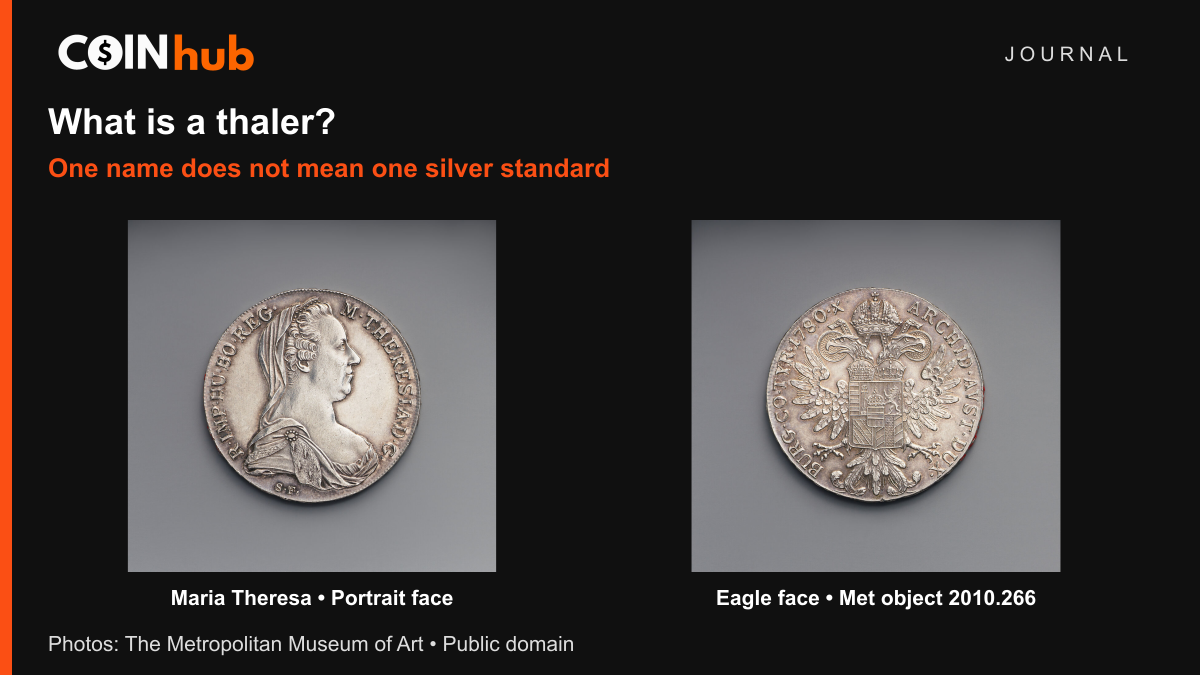
The two photographs show a Maria Theresa thaler in The Metropolitan Museum of Art's collection, object 2010.266. The museum attributes it to the Günzburg Mint and catalogs it under 1780. The portrait face names Maria Theresa; the other face has a crowned, double-headed eagle and the visible date.
The Met's object record lists silver as the material, a diameter of 39.5 millimeters and a weight of 26.067 grams. Those figures describe that one coin. Keep them with its accession number, which is the museum's ID for the piece.
This is a useful habit for any coin reference. Keep “what this specimen measures” separate from “what this issue was meant to weigh.” A museum may list what one coin weighs. That is not a rule for all coins of its type.
Compare the right numbers
The Austrian Mint's current Maria Theresa taler is explicitly described as a historical restrike. Its product specifications list a 42-millimeter diameter, 28.07-gram total weight and 23.39-gram fine weight. Fine weight means how much silver is in this coin. Total weight includes the other metals too.
The two sets of figures differ. Check which coin each source describes. A difference alone does not prove the museum coin is false. Nor should you replace the museum's recorded weight with a number from a modern sales page.
| Reference | What its figures describe | Safe use |
|---|---|---|
| Met object 2010.266 | A particular cataloged coin: 39.5 mm and 26.067 g | Describe that museum specimen |
| Austrian Mint current product | A modern restrike: 42 mm, 28.07 g total, 23.39 g fine silver | Understand that specific current product |
| A thaler you own | Your observed measurements and its eventual attribution | Choose a matching specialist reference before comparing specifications |
A scale reading is one clue. It cannot tell you the exact type or prove a coin is real. Write down the weight. Then check that your source covers the same issuer, face value and type. Otherwise, a precise number can support the wrong comparison.
The date needs context too
The Austrian Mint explains that the Maria Theresa design has continued in later production with its historical date. A coin bearing 1780 therefore does not prove it was struck in that year. This is a feature of that series, not a reason to distrust every old date on every thaler.
CoinHub's separate guide to restrike coins explains that distinction in more depth. Use it for the terminology; use a specialist attribution for a particular piece. A broad history cannot tell you when an unknown piece was struck.
Write a description you can check later
Begin with photographs of both faces and the edge. Copy visible letters, dates and symbols before trying to expand every abbreviation. Keep uncertain readings marked as uncertain. A portrait resemblance alone is a weak basis for choosing an issuer.
- Identify the authority. Record the ruler, state or mint attribution supplied by a reliable reference.
- Name the issue. Include the denomination, design and catalog number when known.
- Separate date from manufacture. Preserve any documented restrike qualification.
- Attach measurements to their source. Distinguish your reading, a museum measurement and a published standard.
- Keep the evidence. Save the reference URL, photographs and the date you checked them.
For example, “Maria Theresa thaler, dated 1780; production period unconfirmed” communicates more than “1780 silver coin” when the striking period is unresolved. It also shows the next person what to check. Do not name a mint unless you have proof.
Identification comes before a value comparison
There is no single collector price for the word “thaler.” Compare the same issue in a similar state of wear. Read the sale terms too. A current Mint retail price is not an appraisal of an old museum specimen or of the coin in your hand.
Start with a clear label you can trust. Once you know the issue and its key details, look for matching sources and sales. The broad name opens the subject; the details tell you which coin you actually have.
Sources checked October 6, 2026: ANA, The Metropolitan Museum of Art and the Austrian Mint, linked above. Photos: The Metropolitan Museum of Art, Anonymous Gift, 2010, object 2010.266; public-domain Open Access images. Complete photographs resized in a CoinHub layout; coin details unchanged.