
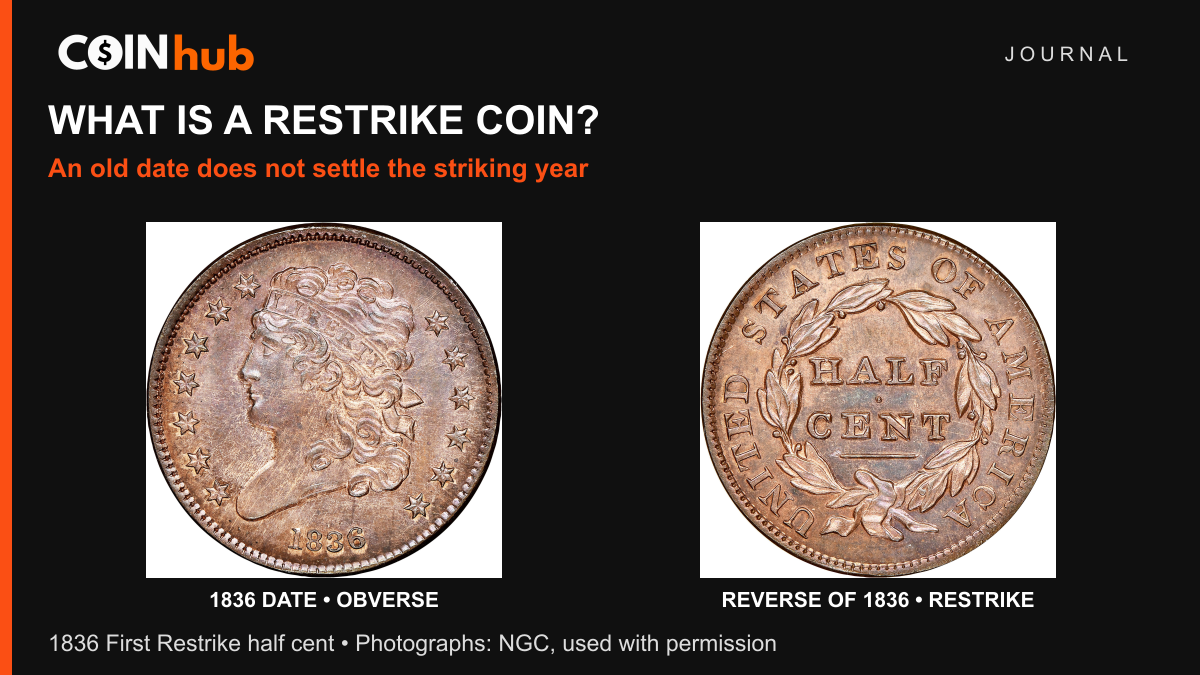
When the date and the striking year tell different stories
A restrike is a later striking of an earlier issue. In the strict U.S. terminology used by PCGS, an official restrike was minted significantly later than the date it carries. The word needs context: who made it, which dies were used and how specialists classify that particular issue all matter.
A date is one of the first things a collector reads. It feels like a simple timestamp, yet a coin can carry an older date without having been manufactured in that year. That distinction becomes important when a listing offers an “original,” a “restrike” or a modern recreation of a familiar design.
The useful question is not whether the coin looks old. It is what evidence connects that specific piece to a particular production period. A later striking can have a well-documented history of its own; calling it a restrike does not explain its entire story.
Start with the complete description
PCGS separates officially minted restrikes from what it calls private “restrikes.” Its terminology also treats patterns, Proofs and clandestine strikes as different concepts. A Proof describes a method of manufacture, while a pattern concerns a proposed design. Neither word, by itself, establishes when a particular piece was struck.
Read the issuer, denomination, date, attribution and any parenthetical year together. A seller's short headline may omit the very distinction that a specialist catalog considers essential. If “restrike” appears only in a description without supporting documentation, treat that as a question to resolve.
An 1836 half cent shows why attribution matters
The photographs above show an example in NGC's 1836 reverse-of-1836 restrike entry. NGC explains that a later striking used the same dies as the originals. Subsequent die polishing left the later pieces with somewhat shallower relief. The entry calls this the First Restrike and identifies the normal Classic Head reverse.
That is a specific description of one issue, not a test for all restrikes. Shallow detail on an unrelated coin does not prove later manufacture. Wear, striking quality and the way a photograph is lit can complicate a comparison. A general illustration should help you understand the label, not persuade you that you can certify a valuable attribution from one image.
CoinHub's Classic Head half-cent guide introduces the series. For an individual 1836 piece, follow the specialist attribution further before making a purchase or price comparison.
A historical date can remain in regular use
The Austrian Mint's Maria Theresa taler offers another useful example. The issuer describes the coin as a historical restrike and says it has been continuously restruck since 1857. Its familiar design dates to 1780, the year of the empress's death.
Consequently, seeing 1780 on a Maria Theresa taler does not establish manufacture in 1780. The original date and the later production history belong in separate parts of the description. Do not assign a precise striking year to an unattributed example merely because a modern product page explains the general series.
Five questions to ask about a restrike
- What is the exact issue? Record the full date, denomination, design and catalog attribution, including qualifiers.
- Who made it? Identify the mint or producer rather than assuming every historical-looking piece came from the original issuer.
- What supports the production period? Look for a specialist reference, issuer documentation or a recognized attribution.
- Which diagnostic details apply? Compare the correct die pairing and issue-specific features. Do not substitute color or apparent age for evidence.
- What is the comparison actually comparing? Keep originals, later official strikings and private reproductions in their appropriate categories.
Save the reference with the coin's records. If two sources disagree, retain both descriptions and the dates you checked them. Resolving a disagreement is more useful than quietly dropping the qualifier that makes the coin difficult to describe.
Does a restrike always have a lower value?
No blanket percentage or rule settles that question. A useful comparison needs the exact issue and attribution as well as condition, surfaces and credible sales evidence. A common later issue and a scarce historical restrike are not interchangeable simply because both descriptions contain the same word.
Likewise, a modern coin inspired by an old design is not automatically the same numismatic issue as the original. Read its actual specifications and release description. For another frequently confused category, see what pattern coins and Judd numbers mean.
Can the date alone identify a restrike?
No. The date is a starting point. Identification depends on the issue's documented production history and the features of the actual piece. When the attribution is uncertain, describe it as uncertain and seek a qualified specialist's opinion before treating it as established.
References checked September 25, 2026: PCGS numismatic terminology, NGC Coin Explorer and the Austrian Mint, linked above. Photographs courtesy of NGC, used with permission; complete images resized with CoinHub layout added.