
Decode the reference before judging the coin
A Judd number on a pattern coin points to a catalog entry. It does not tell you the coin's grade, its price, or how many examples were struck. A listing such as “J-264” therefore needs to be read alongside the date, denomination, metal, grade and supporting reference.
Quick answer: J is shorthand for Judd, the reference system used for many United States patterns and related pieces. “J-264” and “Judd-264” refer to the same catalog number. Start with the entry it identifies, then check whether the offered coin matches that description.
What makes a coin a pattern?
In its narrow sense, a pattern is an experimental piece testing a proposed design or a change in such features as composition, size or shape. The collecting category is broader. NGC's history of patterns and trial coins explains that it also encompasses die trials, restrikes and pieces made principally for collectors. A catalog label does not establish that every example was a serious proposal for circulation.
This distinction helps when an unfamiliar design appears online. “It looks different” is an observation; “it is a genuine Mint experiment” is a conclusion requiring evidence. Keep the seller's description separate from what the reference and certification actually establish.
J, Pollock, grade and rarity are different fields
PCGS explains the Judd shorthand through Dr. J. Hewitt Judd's United States Pattern, Experimental and Trial Pieces, first published in 1959. Listings may also cite Andrew Pollock's separate reference system. A Pollock number is another catalog attribution, not a Philadelphia mintmark in that context.
| Field in a description | What it does | What it does not establish |
|---|---|---|
| J or Judd plus a number | Identifies an entry in the Judd reference system. | A unique serial number for that physical specimen. |
| Pollock or an identified P reference | Points to a separate catalog entry. | A substitute for checking the full attribution. |
| PF 66 or PR 66 | Records the service's Proof grade notation. | The pattern's catalog number or surviving quantity. |
| An R rating | Expresses rarity within the cited scale. | A numeric grade or a guaranteed current count. |
Copy the reference prefix, number and any suffix exactly. If two descriptions differ, do not silently remove the inconvenient letter. Ask which reference edition or attribution the seller is using. Our PCGS and NGC label guide explains the surrounding certification fields.
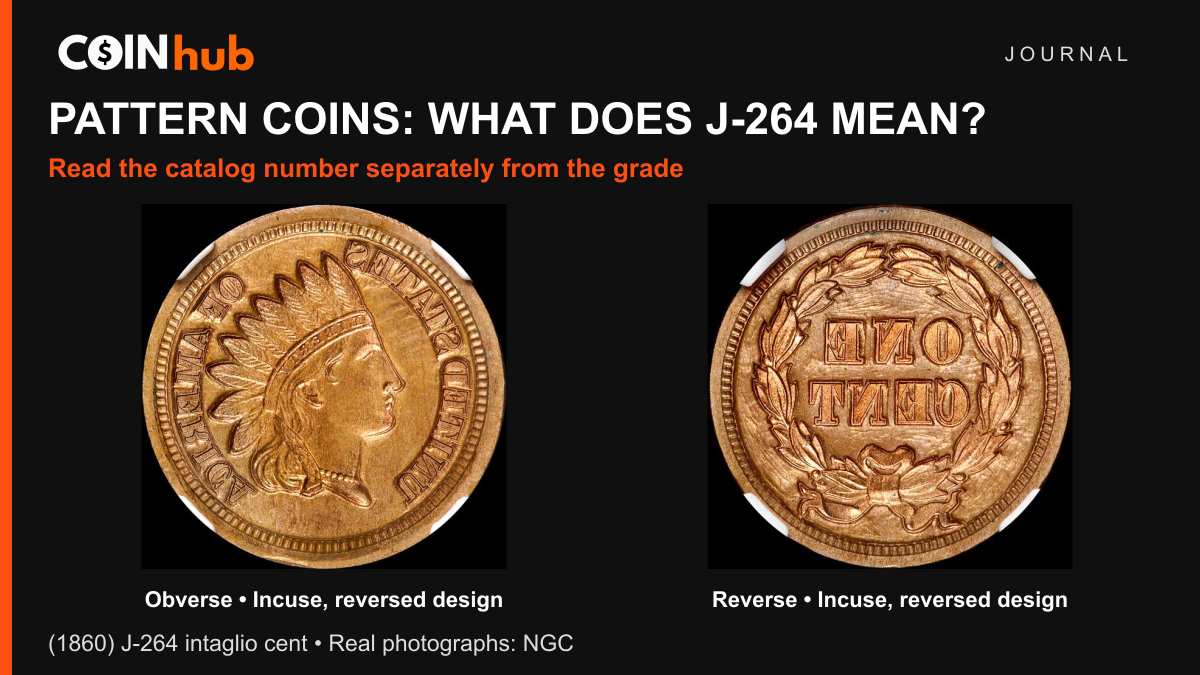
A real example: the unusual J-264 intaglio cent
The photographs above show the piece in NGC's 2012 report on J-264. Its design is incuse and reversed because it was struck from hubs. The undated obverse uses the rounded-bust Indian cent design; the reverse uses the wreath and ONE CENT arrangement associated with the 1859 cent. NGC describes a copper-nickel blank and identifies the pictured specimen as PF 66.
The attribution is conventionally written “(1860) J-264.” The parentheses matter: there is no visible 1860 date to point to on this coin. NGC also says the exact purpose is unknown. A suggested connection with anti-counterfeiting experiments remains an explanation to investigate, not an established intention.
The old report's certification rank is not presented here as a current ranking. For any purchase, check current information for the particular specimen. The historic article documents an examination at a particular time; it cannot guarantee what later submissions or research have established.
Build a short attribution record
- Transcribe the listing. Save its complete date, denomination, reference numbers, metal description, service, grade and certification number.
- Open the reference. Record the title, edition or page URL. Compare both sides, not just the portrait that first caught your eye.
- Mark what is missing. If the attribution depends on metal or edge details that the photographs do not show, record those as unresolved. Color alone does not establish an alloy.
- Match the specimen. Use certification verification and available images to check the offered coin and holder. A number copied into a sales title is not the same as an independently matched object.
- Separate identity from price. Only after the attribution is supported should you compare appropriately matched sales.
For example, suppose an offer gives a Judd number but shows only a small obverse photograph. Your next useful question is for the reverse, complete holder and supporting reference—not whether the catalog number sounds rare. Our provenance guide can help organize a claimed ownership or auction history.
Common questions about pattern listings
Is every strange-looking coin a pattern?
No. Appearance alone does not establish origin. Preserve clear photographs and seek an attribution based on an identified reference and the actual specimen.
Does a higher Judd number mean a rarer coin?
No. Treat it as a catalog reference. Research the rarity evidence separately, including its source and date, rather than ranking coins by their J numbers.
Where does the 1856 Flying Eagle cent fit?
Its specific pattern and production history deserves issue-level treatment. See our 1856 Flying Eagle cent guide rather than applying one broad pattern rule to every example.
Sources checked September 18, 2026. Photographs reproduce a documented NGC example without altering its reversed designs. This guide makes no current price, finest-known or surviving-population claim.