
An antoninianus is a Roman coin introduced under Emperor Caracalla in 215 CE. Its plural is antoniniani. Often called a double-denarius, it is generally understood to have begun with a face value of two denarii. That did not mean it held twice as much silver. Its metal content changed greatly during the third century.
Many examples show an emperor with a spiked, or radiate, crown. That is a useful clue when you first look at a coin. It is not enough by itself to settle the coin's type, date or metal content.
Start with the name, then check the issue. “Antoninianus” describes a denomination, a unit of money. To identify one coin, match both sides and their inscriptions to a trusted catalog record. Keep uncertain details open.
Why a double-denarius was not double the silver
Stellenbosch University's coin collection describes the new coin as worth two denarii but weighing about one and a half. The distinction is between its stated value and the metal in the piece. Those are different measurements.
For a simple illustration, imagine two coins with the same silver percentage. If one weighs one and a half times as much, it also holds one and a half times as much silver. Calling it “double” would not change that amount. This is a ratio example, not a weight test for an ancient coin.
The University of Bonn's record of a Caracalla coin from 215 describes the double-denarius value as the majority view. That qualification matters. We should not present every part of Rome's monetary system as if a modern price chart survives for it.
Our denarius guide explains the earlier denomination. The antoninianus belongs to a later chapter. It should not inherit one fixed weight or silver standard from all the denarii that came before it.
Read the crown and portrait together
On many male portraits, the rays rise above the head like spikes. Empresses can instead appear with a crescent beneath the bust, the head-and-shoulders portrait. Stellenbosch describes these features as ways to distinguish antoniniani from denarii of the period.
The word radiate describes what you see. The denomination name is an interpretation supported by the whole coin. Record the visible crown, letters and back design first. Then compare them with a published example from the same ruler and period.
One reason to keep that order is that a worn portrait can hide details. A partial crown should not force a precise match. Nor should you fill in missing letters just because one online photograph looks close.
Use this Aurelian coin as a reading exercise
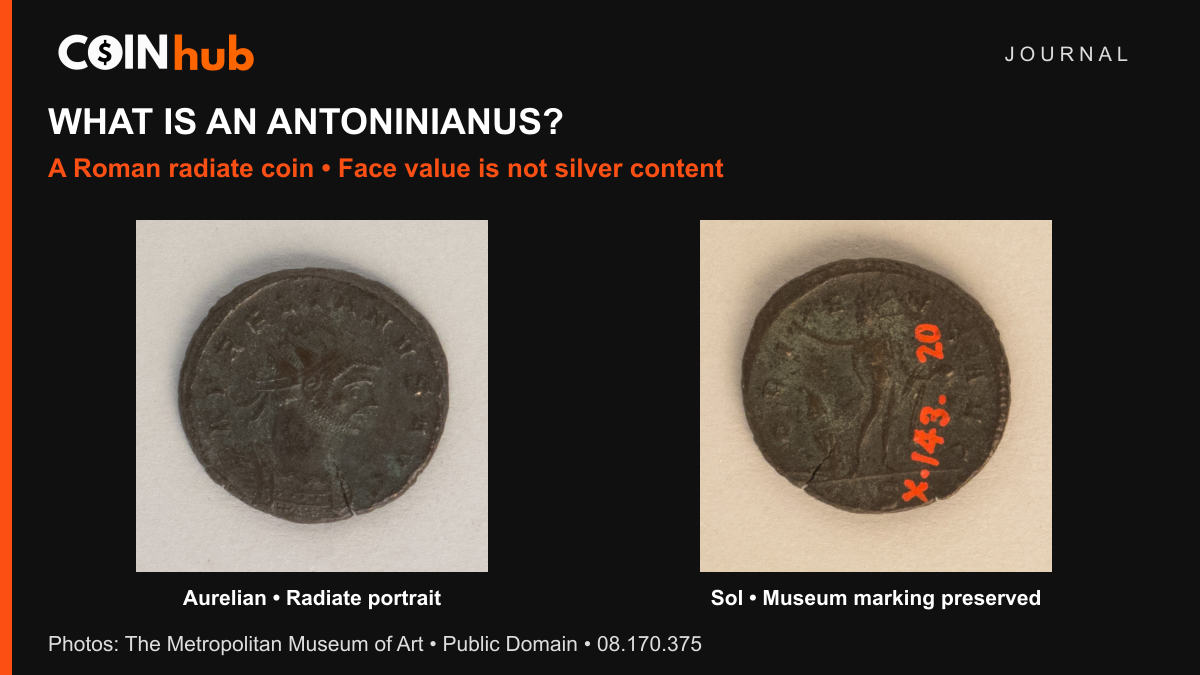
The photographs show a later example in the Metropolitan Museum of Art. The museum dates it to 270–275 CE and identifies Siscia as its mint. It records a diameter of 2 centimeters and a weight of 4.1 grams. Its object number is 08.170.375.
On the front, look for the rays above Aurelian's head. The museum records the inscription AVRELIANVS AVG. On the back, it identifies Sol, the sun god, holding a globe, with a captive at his feet. The words are ORIENS AVG.
Try making two short notes: one for what you can see and one for what the catalog supplies. “Rays above the portrait” is a visual observation. “Siscia, 270–275 CE” comes from the object's attribution. Keeping the two apart makes your notes easier to check later.
A silver label is not a purity measurement
The Met catalogs this object as silver. Its short record does not give a tested silver percentage. Do not turn that material label into a claim that the coin is pure silver, or apply its 4.1-gram weight to every antoninianus.
As the series continued, the silver content fell sharply. Rod Blunt's illustrated study follows the denomination's rise and changing metal content. A bright early piece and a dark later one can belong to the same broad series. Surface color alone cannot measure how much silver lies within a coin.
Specialist names can vary too. Forum Ancient Coins' reference notes that later reformed radiates are sometimes called aurelianiani. When two catalogs use different labels, check the date, ruler and reference number before treating the difference as an error.
Build a useful record before judging value
- Photograph both sides clearly and keep the original images.
- Write down the weight, diameter and letters you can actually read.
- Save the catalog match, its reference number and the source link.
- Mark any uncertain ruler, mint or date as uncertain.
These notes give a specialist something concrete to examine. They do not authenticate a coin on their own. Two pieces can share a ruler and denomination yet have different designs, surfaces or damage. A sale price only helps when the comparison is close enough to be useful.
For the wider process, see our ancient coin identification guide. With an antoninianus, the best first result is a match you can explain: which details agree, which source supports the name and which questions remain.
Sources and photograph credit
Research sources are linked beside the relevant facts: Stellenbosch University, the University of Bonn, the Metropolitan Museum of Art, Rod Blunt and Forum Ancient Coins. Photographs: The Metropolitan Museum of Art, Rogers Fund, 1908, object 08.170.375. Public domain through the Met's Open Access program. Photographs resized for this graphic; coin details unchanged. Enlarged, not actual size.