
Encased postage is a postage stamp held inside a small metal case so it could pass from hand to hand as money. In the United States, John Gault's 1862 version placed the stamp behind a clear mica window. It helped people make small payments when coins were scarce during the Civil War.
The round shape can look like a coin at first. Look closer: the value on the front belongs to a paper stamp. The metal back may carry a business name or an advertisement. Read those two sides together before you try to match the piece to a catalog.
Three parts to record: the stamp, the clear window and the metal case. A clear view of one part does not tell you the condition or history of the other two.
Why put a stamp inside metal?
The National Postal Museum explains that coin hoarding in 1862 left too little change for trade. People used stamps for small payments, but loose stamps could stick together and suffer damage. Gault received his patent on August 12, 1862.
His case used cardboard behind the stamp, mica over its face, and a metal frame with a brass back. Mica is the thin, clear mineral sheet that lets the stamp remain visible.
Read the pictured ten-cent example
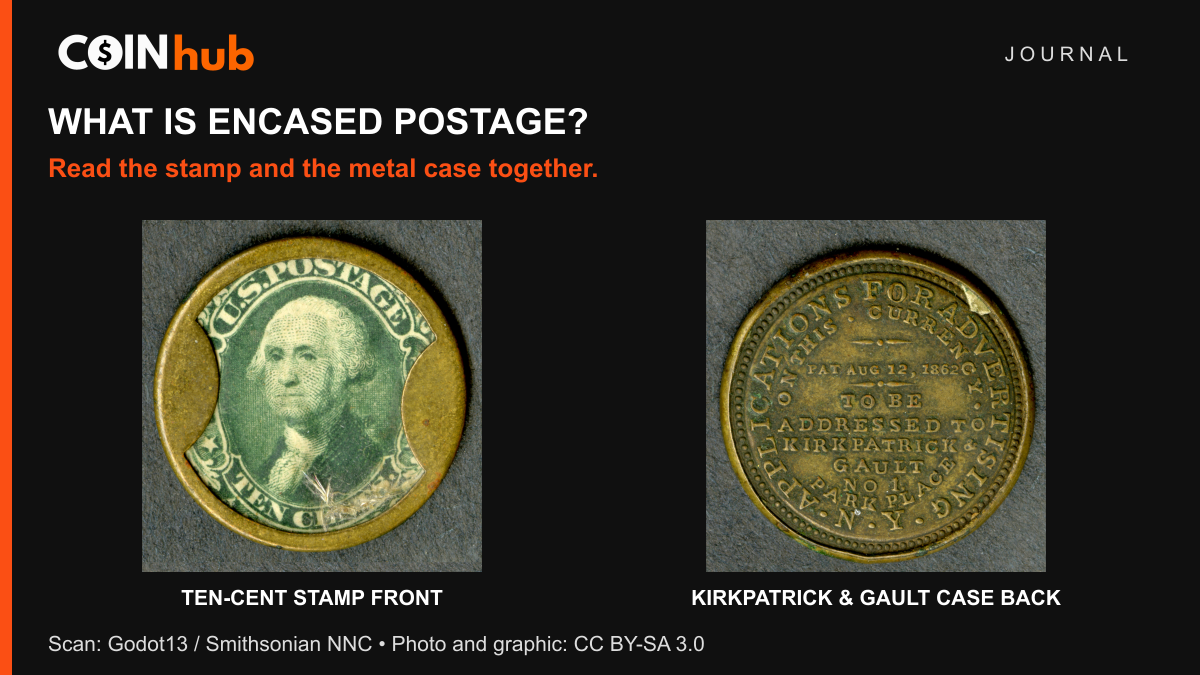
The photograph above comes from the National Numismatic Collection at the Smithsonian Institution. Godot13 scanned the object; both faces appear in the licensed source image. The left view shows a green Washington stamp. Its visible wording includes U.S. POSTAGE and TEN CENTS.

The right view shows the metal back. You can read the name Kirkpatrick & Gault, a New York address and the patent date. This side invites applications for advertising on the currency. It is not the same back as an example that names a medicine, hotel or shop.
Notice the distinction between a patent date and a stamp issue. The date on the case refers to the patented design. It does not mean that the stamp was printed that day or that this exact piece changed hands on that day. Keep each date attached to the thing it describes.
| Visible detail | What to record |
|---|---|
| Stamp portrait and value | Washington and ten cents in this photograph |
| Words on the back | Copy the full business name and wording, not just Gault |
| Patent date | A design reference; not a personal ownership date |
| Window and case | Visible cracks, clouding, bends or gaps, without opening it |
The back could carry an advertisement
Steve Swain's illustrated account for the Ephemera Society of America describes Gault selling the pieces to businesses that needed change. Advertising gave the back a second role. The account shows an Ayer's Sarsaparilla example and names other customers, including the Tremont House and a bread business.
That makes the back worth photographing even when the stamp is easy to identify. Two pieces with the same stamp value can have different wording behind them. A listing that shows only the front leaves an important part of the object out of view.
Encased postage is not a paper fractional note
The National Postal Museum dates the government's postage currency to August 1862 and its next fractional currency to 1863. Those paper issues belong to the same shortage story, but they are not stamps enclosed in metal. The stamp-and-case construction is the key distinction here.
Private metal tokens were another response to the shortage. Our Civil War token guide explains store cards, patriotic tokens and sutler issues. Use that guide for a solid metal token; use the stamp, window and case as your starting point for encased postage.
Make a useful record without taking it apart
Begin with clear photos of the whole front and back. Add a close view of the case edge and any area that is hard to read. Keep the original files, the seller's description and any older collection ticket together. If you cannot read a letter, mark it as unclear instead of filling in the name you expect.
- Record the stamp. Note the portrait, printed value and visible color.
- Record the back. Transcribe the advertiser or maker, address and date.
- Describe what you see. Separate damage to the window from marks on the stamp or case.
- Keep claims separate. A seller's statement that a piece is original needs its own supporting evidence.
Do not open the case just to obtain a better picture. If condition or past repair is uncertain, keep it intact for specialist review. A photograph can help you sort the type and prepare questions. It cannot prove that every part has stayed together since the Civil War.
Sources and photograph credit
Historical sources: the National Postal Museum's encased-postage exhibit and Steve Swain's Ephemera Society account, linked above. Object image: scan by Godot13, National Numismatic Collection, Smithsonian Institution, via Wikimedia Commons, CC BY-SA 3.0. Both complete faces are arranged side by side in a new layout; object details are unchanged. The adapted graphic uses the same license. CoinHub trademark rights remain separate. Enlarged, not actual size.