
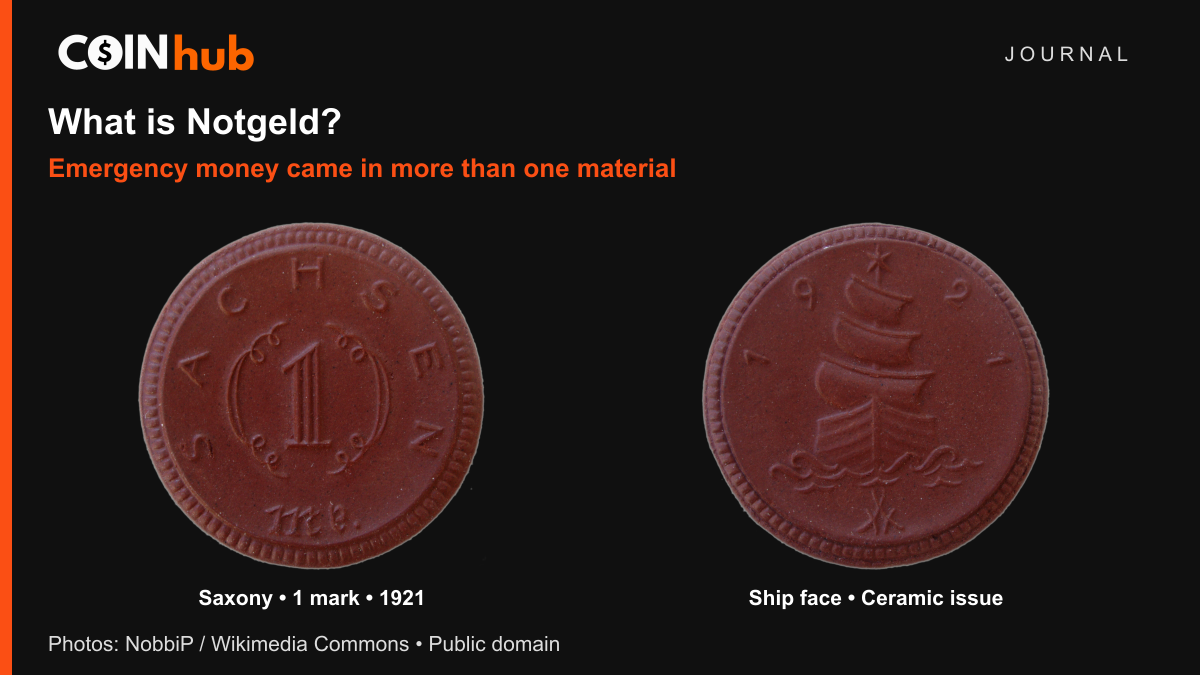
Notgeld means “emergency money” in German. Collectors use the term for money issued by towns, businesses and other local bodies when normal money was scarce or unreliable. It can be a note or a coin-like piece. German Notgeld from the First World War and the years that followed is widely collected.
Not every piece was made to solve the same problem. Some supplied small change. Some later notes served collectors. Others reflect the soaring prices of 1923. Read the issuer, date, value and material together before deciding which story your piece tells.
Small change came before the huge numbers
The American Numismatic Association's wartime exhibit explains how a shortage of coins led cities, businesses and other groups to issue local substitutes. War also increased demand for metal. Emergency money could therefore take forms that look quite unlike a regular national coin.
The ANA's German emergency-money overview includes paper and materials such as cloth and porcelain. It also separates early small-change issues from the high-value money of the later inflation crisis. A modest face value does not rule out Notgeld.
Read the ceramic one-mark example
The genuine photographs above show a brown ceramic piece identified by their source as a 1921 Saxony one-mark issue, with a ship on the other face. The value face reads SACHSEN, 1 MARK and 1921. Those visible details give you a much better starting point than the broad label “German emergency coin”.


Face value is not a price guide. “1 MARK” is the value written on the piece. It does not tell you today's collector price, prove that this individual piece circulated, or prove that it is rare.
Keep the material in the record. A ceramic object needs different handling from a paper note. Support it over a soft surface and avoid knocks. Do not scrub a surface, test it with chemicals or force a brittle piece into a tight holder to make it match an example online.
Some colorful notes were collector issues
Serienscheine means series notes. The ANA describes these collector-oriented issues in 1920 and 1921, before the worst of the later inflation. Their pictures may show local scenes or stories. A dramatic design alone is not evidence that the note bought goods in an emergency.
For a note, save images of both sides and any printed dates or series information. For a coin-like piece, record both faces and the edge when visible. Leave a detail marked “not checked” if a holder or an unclear photograph hides it.
Build a record before making a comparison
| Detail | What to record | What it prevents |
|---|---|---|
| Issuer | Place, business or issuing body | Mixing different local issues |
| Date and value | Every printed date; number and unit | Confusing a series note with a later inflation issue |
| Material and design | Paper, ceramic or metal; both faces | Matching only a similar picture |
| Condition and source | Cracks, tears, wear and seller or collection record | Comparing unlike examples without noticing damage |
Use an appropriate catalog or specialist once you have these basics. Compare the same issue and condition in completed sale records; an ambitious asking price is not a completed sale. Treat a seller's label as a claim until you can check it.
America's Civil War tokens offer another example of private substitutes for scarce change. They belong to a different time, place and catalog system. That connection helps explain the need but the two fields are not the same.