
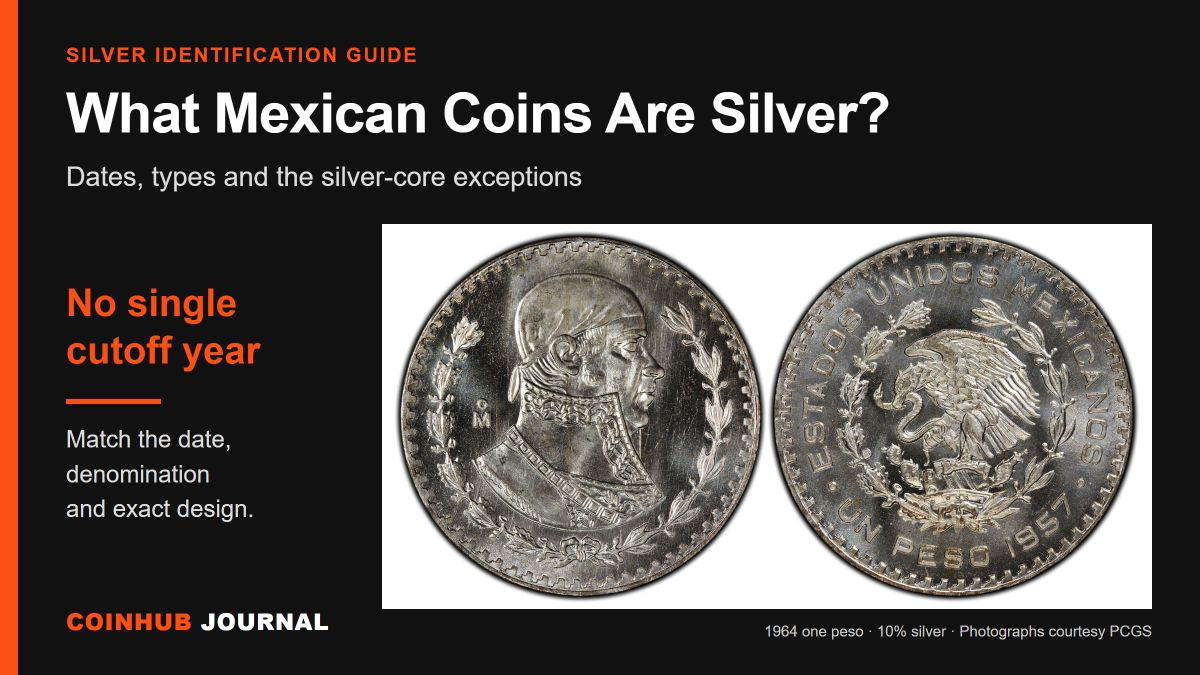
Many older Mexican pesos and centavos contain silver. Selected later coins do, too: the 1957–1967 one peso has 10% silver, while some 1990s nuevos pesos have sterling-silver centers. Modern silver Libertads are .999 fine. Match the denomination, date and exact design. There is no single cutoff year for every Mexican coin.
A silver-colored coin is not always a silver coin. Mexico used several alloys, meaning mixtures of metals, for coins with the same face value. The amount printed on a coin is its denomination. That number does not tell you how much silver is inside.
Use this guide to sort common older types and spot later silver issues. It is a starting reference, not a complete catalog of every Mexican coin. If your coin does not match a listed type, look up that exact issue before assuming it contains silver.
Common Mexican silver coins by date and type
The table shows selected silver types from NGC's world silver reference. These date ranges identify catalog groups. They do not mean that every denomination, design or coin struck within those years has the same composition.
| Selected silver type | Reference dates | Silver by weight | Full coin weight |
|---|---|---|---|
| One peso | 1920–1945 | 72% | 16.66 g |
| One peso | 1947–1949 | 50% | 14 g |
| One peso | 1950 | 30% | 13.33 g |
| One peso with Morelos portrait | 1957–1967 | 10% | 16 g |
| Silver 25 pesos | 1968–1972 | 72% | 22.5 g |
| Silver 100 pesos | 1977–1979 | 72% | 27.77 g |
The listed weights are reference weights. A match alone does not prove that a coin is real. Wear can reduce weight, and a fake or altered coin may need expert review. Check the pictured design and the full catalog entry along with the date.
Older centavos also deserve a closer look. For example, NGC lists a 72%-silver 20-centavo type for 1920–1943 and a 30%-silver 25-centavo type for 1950–1953. Those are specific silver issues. Do not extend their composition to every coin marked “20” or “25,” or to an entire jar of old Mexican change.
The Morelos one peso: silver, but only 10%
The large one peso dated 1957–1967 is easy to overestimate. Its reference weight is 16 grams, but only 1.6 grams of that weight is silver. The rest is other metal. Size and a bright surface can make it look like a much richer silver coin.
PCGS identifies this series by its José Morelos portrait and Mexican eagle design. Its silver content is about 0.0514 troy ounces per coin. “Last circulating silver one peso” describes this denomination and series. It does not mean that Mexico stopped making all silver coins in 1967.
1990s nuevos pesos: check the center separately
A bimetallic coin has a center and an outer ring made from different metals. That matters for Mexican silver. Some 1990s “new peso” coins have a silver center inside a ring of other metals. Their silver percentage applies to the center, not to the whole coin.
In 1993, Mexico introduced the new peso, worth 1,000 of the previous pesos. The mark N$ stands for nuevos pesos, or new pesos. An old 100-peso coin and an N$10 coin belong to different currency periods. Those numbers do not tell you which coin holds more silver.
Ten pesos dated 1992–1995
Banco de México's October 1997 circular separates ten-peso coins with silver cores struck in 1992–1995 from coins with an alpaca center. A coin can bear a date earlier than its first release. The 1992 date is not a reason to reject a matching silver-core issue.
The family B ten-new-peso specification identifies the center as sterling silver, or 92.5% silver, surrounded by a bronze-aluminum ring. Later ordinary ten-peso coins use an alpaca center. Here, alpaca is a copper, nickel and zinc alloy; it does not mean silver plating.
Twenty and fifty nuevos pesos
Banco de México also documents an N$20 coin with Hidalgo and an N$50 coin with the Niños Héroes. Both have .925-silver centers and outer rings of other metals. Its 1993, 1994 and 1995 sets include these silver-center types. This does not make every later 20- or 50-peso coin silver.
Do not calculate a silver-core coin as though it were solid sterling. Multiplying the entire coin's weight by 92.5% counts the outer ring as silver. Use a reliable reference for the silver content of the exact core and issue. Never remove the center, file the edge or acid-test the coin to find out.
Modern Libertads and special silver issues
A late date does not rule out silver. Mexico continued making silver for collectors and bullion buyers after the older circulating series ended. Bullion coins are made primarily for their precious-metal content, though individual examples can also attract collector premiums.
Banco de México lists the modern silver Libertad series at .999 fineness, meaning 99.9% silver. Sizes include one ounce, larger pieces and fractions of an ounce. Read the size on the actual coin or its exact official specification. A small Libertad is not automatically a one-ounce piece, and Libertads also have separate gold issues.
Keep bullion and special collector issues separate from ordinary change when sorting. Match the metal, size and design to the correct reference. A silver-colored center or the word “pesos” alone cannot identify the alloy.
Calculate silver content after you identify the coin
For a coin made from one uniform alloy, multiply its reference weight by the silver fraction. Then divide the silver grams by 31.1034768 to convert them to troy ounces. A troy ounce is the unit used for precious metals; it differs from the everyday ounce used for food.
Silver troy ounces = number of coins × reference weight in grams × silver fraction ÷ 31.1034768.
For ten confirmed 1957–1967 one-peso coins: 10 × 16 × 0.10 = 16 grams of silver, or about 0.5144 troy ounces.
At a made-up example price of US$40 per troy ounce, that metal would be worth about US$20.58. This is a worked example, not today's silver price or a dealer's offer. Actual weight, buying costs and collector demand can affect a sale. A coin may be worth more to a collector than its metal alone.
CoinHub Labs' silver melt calculator currently has presets for U.S. coins. Do not enter a Mexican coin under a similar-looking U.S. row. Use the formula above with verified Mexican specifications, and keep the calculation with your coin's records. This whole-coin formula does not apply to a silver center inside a base-metal ring.
Sort a mixed collection without damaging it
- Record both sides. Note the date, denomination, portrait or other design, mint mark and any N$ marking. Take clear photos without cleaning the coin.
- Match the exact type. Compare your coin with Banco de México or an established coin catalog. Keep uncertain pieces separate rather than assigning the closest silver percentage.
- Save the source and calculation. Use a record for each type, and keep silver-core coins in their own group. CoinHub's collection-records checklist helps organize identification, photographs and dated estimates.
Do not scratch, polish or separate a coin to test it. If the date, design and reference do not agree, get help identifying the issue before selling it as silver. A careful identification gives you a useful starting point for both metal calculations and a fuller collector-value review.
Sources and image credit
Historical specifications: NGC's linked world silver reference and PCGS's Morelos one-peso series article. Silver-core dates, designs and alloys: Banco de México's linked family B pages, 1990s sets and October 1997 circular; the official ten-peso composition decree defines the alpaca alloy. Modern Libertad fineness and sizes: Banco de México's linked series specifications.
Main image: genuine 1964 Morelos one-peso photographs courtesy PCGS, from its 1957–1967 series article. CoinHub Journal layout added; both coin faces and specimen details preserved. The photograph illustrates the type and does not establish the identity, grade or value of another coin.