
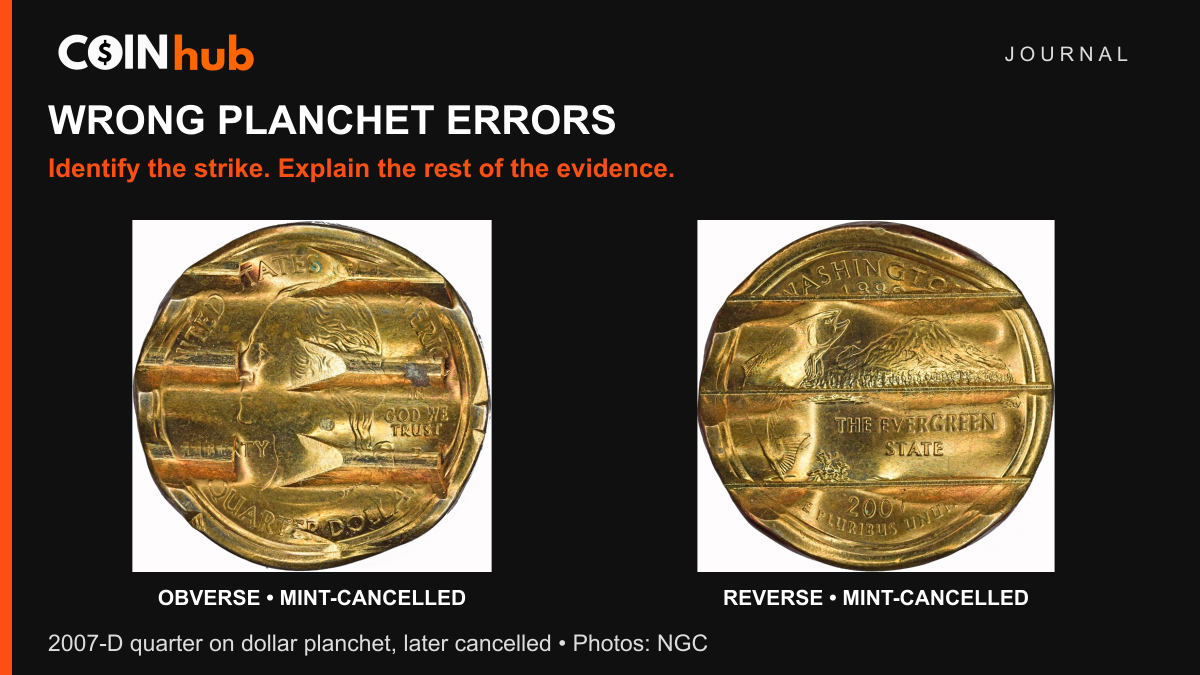
A design struck on a blank intended for another coin
A wrong-planchet coin error occurs when a coin's dies strike a planchet intended for a different issue. The result combines the design from one coin with the physical starting material for another. A planchet is the prepared metal blank that receives the strike.
The challenge is showing that this happened at the Mint. An odd color, low weight or missing section of lettering can have more than one explanation. Treat those observations as questions to investigate, rather than labeling every unusual coin a rare error.
What a wrong planchet can change
NGC's illustrated overview includes a Washington quarter struck on a clad dime planchet. The smaller blank could not receive all the peripheral design. The article reports a weight of 2.2 grams for that particular specimen. That number describes the documented coin; it is not a universal pass-or-fail threshold for an unknown quarter.
NGC also documents a 1943 cent struck on a planchet intended for a Curaçao coin. This shows why the search for a possible blank is not always limited to another familiar U.S. denomination. It does not mean that every unexplained weight can be assigned to a foreign planchet without supporting evidence.
The terms wrong planchet and off-metal often appear together. Error-Ref's specialist discussion distinguishes a blank intended for another denomination from the broader question of incorrect composition. Preserve the exact attribution on a grading label rather than treating every related term as interchangeable.
Build an evidence table before seeking a value
| Observation | Useful record | What it cannot prove alone |
|---|---|---|
| Design | Full photographs of both sides, with readable date and mint mark when present. | Which blank supplied the metal. |
| Weight | Repeated measurements, scale precision and whether the coin was weighed without packaging. | That a difference arose during minting rather than afterward. |
| Size and edge | Actual measurements and sharp views of the edge and surviving rim. | The original blank's dimensions from a distorted finished coin. |
| Color and surfaces | Neutral-light photographs and literal descriptions of layers, wear or damage. | The alloy, or whether plating or other alteration occurred. |
| Attribution | Exact service wording, certification number and matching specimen images. | That another coin with a similar appearance is the same error. |
These are recordkeeping steps, not a home authentication procedure. Start with our guide to weighing coins if the measurement is the first clue. A useful submission to a specialist includes the observations and the uncertainty, rather than only a proposed high-value identity.
One photographed coin, two separate events
The genuine specimen shown above comes from NGC's July 2018 certification report. NGC identified it as a 2007-D Washington quarter struck on a Sacagawea dollar planchet. The Mint subsequently cancelled it, leaving the conspicuous waffle-like distortion.
The photograph therefore illustrates a documented wrong-planchet attribution and a later cancellation. The ridges are not the diagnostic appearance of all wrong-planchet coins. Looking only at the shape would miss the distinction between the original striking error and the subsequent treatment.
NGC's report describes surviving detail as sufficient for identification despite the cancellation. That is a specialist assessment of this specimen, not an invitation to authenticate a similarly damaged find from a single photograph. The full original images are retained here without added marks or reconstructed detail.
Wrong blank is different from two denominations
A wrong-planchet strike starts with the wrong blank. A double-denomination error involves a previously struck coin receiving another denomination's design. The surviving evidence and the explanation are different: do not require two designs to recognize every wrong-planchet attribution, or assume a single strange design establishes a double denomination.
NGC's variety-versus-error reference places wrong-planchet strikes among production errors. An unusual feature repeated from a die and accidental use of the wrong blank are different mechanisms. Keep the mechanism separate from the broad phrase “error coin.”
What to do with a possible example
Keep the coin as found. Do not polish, scrape an edge, apply chemicals or perform a destructive metal test to make the evidence easier to see. Photograph the whole object before any close-ups, and protect it from further contact using an appropriate holder.
Then seek a qualified error specialist's assessment. If certification is being considered, check the service's current submission requirements and costs against the uncertainty of the attribution. A spectacular auction result for a different error does not establish that paying those costs will make sense for yours.
Does every wrong-planchet coin look dramatically misshapen?
No single silhouette defines the category. Begin with the proposed relationship between dies and blank. In the illustrated specimen, the dramatic final shape specifically includes later cancellation.
Can a normal weight rule out every mint error?
No. Weight is one observation about one proposed explanation. Other error mechanisms have different diagnostics. Avoid converting a useful measurement into a verdict on every possible type of error.
Sources and photographs: NGC and Error-Ref references checked September 27, 2026. Original NGC photographs used with permission. The cancellation is explicitly distinguished from the wrong-planchet strike; no value or grade is assigned to an unexamined coin.