
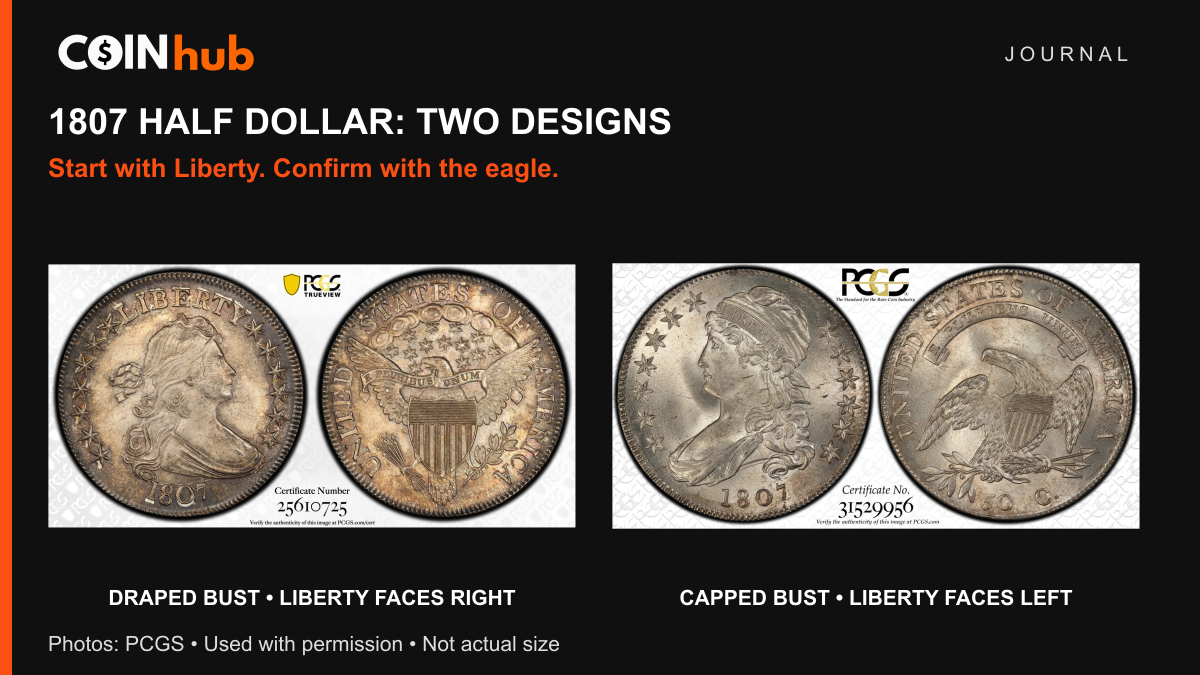
An 1807 half dollar can be a Draped Bust or a Capped Bust. Start with Liberty's face: the Draped Bust portrait faces right with her hair uncovered, while the Capped Bust portrait faces left and wears a cap. Both are regular designs from the same year. The date alone cannot tell you which one you have.
Turn the coin over to check that first impression. The older design has a large shield on the eagle and a group of stars beneath clouds. The newer design has a different eagle, a scroll above it and 50 C. below. These broad features are more useful for this first step than tiny differences in the date.
A quick photo check: read the date, check which way Liberty faces, then compare the reverse. Keep both sides upright. Reversed or poorly cropped listing photos can make a simple match confusing.
Begin with the portrait, not the price
The obverse is the coin's front. On the Draped Bust half dollar, Liberty's nose points toward the right rim. Her loose hair falls behind her head, and cloth covers the bust below. The word LIBERTY sits above her head rather than on a cap band.
On the Capped Bust coin, her nose points left. A soft cap rises above the band marked LIBERTY. Look for the whole shape of the cap, not just one worn letter. PCGS lists the exact 1807 Draped Bust half dollar and the 1807 Capped Bust, Large Stars half dollar separately.
The photographs here show one example of each type. Their color and surface marks belong to those individual coins. A darker coin is not a different design, and matching its tone is not part of the identification test.
Use the eagle to confirm the match
The reverse is the back. Both designs show an eagle with a shield, so “it has an eagle” does not settle the question. On the Draped Bust example, the shield dominates the center. Stars and clouds fill the space above the bird, and a ribbon passes across its upper body.
The Capped Bust reverse has a more open space around the eagle. The E PLURIBUS UNUM scroll sits above it, and the denomination appears beneath it as 50 C. The PCGS lettered-edge type reference describes this design and its 1807 introduction.
Suppose a seller shows a right-facing portrait but a reverse with 50 C. below the eagle. Do not guess which image is wrong. Ask for fresh, clear pictures of both sides of the same coin. That mismatch could be a listing mistake; it is not evidence of a rare pairing.
Why 1807 has two normal designs
The date marks a change in the half-dollar series. Stack's Bowers identifies 1807 as the final Draped Bust year, with the Capped Bust design replacing it later that year. A collector can therefore build a pair of different types bearing the same date.
This is a design change, not a minting error. It is also separate from the later 1836 lettered-edge and reeded-edge half-dollar change. Both of the 1807 types have lettered edges. Edge lettering alone will not separate this pair.
Leave the small variety details for the next step
After choosing the correct type, you can study its smaller features. PCGS lists Small Stars, Large Stars and other entries within the 1807 Capped Bust group. Those names do not replace the broader Draped Bust versus Capped Bust distinction.
A useful collection note might read: “1807 half dollar; left-facing capped portrait; 50 C. below eagle; Capped Bust type; smaller variety not yet checked.” That record says what the photographs support without filling gaps with a guess. Our guide to type sets and date sets explains why both the design and year matter in a collection.
A type match does not establish authenticity, grade or value. Wear, weak detail and glare can hide useful features. Keep uncertain details open, avoid cleaning the coin to reveal them, and seek an experienced numismatist's review before treating a photograph as proof of a valuable variety.