
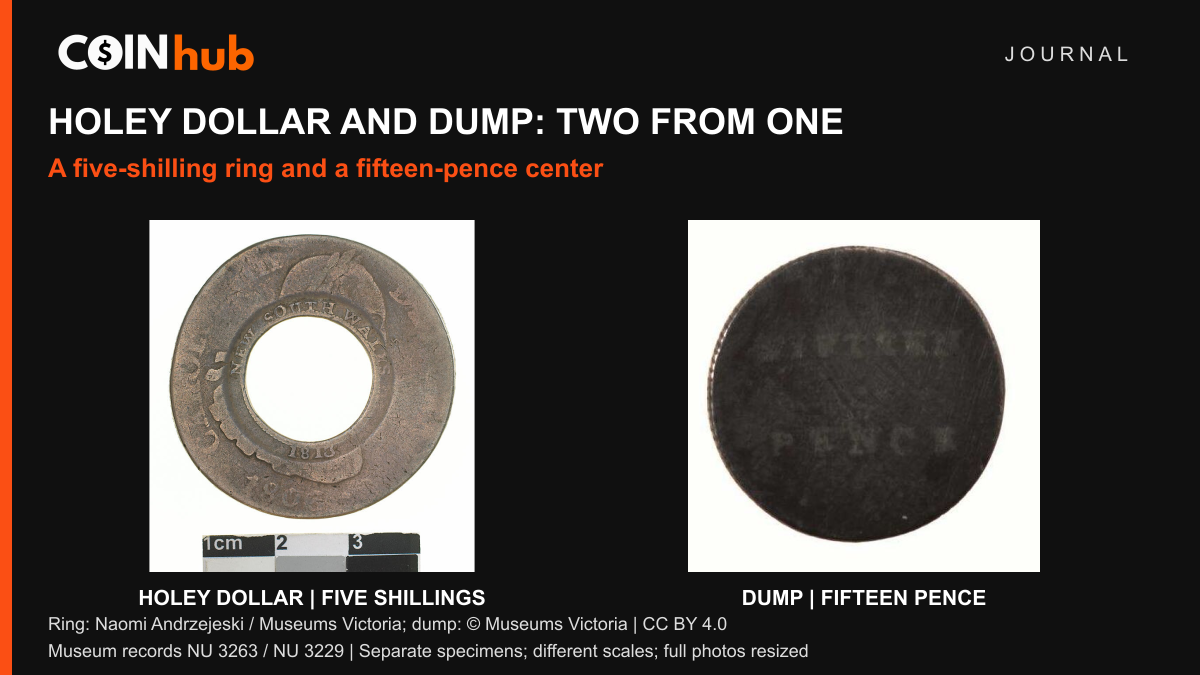
A ring and a small coin with different values
The New South Wales Holey Dollar and Dump were two coins made from one Spanish silver dollar. The outer ring became the Holey Dollar, worth five shillings. The piece cut from the center became the Dump, worth fifteen pence. Both received new marks for use in the colony.
The hole is only part of the story. An old silver coin with a hole is not automatically a Holey Dollar. The host coin, colonial stamps and their relationship all matter. The small Dump is also a coin in its own right, rather than loose scrap from the ring.
Read the names separately: The Holey Dollar is the ring. The Dump is the center piece. The photographs show two separate museum specimens, not a proven matching pair, and they are not displayed at the same physical scale.
Why New South Wales changed Spanish dollars
The colony had too few coins for local trade. Foreign money circulated, but coins also left as payment for imported goods. Governor Lachlan Macquarie arranged to turn Spanish dollars into money that would be more likely to stay in New South Wales.
The National Museum of Australia’s account describes a shipment of 40,000 Spanish silver dollars arriving in 1812. William Henshall cut out the centers and stamped both pieces with new designs. A counterstamp is a new mark struck onto an existing coin.
Cutting created two pieces to use in trade, but it did not create more silver. The assigned values were five shillings for the ring and one shilling and three pence for the Dump. In the old system, twelve pence made one shilling.
| Piece | Form | Colonial face value |
|---|---|---|
| Holey Dollar | Outer ring of the Spanish dollar | 5 shillings, or 60 pence |
| Dump | Center cut from the dollar | 15 pence, or 1 shilling 3 pence |
| Both pieces | Two coins from one host | 6 shillings 3 pence, or 75 pence |
At those assigned values, the two pieces together represented 25 percent more than five shillings. That is a change in stated monetary value, not a gain in metal. It also says nothing about what a collector should pay for either coin today.
How to read the Holey Dollar
The ring retains parts of the original Spanish dollar around its outer edge. New stamps appear around the hole. Look for NEW SOUTH WALES and 1813 on one side, with FIVE SHILLINGS on the other. Wear can leave some letters incomplete.
The pictured Museums Victoria specimen, NU 3263, was made from a Mexico Mint eight-real coin dated 1806. Its colonial stamp reads 1813. Those dates refer to two stages in the same object’s history: the original coin and its later conversion.
Do not assume every genuine Holey Dollar used a host from the same mint or year. This example is a reference for one documented piece. Its worn surfaces and partly missing text should not be replaced with an imagined perfect design.
What to look for on the Dump
The Dump received a crown, NEW SOUTH WALES and 1813 on its front. The back bears FIFTEEN PENCE. Henshall’s small H can appear between those words. On a worn specimen, some of that detail may be hard to see.
Museums Victoria’s NU 3229 record identifies the second photographed coin as a genuine 1813 fifteen-pence Dump. The selected reverse is dark and worn; the museum record supplies its identification. It is not a photograph of the center removed from the particular ring shown beside it.
A small old silver disc needs more than a rough resemblance to that picture. Do not force a mark into the shape of an H or assign a die variety from an unclear image. Clear photographs of both faces and the edge give a specialist more useful evidence.
Why 1813 can appear on a coin delivered in 1814
The stamped date and the delivery date are different facts. The National Museum records the first batch delivered on February 25, 1814, with the final batch following that August. Museums Victoria also notes that work continued into 1814 without new dies dated for that year.
That does not turn the coins into an 1814-dated issue. Keep the visible 1813 stamp in the description, then explain the later production or delivery when relevant. The same care helps when reading other coins with more than one date.
Separate originals, later issues and ordinary holes
Modern coins can honor the same history. The Royal Australian Mint’s August 18, 2026 announcement describes a $1 commemorative design featuring a historic Holey Dollar. That modern issue is a different coin, with its own denomination and design. Its existence does not make it an original 1813 ring.
Nor is every official holed coin related to New South Wales. Chinese cash coins often had holes as part of their original design. Chopmarked Trade dollars carry other marks made in a different trading context. Read the issuer and the actual marks before choosing a name.
Keep an uncertain coin unchanged. A hole, an old date or a seller’s description cannot establish the colonial stamps as genuine. Seek specialist authentication before treating a possible Holey Dollar or Dump as an important rarity. Cleaning or cutting would destroy evidence rather than answer the question.
Photographs: Holey Dollar NU 3263 by Naomi Andrzejeski / Museums Victoria; Dump NU 3229 by Museums Victoria. © Museums Victoria. Both are licensed CC BY 4.0 at the linked museum records above. Complete photographs are proportionally resized, with CoinHub layout and labels added outside them. No coin detail is reconstructed. These are separate specimens, shown at different scales.