
Read two areas before choosing a variety
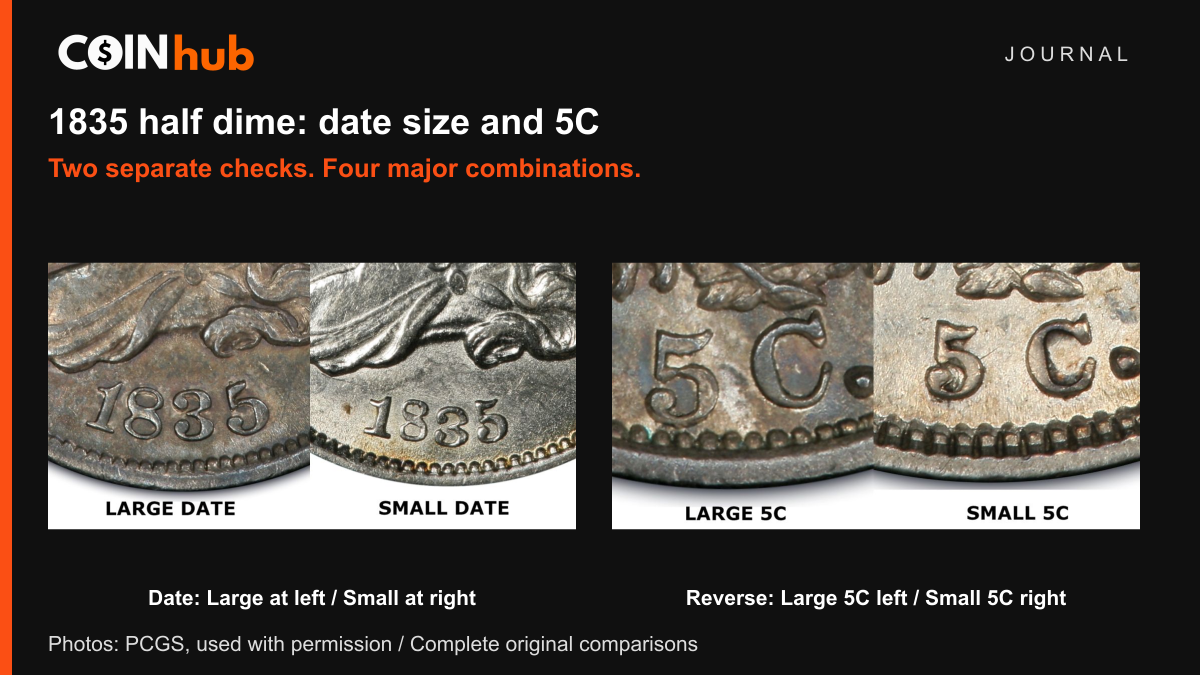
An 1835 Capped Bust half dime can have a Large or Small Date on the front and a Large or Small 5C on the back. Read those features separately. They form four major combinations, so a label saying only “Large Date” leaves part of the identification open.
The date-size photo above shows Large Date at left and Small Date at right. The second comparison shows Large 5C at left and Small 5C at right. These genuine PCGS details keep the two checks visible. A half dime has a five-cent face value; the 5C is its denomination, not a grade or a mint mark.
Start with the complete date
Find 1835 below Liberty's portrait on the obverse, or front. Compare all four numerals with a labelled reference. In the Large Date example, the numerals have a fuller, taller appearance. The Small Date example uses a more compact set. Look at the whole date rather than trying to judge one worn stroke.
Photograph the full face as well as the close-up. Keep the rim visible, with the date in the same general orientation as the reference. The two panels are enlarged details; their displayed width is not a measurement of the coin or a rule you can apply in millimeters.
Turn the coin over and compare 5C
On the reverse, or back, look below the eagle for 5 C. Compare the 5, the C and their overall layout with the denomination photo. The Large 5C reference has larger, fuller characters. The Small 5C reference has smaller characters. The size of the date does not decide which reverse you have.
PCGS's Large Date, Small 5C page provides both comparisons. Its Large Date, Large 5C page lists the four major combinations. The different punch sizes used in the dies produced these normal design varieties. A die is the metal tool that strikes the design into the coin.
| Front date | Back denomination | Major label to record |
|---|---|---|
| Large | Large 5C | Large Date, Large 5C |
| Large | Small 5C | Large Date, Small 5C |
| Small | Large 5C | Small Date, Large 5C |
| Small | Small 5C | Small Date, Small 5C |
This is a major-variety checklist, not a complete list of dies or a ranking of values. Each label needs support from both sides of the actual coin.
A broad label does not establish an LM number
A specialist listing may add an LM number for a particular combination of front and back dies. More than one detailed variety can fit the same broad date-and-denomination group. PCGS, for example, lists LM-5.1, LM-5.2 and LM-6 under Large Date, Small 5C.
Save a seller's or holder's full wording before shortening it for a collection note. Check the details needed for that specific attribution. If you have verified the two size labels but have not checked the die combination, write that limit down. It is a useful partial identification.
Handle weak details with care
Wear and a poorly lit photograph can hide the outline of a numeral or letter. Try another light direction and a sharper, square-on photograph. Keep the original images alongside the new ones so the record shows what each view supports.
Leave either field undetermined when the evidence is unclear. Do not clean the date or reverse to make the lettering stand out. Keep surface damage separate from a missing photographic detail; our Details grade guide explains why a readable design and a problem-free grade are separate matters.
Build a record that supports the next decision
- Record Capped Bust half dime and the full 1835 date.
- Save the front-date comparison and the reverse-5C comparison.
- Write each supported size label in its own field.
- Record the exact holder wording and any unresolved LM attribution.
- Assess condition and surfaces before choosing sold comparisons.
A listing for a large cent or a ten-cent dime is a different denomination, even when the year matches. Our Liberty Seated half-dime guide covers the later design; its reference photographs do not identify an 1835 Capped Bust variety.
For a value comparison, match the whole label and condition. A seller's asking price does not establish what another example sold for. Keep the source, sale date and photographs with your notes. If a costly purchase depends on a detailed attribution, have the coin examined by someone familiar with this series.
Sources checked October 12, 2026: PCGS CoinFacts 4282 and 4283, including their major and die-variety listings. Original comparison photographs: PCGS, used with permission; complete labels retained and images resized. No grade, price or authentication verdict is assigned here.