
Two nicknames, two portrait details
These are established names for design varieties. They do not mean that the Mint struck a defective coin or that the portrait was damaged after it entered circulation. The names are useful shorthand, but the metal itself must support the attribution.
Read the photograph from left to right
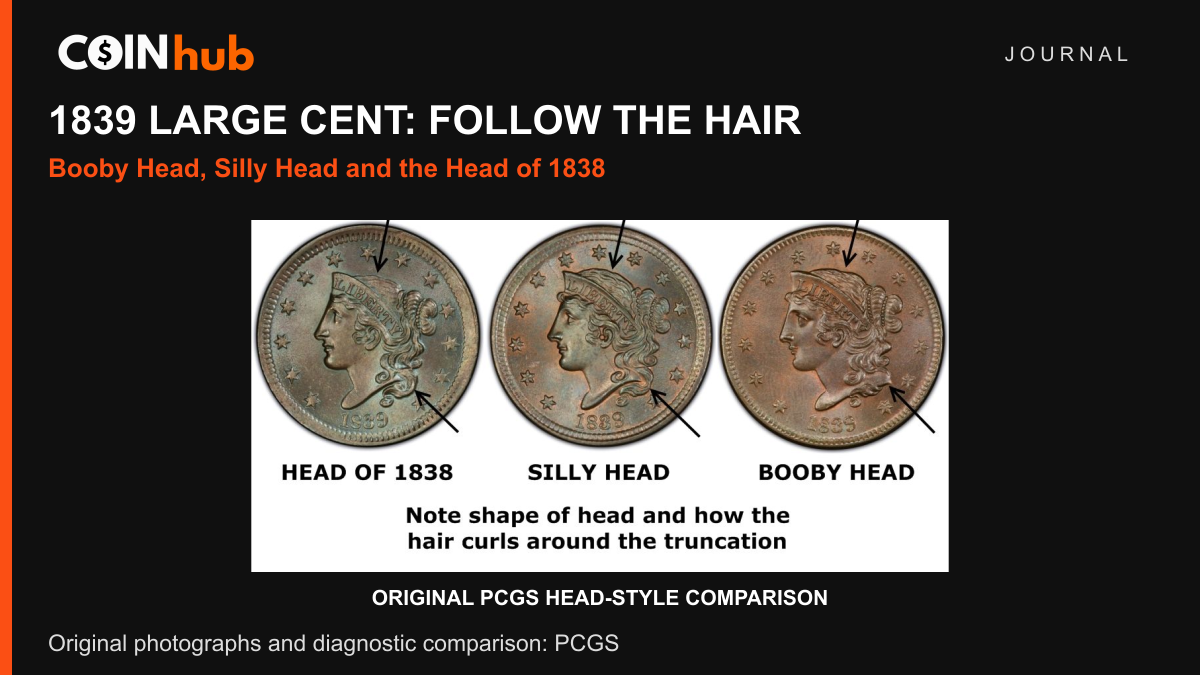
The original PCGS comparison above shows Head of 1838, Silly Head and Booby Head. All three photographed coins are dated 1839. A name containing 1838 therefore does not mean the date on that coin must read 1838.
Start with the upper arrows, which direct attention to the shape of the head and the hair above the coronet. The middle and right specimens have the projecting forehead lock. Then use the lower arrows to compare the hair where it meets the bottom of the portrait. On the right-hand Booby Head, the curl turns around the truncation, exposing the small tip.
| Check | Silly Head | Booby Head |
|---|---|---|
| Projecting forehead lock | Present | Present |
| Hair at the bust truncation | No exposed shoulder tip of the Booby Head style | Curl wraps around the truncation; tip exposed |
| What the name identifies | A major head style | A major head style |
| What still needs separate work | Die marriage, condition and authenticity | Die marriage, condition and authenticity |
The forehead curl is only the first check
NGC's Silly Head discussion identifies the projecting forehead lock as the most obvious change from the Head of 1838. That makes it a useful starting point, but it does not by itself distinguish Silly Head from Booby Head.
The second check matters because both names may be offered for a coin with a visible forehead curl. Move down to the shoulder and compare the complete curl-to-bust relationship. Avoid deciding from the general expression of Liberty's face or from how amusing the nickname sounds.
Do not force every 1839 cent into two boxes
The third specimen in an identification problem may belong to neither of the two styles you first considered. The Head of 1838 in the photograph is an immediate example. The broader 1839 series also includes other cataloged varieties; this guide compares the pictured portrait features rather than serving as a complete attribution key for the date.
Confirm the date and retain a full obverse photograph before making a close comparison. A tightly cropped hair detail can hide information needed to recognize that the original choice of categories was wrong.
Head style and die marriage answer different questions
Calling a coin Silly Head identifies its portrait style. It does not finish a specialist attribution. NGC lists two Silly Head marriages, N-4 and N-9, made with different obverse dies and a shared reverse die.
Those Newcomb numbers refer to particular die combinations. The same major head style can therefore occur on more than one die marriage. Our die-marriage guide explains why identifying the two working dies is more specific than naming a broad design variety.
When wear makes the answer uncertain
Old copper often shows wear, corrosion or marks precisely where the little hair details matter. Use moderate magnification and steady light. Rotate the lighting angle slightly to distinguish an actual edge from a shadow, but keep the coin's orientation comparable to the reference.
If the shoulder tip or surrounding curl cannot be read, describe it as uncertain. Do not scrape the area, redraw a missing feature in an edited photograph or treat a single dark pixel as proof. A clear original image is more useful than an aggressively sharpened one. See our photography guide for a simple setup.
Use the attribution to make fair comparisons
A correct head-style name helps organize a collection and narrow comparable sales. It does not establish grade, surface originality or a guaranteed premium. Compare coins with similar condition and problems, and use a specialist attribution when a claimed die marriage materially affects the purchase.
Record the date, proposed head style, visible diagnostic and any uncertainty beside your photographs. That short record gives another collector something concrete to check and keeps a colorful nickname from becoming an unsupported conclusion.
Sources: PCGS CoinFacts Booby Head and Silly Head, plus NGC Coin Explorer, reviewed September 29, 2026. The original PCGS comparison, including its labels and arrows, is preserved.