
Arrows and rays belong to the quarter's design
That matters because altered coins can mimic the scarcer issue in more than one way. Some have had design details removed. Others began as a different date. Read the entire quarter before treating a missing feature as evidence of a rarity.
Start with the denomination and both faces
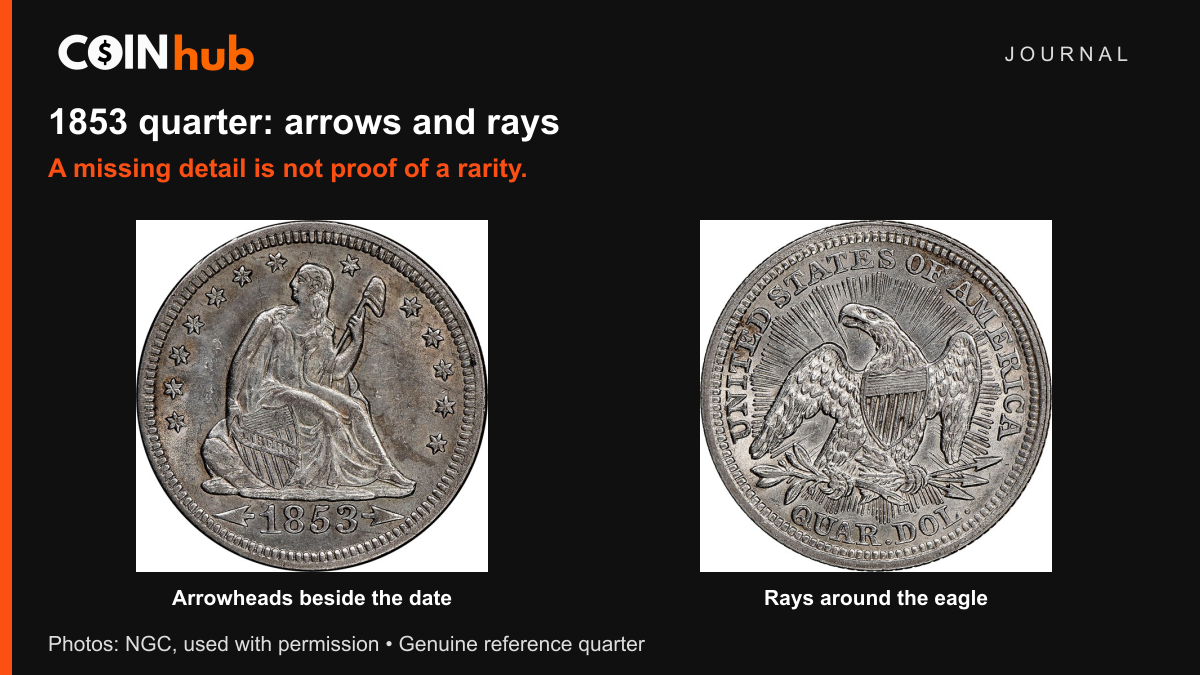
The NGC photos above show a genuine Arrows and Rays quarter. On the front, arrowheads flank 1853. On the back, rays fill the space around the eagle, and QUAR. DOL. identifies the denomination. The arrows in the eagle's grasp are separate from the arrowheads beside the date.
The 1853 half dollar also used arrows and rays. That makes the denomination a key first check. A cropped image of Liberty or the eagle is not enough to tell the quarter and half dollar apart.
Philadelphia quarters have no mint mark; New Orleans pieces have an O below the eagle on the reverse. Record the mint and date together. A seller's phrase such as “no mint mark” describes only one feature, not a special error or an automatic premium.
What changed in 1853
The Mint cut the weight to help keep silver coins in use. The new quarter standard was about 6.22 grams, compared with about 6.68 grams for the earlier issue. The alloy remained 90% silver. NGC's issue reference explains the new marks and lists the lighter standards.
Arrows and rays together make a one-year quarter type. In 1854 and 1855, the arrowheads remained but the reverse rays were gone. PCGS's type history separates those designs. Missing rays on an 1854 quarter are therefore not evidence that somebody removed them.
Alteration route one: remove the arrows and rays
In a 2019 counterfeit-detection report, NGC examined an 1853 quarter whose arrows and rays had been removed. The remaining evidence included disturbed surfaces, tooling around the eagle and a ray the alteration had not fully eliminated.
The lesson is to examine the surrounding metal, not just the empty spaces. An area that appears blank in a small listing photo may show damage under better light. Save close-ups beside the date and around the eagle, as well as full-face photos. Do not polish those areas to “check” them.
Alteration route two: change the date
NGC's June 2026 report describes a different approach. A claimed No Arrows quarter appeared to be an 1858 coin with its final digit altered to resemble a 3. Its design already lacked the earlier arrows and rays, so removing those features was unnecessary.
NGC pointed to the shape of that final digit, including missing rounded ends expected on the genuine 3. Its report also explains that the genuine 1853 No Arrows survivors come from a specific die pairing with a repunched date, where a date punch left more than one impression. The full date matters; merely finding a shape that resembles “1853” is not sufficient.
These are two described cases, not a full test you can use at home. An altered coin can differ from the pictured examples. Leave a claimed rarity unresolved if the evidence is unclear and have an expert examine the coin before relying on the label.
A useful record before making a comparison
- Transcribe the denomination, readable date and mint mark.
- Record whether arrowheads and rays are present, absent or uncertain.
- Take photos of both faces, the edge and any disturbed-looking areas.
- Keep the seller's label separate from your observations.
- Compare the exact issue and similar condition only after you identify the coin.
Weight is supporting evidence, not a verdict. Wear, damage and measuring conditions affect a reading. Do not compare a scale result with a stated standard as though it can establish whether it is genuine on its own. Our coin-weighing guide explains those limits.
Nor does “one-year type” mean every Arrows and Rays quarter is rare. Identify the issue first, then consider condition and relevant completed sales. A price paid for a genuine No Arrows quarter is not a valid comparison for an ordinary Arrows and Rays example or a coin with altered features.
References checked October 11, 2026. Genuine quarter photos: NGC, used with permission; complete photos resized in the CoinHub layout. These reference images do not show the altered specimens discussed in the linked reports and are not CoinHub inventory.