
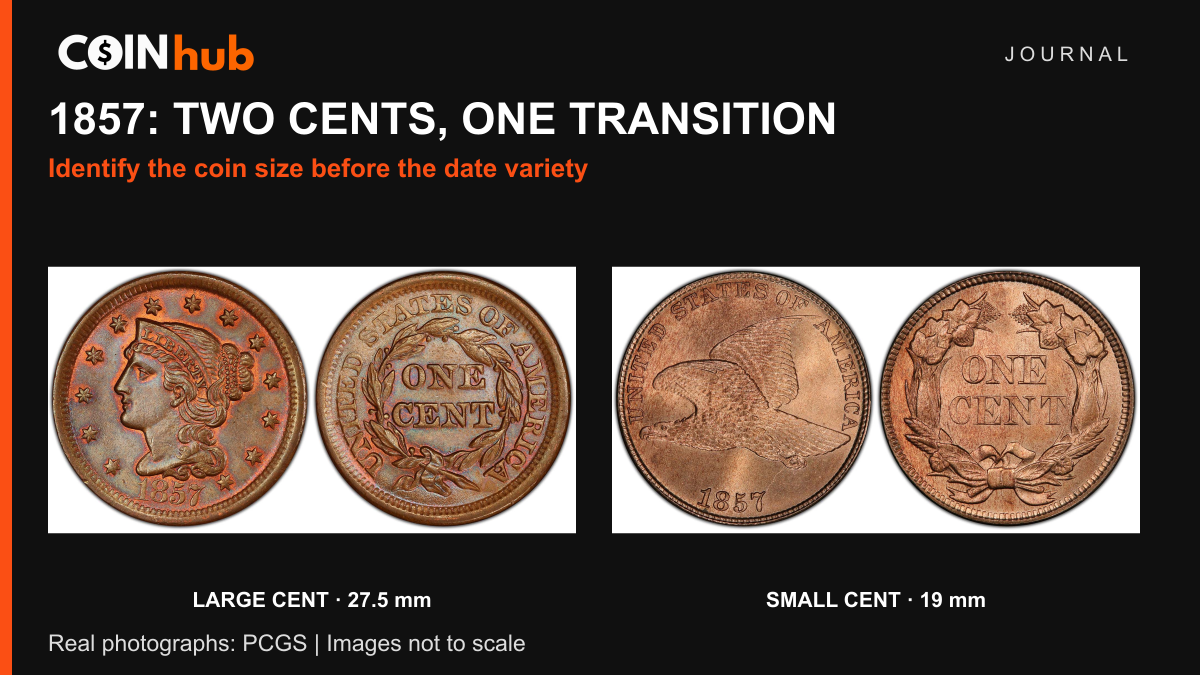
A size change you can see before reading a price guide
An 1857 cent can be a broad copper coin with Liberty's portrait or a much smaller copper-nickel coin with an eagle in flight. Both are legitimate U.S. cent types bearing the same year. For a collector sorting an inherited box or comparing auction listings, the design and physical size settle the first identification question.
Quick answer: The 1857 large cent is the Braided Hair type, approximately 27.5 mm across and 10.89 grams when made. The 1857 small cent is the Flying Eagle type, approximately 19 mm and 4.67 grams. A label saying Large Date or Small Date on an 1857 large cent describes its date numerals, not a change into the small-cent denomination format.
Compare the coin, then compare the label
| Identification point | 1857 large cent | 1857 small cent |
|---|---|---|
| Front design | Braided Hair Liberty portrait | Eagle flying across the field |
| Reverse design | ONE CENT inside a wreath | ONE CENT inside a different wreath |
| Nominal diameter | 27.5 mm | 19 mm |
| Nominal weight | 10.89 g | 4.67 g |
| Composition | Copper | 88% copper, 12% nickel |
| Place in the transition | Last dated year of the large cent | First regular circulation year of the Flying Eagle cent |
The dimensions above are specifications, not an authentication verdict. Wear, corrosion and damage can change an old coin's measured weight. A correctly sized replica can also imitate a genuine coin. Use measurements alongside design details and provenance; our coin-weighing guide explains how to record a useful reading without making weight carry the whole conclusion.
Why the Mint made two formats dated 1857
The large cent had become an awkward everyday denomination. The change authorized in February 1857 replaced that substantial copper piece with a smaller copper-nickel cent. The Flying Eagle design had already appeared on 1856 pieces associated with the proposal, but 1857 brought regular production for circulation. PCGS discusses that sequence in its history of the large-to-small-cent transition.
The date therefore sits at the junction of two collecting stories: the end of a long-running format and the introduction of its successor. That does not make every 1857 cent rare. Identify the actual issue and condition before applying any market comparison. The famous 1856 Flying Eagle belongs to a separate rarity discussion; see our 1856 Flying Eagle cent guide rather than transferring its reputation to an 1857 coin.
The Large Date and Small Date trap
Imagine two listing titles: “1857 Large Cent, Small Date” and “1857 Flying Eagle Cent.” The first still describes a large copper cent. The words after the comma narrow the date variety within that type. The second describes the physically smaller coin. Shortened listings can hide this hierarchy, particularly when a seller uses “small 1857 cent” loosely.
A reliable collection record keeps the information in separate fields: denomination, design type, date, variety and condition. For example, “U.S. one cent / Braided Hair / 1857 / Small Date” is clearer than “1857 small.” When a listing lacks a reverse photograph or a legible label, ask for those views before treating its description as complete. Photographs in our graphic are intentionally enlarged independently; they show designs, not a scale comparison.
Build a useful two-coin comparison
For a transition-year pair, start with examples whose surfaces and identity are easy to evaluate. A modest circulated pair can explain the historical change without requiring exceptional grades. Keep the original seller information and photograph both sides of each piece under comparable lighting. Record whether the large cent's date variety is verified or still undetermined.
Then write one sentence about what each coin contributes to the pair. The large cent represents the outgoing format; the Flying Eagle represents the incoming format. This keeps the project focused and prevents an unclear variety label from becoming an accidental extra purchase. Handle either coin by its edge over a soft surface, following our safe coin-handling checklist.
Questions collectors ask
Does Small Date mean Flying Eagle?
No. On an 1857 Braided Hair cent, Small Date identifies a date style within the large-cent type. Flying Eagle identifies a different design and smaller physical format.
Can color identify the two cents?
Color can support an identification but should not lead it. Toning, surface problems and photographs can change appearance. The portrait-versus-eagle design and diameter are much clearer starting points.
Which 1857 cent is worth more?
There is no sound answer from the year alone. Compare the correct type, variety, grade and surface condition using actual completed sales. An asking price for another 1857 cent is not automatically a comparable result.
Historical and specification sources: PCGS Flying Eagle history, final large-cent year and large-cent specifications. Checked September 17, 2026. This article compares types; it does not assign a grade or value to an individual coin.