
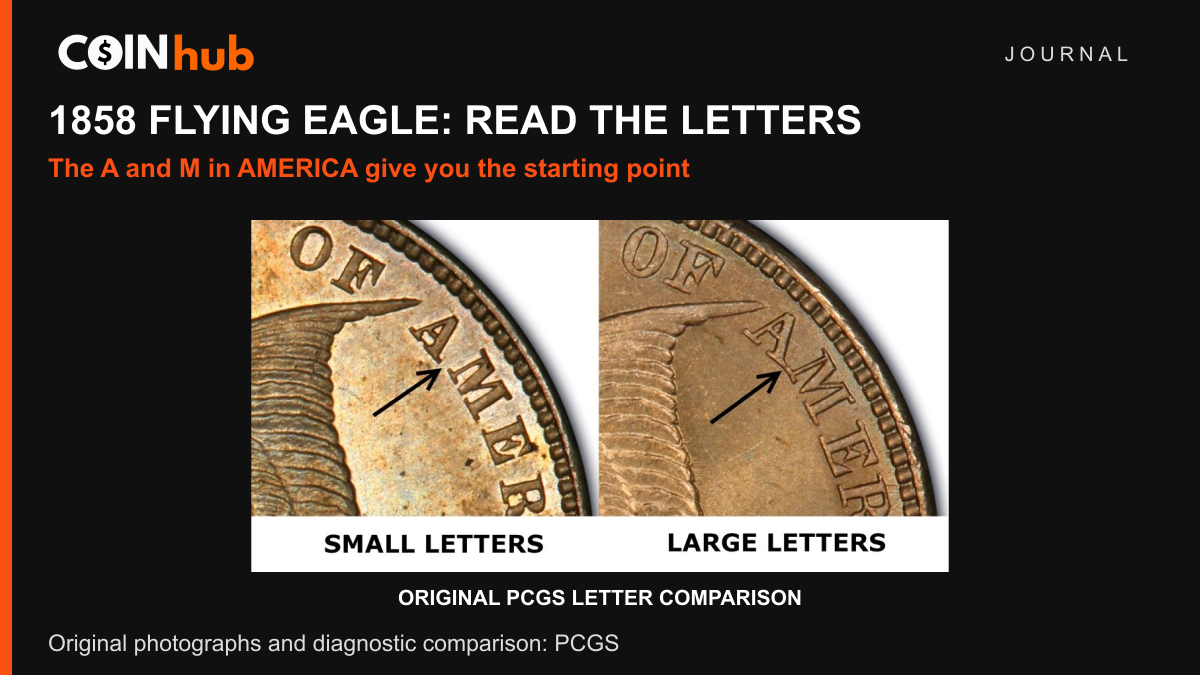
Start with two letters on the eagle side
A dealer's photograph may make every letter look large. A worn coin can make them all look small. Instead of comparing overall size by eye, choose a repeatable feature: the meeting point between the first two letters of AMERICA, on the right side of the eagle.
Read the comparison photograph
The PCGS CoinFacts comparison above places Small Letters on the left and Large Letters on the right. Follow the original arrows to the bottoms of A and M. Ignore the apparent color difference between the specimens; color is not the diagnostic.
| Check | Small Letters | Large Letters |
|---|---|---|
| AM in AMERICA | Separate bases with visible space | Bases connect |
| Where to look | Eagle side, right-hand legend | The same location |
| What the name establishes | A normal lettering variety | A normal lettering variety |
| What it does not establish | Grade, authenticity or proof status | Grade, authenticity or an overdate |
Inspect your coin without forcing an answer
First confirm that the date reads 1858. Hold an unencapsulated coin by its edge over a soft surface; leave a certified coin in its holder. Use steady light and moderate magnification. Our coin loupe guide explains a simple inspection setup.
Find AMERICA, then follow the A down to its base and the M down to its nearest foot. Compare the shapes with the supplied photograph. Move the light slightly if glare fills the gap. The useful question is whether you can actually see the two letter bases, rather than whether a dark patch looks like a connection.
If wear, corrosion, a contact mark or an out-of-focus image obscures that point, record the variety as uncertain. Do not scrape out the gap or clean the coin to expose it. A clearer photograph or an experienced in-hand opinion is a better next step than a confident label built on an unreadable feature.
Large Letters does not mean large cent
Both letter styles belong to the small-cent Flying Eagle design. PCGS lists the regular 1858 issue at 19 millimeters and 4.70 grams, with an alloy of 88% copper and 12% nickel. Those specifications describe the issue, not a guarantee that any coin matching them is authentic.
The 1857 large-cent versus small-cent comparison concerns two visibly different coin types. For 1858 letter attribution, putting a ruler beside the coin will not answer the AM question. Likewise, the size of ONE CENT on the reverse is not the starting diagnostic shown here.
Keep overdates and proofs separate
PCGS lists Small Letters separately from Large Letters and the 1858/7 overdate. Seeing joined AM bases does not by itself identify an overdate; that is an additional attribution requiring its own diagnostics.
Proof manufacture is another question. PCGS's discussion of Flying Eagle proofs includes both 1858 lettering styles. Neither a separated AM nor bright surfaces proves that a coin is a proof. Avoid adding that claim to a sale description without suitable attribution.
Make the next comparison a fair one
Once the lettering is established, compare coins with the same attribution and similar condition. A cleanly photographed high-grade specimen is useful for learning the letters, but its auction result does not price a worn or damaged coin. Asking prices are also different from completed sales.
Save a full obverse image, a full reverse image and a sharp close view of AM. Write down what is visible and what remains uncertain. That small record makes it easier to ask a useful question, check a seller's description or decide whether specialist attribution is warranted.
Identification references: PCGS CoinFacts and its Flying Eagle proof discussion, accessed September 28, 2026. The photograph illustrates the lettering diagnostic; it does not authenticate an unexamined coin.