
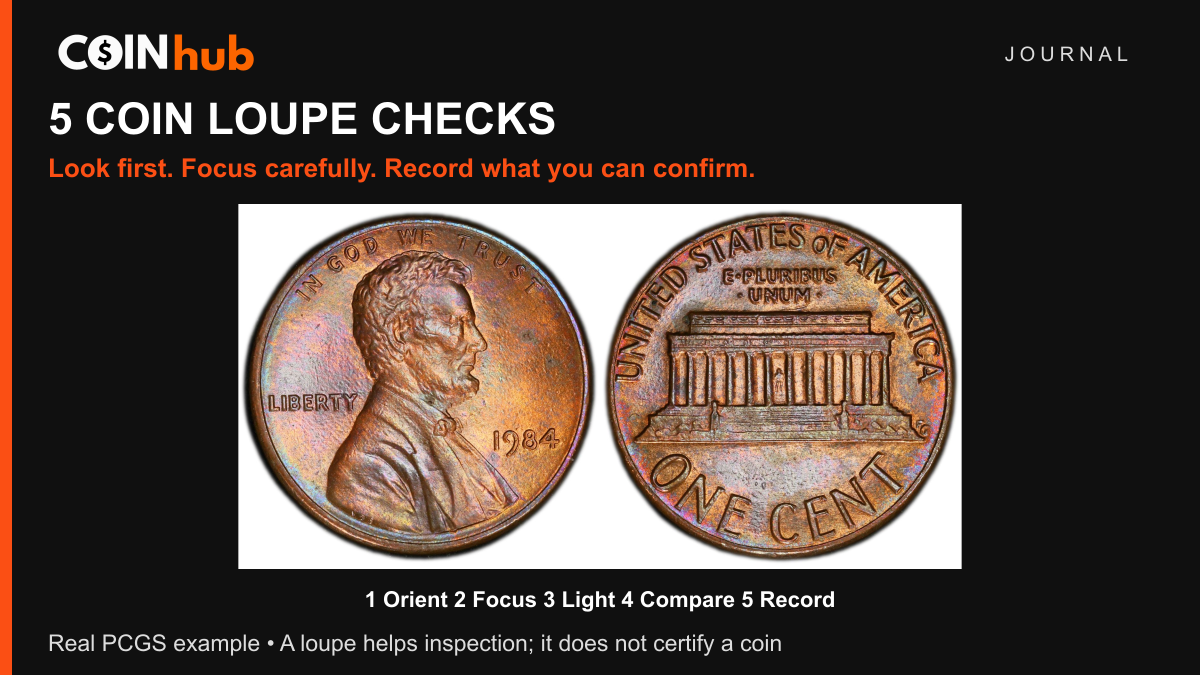
A five-check routine for turning a closer look into useful evidence
To use a coin loupe, bring the lens close to your eye and move the coin until the detail comes into focus. The harder part is deciding what that detail actually tells you. A repeatable routine helps you inspect the whole coin, keep glare under control and record an observation without jumping to a grade or variety name.
Start here: Use a modest power for the overall inspection and a closer view for a specific question. PCGS grader Steve Feltner describes 5x to 10x as common working magnification in Tools of a Professional Coin Grader. The strongest lens is not automatically the most useful one.
1. Orient yourself before using the lens
Set the coin over a clean, stable work area. Look at both sides without magnification, then write down its date, denomination and visible mintmark. Note whether it is loose or inside a holder. Keep an encapsulated coin in its holder; opening it is not part of a loupe check. For a loose coin, follow our coin-handling guide and avoid touching the faces.
Choose a question before zooming in: “Can I read this date digit?” is useful. “Can I find something valuable?” is too broad. The first question directs attention to a feature that can be recorded and compared. The second makes any unfamiliar mark feel like a discovery.
Pass this check when: you can identify the area you intend to examine and can hold the coin securely without reaching across its surface.
2. Establish a sharp, steady view
Bring the loupe toward your eye instead of holding it at arm's length. Keep it steady and adjust the coin-to-lens distance until a known feature, such as a date digit, becomes sharp. Work over your prepared surface. Do not press the glass against the coin or holder to steady it.
Start with 5x if available. Use 10x when the question requires a closer view and you can keep the image stable. If the detail remains blurred, pause and correct the viewing setup before making a judgment. More magnification cannot turn a poorly focused image into reliable evidence.
Pass this check when: the same known feature stays clear long enough to describe. If your hands or eyes tire, take a break; an uncertain view belongs in your notes as uncertain.
3. Test the light before judging the surface
Keep a manageable light source steady and slowly tilt or rotate the coin. Observe the same area at more than one angle. PCGS's professional-grader guidance emphasizes controlled lighting and rotation because a single fixed view can leave important surface information hard to see.
For a holdered coin, ask whether a line is on the plastic or appears on the coin beneath it. Refocus and change the angle without opening the holder. If you cannot separate the two, record that limitation rather than deciding it is a scratch on the coin.
Do not wipe a hazy surface to improve the view. If a feature raises a cleaning question, compare it with the distinctions in die polish lines versus cleaning hairlines. One bright line seen at one angle is a reason to investigate, not a complete diagnosis.
Pass this check when: you have examined the concern from several angles and can say what remains visible, what changes with glare and what you still cannot resolve.
4. Compare the specific feature with a suitable reference
Return to your original question. A suspected variety should be compared with the same issue and the relevant diagnostic area. The PCGS photograph in this article shows an attributed 1984 doubled-die obverse Lincoln cent. It illustrates why examining a particular part of the design matters; it does not establish the identity of another 1984 cent.
For that variety, use our separate 1984 doubled-ear identification guide. For general condition comparisons, PCGS Photograde provides approximate visual grade references. Keep a reference comparison separate from certification.
Also separate questions about sharpness from questions about wear. If a high point looks flat, our weak strike versus wear guide supplies the next focused investigation. A loupe makes the feature easier to examine; it does not decide which explanation is correct.
Pass this check when: you have either matched the relevant evidence or clearly identified the extra view or expert examination needed.
5. Record an observation you can reproduce
Make a note that another collector could follow: “Obverse, below the date; short line visible at 5x and 10x under two angles of light” is more useful than “possible rare error.” Add the date of inspection, the power used, whether the coin was in a holder and a link to the reference you compared.
A simple record has four fields: coin identity, exact location, observed feature, next check. Keep your conclusion separate. You might write “attribution unresolved” while still having a valuable record of the observation.
If photographs will help, capture both complete sides before trying a detail image. Our coin-photography guide explains how to document the coin without altering it. Preserve an unedited original so a reviewer can assess the image in context.
Quick troubleshooting at the desk
| Problem | Next check | Hold off on |
|---|---|---|
| The date never comes into focus. | Steady the lens and change the coin-to-lens distance. | Calling the digit missing or altered. |
| A bright patch hides the feature. | Change the viewing angle while keeping the light stable. | Judging the hidden surface. |
| A line may be on the holder. | Refocus and compare multiple angles through the plastic. | Opening the slab for a closer look. |
| The detail resembles a reference only vaguely. | Record the mismatch and seek a sharper comparison. | Naming the variety from resemblance alone. |
Does a coin loupe establish a grade or prove authenticity?
No. It is an inspection tool. NGC's grading scale uses 5x in its definition of a 70-grade coin, but that does not turn every at-home 5x examination into a grading decision. A tiny visible feature also does not, by itself, establish a mint error or a problem designation.
Finish the session with a clear record and a proportionate next step. Sometimes that is another photograph; sometimes it is a specialist's opinion. If the setup cannot answer the question reliably, preserve the coin and the uncertainty rather than forcing a conclusion.
Sources checked September 17, 2026: PCGS's professional-grader tools article, PCGS Photograde and CoinFacts, and NGC's grading scale, linked above. The five-check routine and troubleshooting table are CoinHub's educational workflow, not grading-service certification standards.