
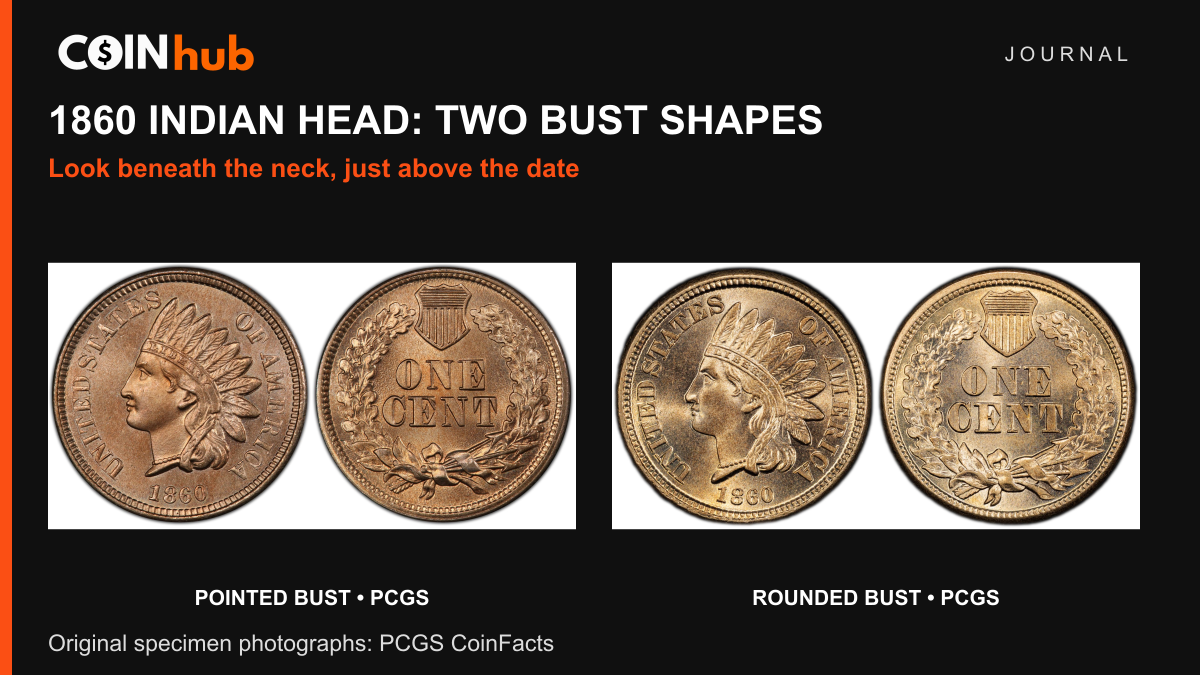
Find the lower tip of the portrait
Both are normal design varieties of the same year's cent. A pointed outline is not a broken die, and a rounded outline is not automatically evidence that someone altered the coin. The task is to compare the shape made by the dies with a clearly attributed example.
Use the obverse, not the wreath
Turn to the side with Liberty wearing a feathered headdress. Find 1860, then move upward to the short projection at the bottom of the portrait. This is the end of the bust, sometimes called its truncation. Follow its upper and lower edges rather than judging one bright highlight.
In the photograph above, the Pointed Bust specimen is on the left and the Rounded Bust specimen is on the right. Each panel shows both sides of its coin; use the portrait side within that panel. The reverse wreath and shield help orient the coin, but the bust diagnostic is on the other side. Open the linked PCGS Pointed Bust reference for a larger specimen view.
| Feature | Pointed Bust | Rounded Bust |
|---|---|---|
| Base beneath the neck | Slender projection with a sharper end | Broader projection with a rounded end |
| Alternative name | Pointed Bust | Broad Bust |
| Where to compare | Portrait side, above the date | The same location |
| What does not decide it | Coin color or reverse lettering | Coin color or reverse lettering |
Why two shapes appear in 1860
PCGS explains that the Pointed Bust continued the style used in 1859. During 1860, the Mint modified the lower portion of the portrait, producing the thicker Rounded Bust. The date therefore bridges two obverse styles.
This is a separate question from the reverse change between the 1859 laurel-wreath cent and later Indian Head cents. A person can correctly recognize the 1860 reverse and still need to examine the obverse to assign the bust variety. Keeping the two questions separate prevents a useful type feature from being mistaken for the finer diagnostic.
Inspect a worn coin carefully
Use steady light and moderate magnification. Leave a certified coin in its holder; handle a loose coin by its edge over a soft surface. Compare photographs at similar orientation and scale. A dramatic tilt can make a narrow feature look broader than it is.
Look for a continuous outline. Wear may soften the point, while corrosion, dirt or a contact mark can interrupt either edge. A dark patch beneath the bust does not necessarily describe the shape of the metal. If the necessary edges are missing, record the attribution as uncertain instead of forcing the coin into one category.
Do not scrape around the tip or polish the surface to make the outline clearer. A sharper photograph is the useful next step. Our coin photography guide explains how to document a coin without changing it.
Keep annual mintage separate from variety estimates
The 20,566,000 figure listed by PCGS is the total mintage for 1860 cents. It is not a production count for Pointed Bust cents alone. PCGS explicitly states that the exact Pointed Bust mintage is unknown.
Its historical discussion cites researcher Rick Snow's estimate that Pointed Busts represented about 5% of the year's production, based on research reported as of 2014. That is an attributed estimate, not a Mint accounting total. Turning it into a precise number of surviving coins would add another unsupported assumption.
Identify the variety before comparing sales
PCGS describes Pointed Bust cents as scarcer, but the name alone cannot price a specimen. Compare the same attribution, similar wear and similar surface quality. Corrosion, cleaning and other damage can make a visibly sharper coin a poor comparison for an undamaged example.
Save full photographs of both sides and a clear view of the bust base. Keep the seller's attribution separate from your own observations. If the feature is unclear or the purchase depends on a substantial variety premium, seek an experienced in-hand attribution before relying on the label.
Sources and photographs: PCGS CoinFacts entries for the 1860 Pointed Bust and regular 1860 cent, reviewed September 29, 2026. Original specimen photographs are reproduced unretouched in a CoinHub layout.