
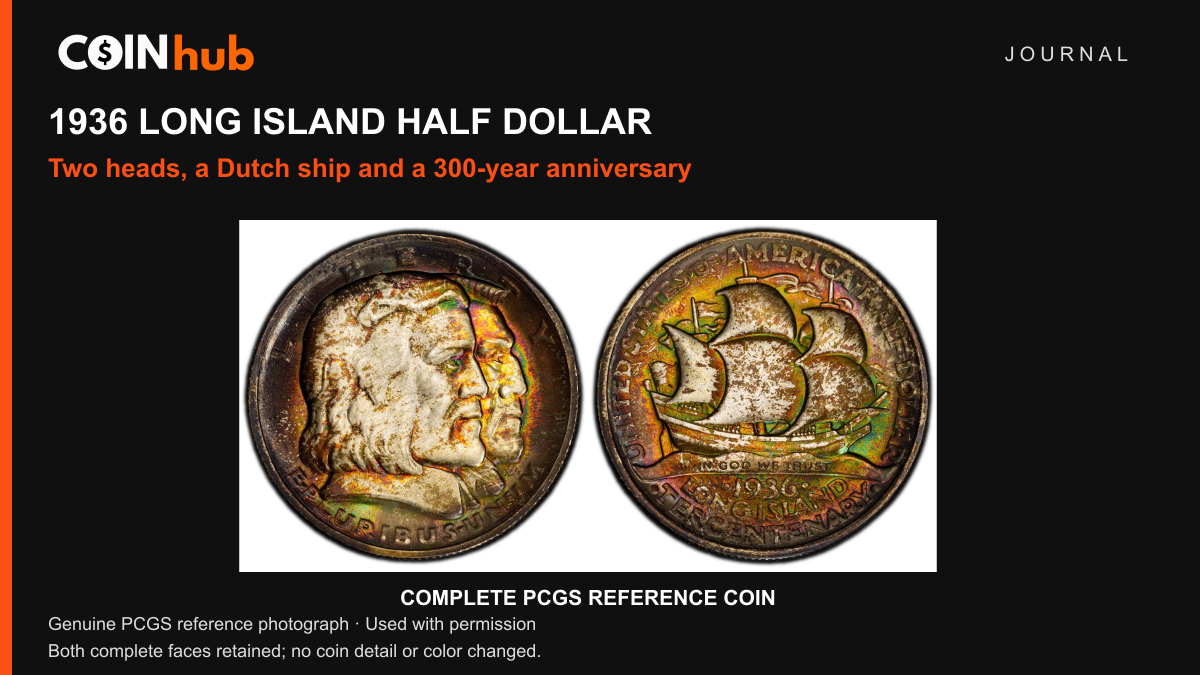
The 1936 Long Island half dollar has two heads facing right on the front. A sailing ship fills the back. The words LONG ISLAND TERCENTENARY identify the event. Tercentenary means a 300th anniversary, here marking the history of European settlement on Long Island.
The U.S. Mint's issue record names Howard K. Weinman as the designer of both faces. He was the son of Adolph A. Weinman, who designed the Walking Liberty half dollar. Shared family names do not make the two coins the same design.
Read the paired heads with care
The obverse, or front, places an Indigenous man's head in front of an early European settler's head. Both face right. The American Numismatic Association's account identifies them as an Algonquin Native American and a Dutch settler.
LIBERTY runs above them. E PLURIBUS UNUM appears below the portraits. Look for the small designer's initials beside the portraits. An artist's initials identify the designer; they should not be read as a mint mark.
The paired portraits are a useful first clue in a small photograph. Other commemorative half dollars show a lone portrait, a family or a building. Read the complete coin before relying on a seller's short title.
The ship side carries the date and the name
The reverse, or back, shows a three-masted Dutch ship under full sail. The ship faces right. UNITED STATES OF AMERICA arcs around the top, and HALF DOLLAR gives the denomination at the bottom. Denomination means the coin's face value.
Find IN GOD WE TRUST on the ribbon below the ship, with 1936 beneath the ribbon. LONG ISLAND TERCENTENARY follows the lower curve above HALF DOLLAR. The island's name is a stronger identifier than the ship alone.
For comparison, the Delaware half dollar has a ship on one face and a church on the other. The Pilgrim half dollar pairs a ship with a different portrait and inscriptions. Match both faces and all visible dates before choosing a reference.
What the 300-year anniversary means
The coin honors the 300th anniversary of European settlement on Long Island. Its 1936 issue year marks that celebration. It does not date the creation of the island or the start of human life there.
The Indigenous portrait is part of the design's historical theme. A commemoration of European settlement should not be described as the first time people lived on the island. Keep the event's specific meaning when writing a collection label.
A commemorative is a coin made to honor a person, place or event. HALF DOLLAR still identifies a United States coin, rather than a private souvenir medal. That wording alone does not authenticate an example or set its current collector price.
Record the type before judging the condition
PCGS lists Philadelphia production, a nominal weight of 12.50 grams and a diameter of 30.60 millimeters. The edge is reeded, with small ridges. The metal is 90% silver and 10% copper. Nominal means a published reference measurement.
Keep clear photographs of both faces and the edge. Note the paired heads, the ship, the island name and the date. These checks help describe the type. They do not prove a coin is real. Tools, wear and damage can affect a reading.
Inspect the faces, open areas and fine sail detail in person when possible. Color and lighting in one photograph cannot settle a grade. If the coin is in a certified holder, check its number with the grading service and retain the full record.
For a price comparison, use completed sales of the same issue in similar condition. A retail asking price, an exceptional auction result or a replica listing answers a different question. Keep the coin as found rather than cleaning it to resemble a bright reference.
U.S. Mint, ANA and PCGS references checked November 6, 2026. No current price, survival estimate or reader-coin grade is assigned. Genuine PCGS reference photograph used with permission; both complete faces and their original detail and color are retained within CoinHub's framing.