
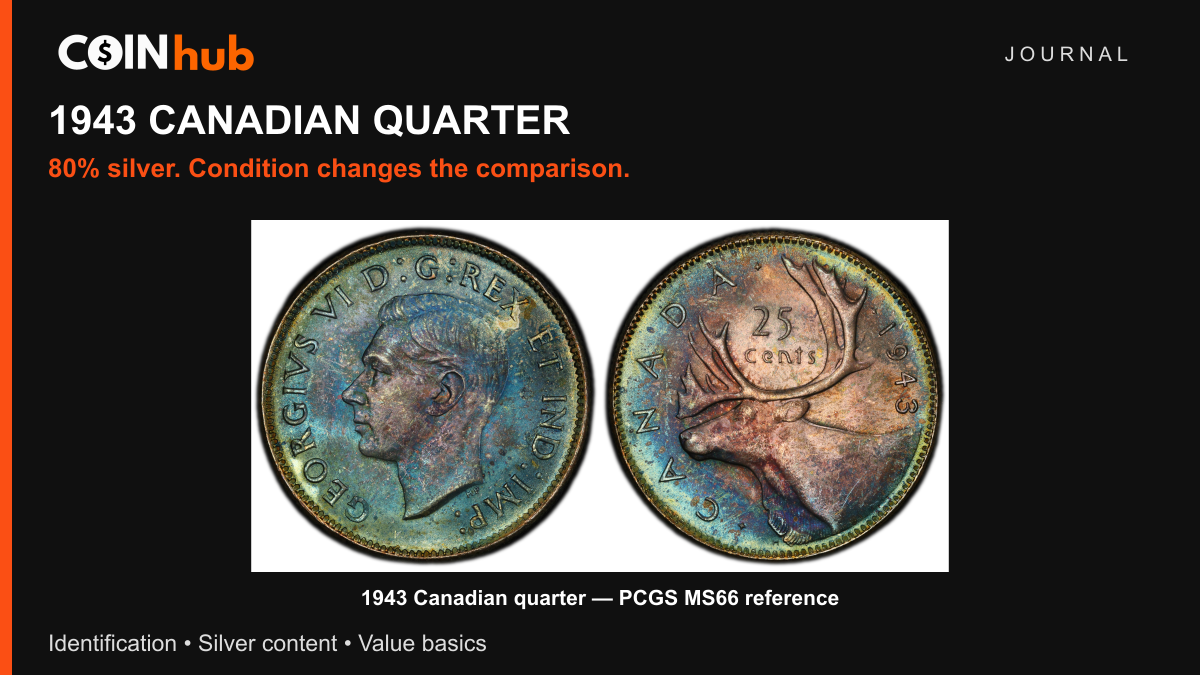
A normal 1943 Canadian quarter is 80% silver and contains about 0.15 troy ounce of silver at its original weight. It shows King George VI on one side and a caribou on the other. Its value depends on more than the date: silver content provides a calculation starting point, while condition and comparable sales determine whether a collector premium is justified.
If you found one in a mixed collection, keep it separate from ordinary modern change. You do not need a price chart to make the first useful decisions: identify the country and denomination, leave the surfaces alone, and document both sides before comparing prices.
Confirm that it is the Canadian quarter
Look for CANADA, the denomination 25 CENTS and the date 1943 on the caribou side. The portrait side names George VI. The photograph above shows a genuine example cataloged by PCGS as MS66; it illustrates the design, not the condition or value of your coin.
A 1943 U.S. Washington quarter is a different coin. A listing that says only “1943 quarter” may refer to either country. Match the design and country before borrowing a price, a grading example or an error attribution. In particular, a Washington-quarter variety number does not identify a variety on a Canadian caribou quarter.
| Reference | 1943 Canadian circulation quarter |
|---|---|
| Composition | 80% silver, 20% copper |
| Reference weight | About 5.83 grams |
| Silver content | About 0.15 troy ounce at reference weight |
| Mintage | 13,559,575 |
| Designers | T. H. Paget: George VI portrait; Emanuel Hahn: caribou |
The Royal Canadian Mint's quarter history gives the 1943 mintage and the period's 80% silver composition. NGC's KM35 reference lists 5.8320 grams and 0.15 troy ounce of silver. Small rounding differences between references are not a reason to label a coin an error.
Reference weight is not an authentication verdict. Wear can remove metal, and a household scale may not be precise enough to support a close comparison. Likewise, failing to stick to a magnet does not prove that an object is silver: other metals can behave that way. A questionable coin needs a broader examination.
Calculate the silver component in the right currency
For a normal full-weight example, multiply approximately 0.15 by the silver price per troy ounce. Use a silver quote and a result expressed in the same currency. Canadian dollars and U.S. dollars are not interchangeable merely because both prices begin with a dollar sign.
Approximate silver value = 0.15 × silver price per troy ounce
At a hypothetical US$40 per troy ounce: 0.15 × US$40 = US$6.
At a hypothetical C$60 per troy ounce: 0.15 × C$60 = C$9.
Those are separate arithmetic examples, not current market quotations or an exchange-rate conversion. They estimate the silver component only. Wear, testing, the size of a transaction and a buyer's margin can affect a real offer. Calculated metal value is not a guaranteed cash minimum.
If you are sorting other Canadian denominations or transition dates, use the Canadian silver coin date guide. A 1943 quarter does not have the same composition question as a 1967 or 1968 quarter, and a U.S. 90% silver calculator preset is not the correct substitute for this Canadian 80% issue.
Decide which prices are meaningful for your coin
The most useful comparison is a completed sale of the same date, country, denomination and similar condition. A seller's ambitious asking price only tells you what that seller wants. A price guide is a reference estimate, and an auction result describes one transaction on one date.
Record the grading service and grade when they are given. A certified Mint State coin should not be used as a direct price comparison for a worn, raw coin with uncertain surfaces. An unusually attractive example may also sell differently from another coin carrying the same numerical grade.
Before relying on a sold result, check its currency, sale date and whether the figure includes the buyer's premium. Shipping and taxes may be separate. For example, Heritage's April 23, 2018 lot 32565 identifies a 1943 quarter graded MS66 by ICCS. That historical, high-grade sale is not an appraisal of a circulated coin found today.
Rather than forcing every coin into a single dollar range, first decide which comparison group fits: ordinary circulated silver, an apparently unworn collectible, or a coin needing authentication or surface review. Then gather several recent, genuinely comparable completed sales. Keep any uncertainty in your notes.
Preserve the surfaces before seeking a grade
Handle the quarter by its edge over a soft surface. Do not polish it to make the design clearer or remove toning before photographing it. A brighter appearance does not establish a higher grade, and cleaning can damage surfaces that collectors examine.
Take straight-on photographs of both sides under consistent light, followed by an edge view and close-ups of any feature that concerns you. Record the weight only if you have a suitable scale. Avoid deciding on a precise grade from a single flattering photograph; wear, luster, marks and strike all need context.
If the coin appears unusually well preserved, seek an experienced dealer's opinion before paying grading and shipping fees. Ask what the evaluation would resolve and whether the likely benefit justifies its cost. An old date or a large online asking price alone is not enough.
Keep evidence with the correct coin
Use a separate record for this quarter with country, denomination, date, photographs, any certification number and the source of each price comparison. Distinguish a metal calculation from a dealer offer and a completed sale. CoinHub's collection-records checklist gives a practical way to keep those details together.
The useful next step is simple: confirm the Canadian design, calculate the silver component in one currency, and judge any additional premium from the coin's condition and documented comparable sales. Leave the surfaces intact while you do it.
Reference facts checked September 29, 2026 against the Royal Canadian Mint and NGC pages linked above. The historical Heritage lot supplies an example of a clearly identified, dated sale, not a current value range. Pricing comparisons and the hypothetical calculations are CoinHub's explanation.
Header photograph courtesy PCGS, showing a genuine 1943 Canadian quarter cataloged as MS66. Used under CoinHub's standing permission; resized in a CoinHub Journal layout with specimen details unchanged. The pictured coin is not the Heritage lot discussed above.