
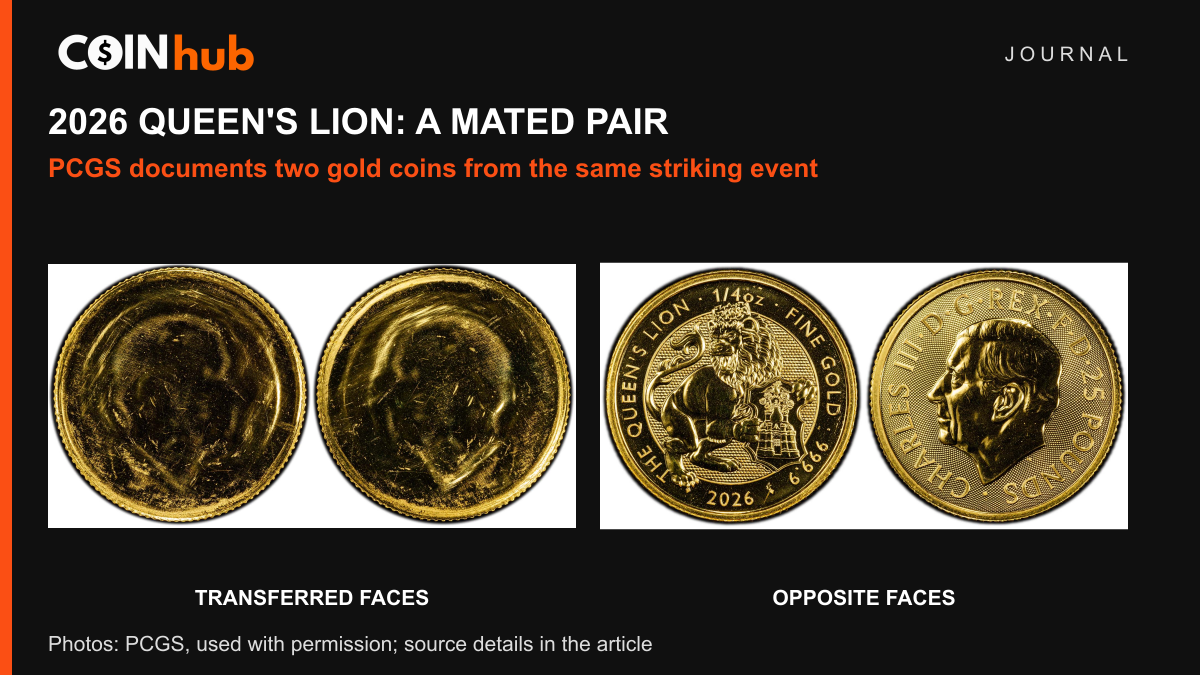
PCGS has reported a mated pair of 2026 Queen's Lion gold coins from Great Britain. Its October 13 account describes two blanks that entered the press together and left with odd transferred designs. The two pieces were later graded and placed together in a dual holder.
The coins are the £25 issue. The pictured normal faces show the Queen's Lion, King Charles III and the quarter-ounce inscription. They are not the one-ounce £100 coins that often appear beside this story in search results.
What PCGS says happened in Paris
In Jay Turner's PCGS report, staff at the Paris office noticed the pair among coins submitted in their original rolls. The report says two planchets, or prepared metal blanks, were struck together instead of one.
PCGS describes one piece as having the obverse, or front, and a brockage on its other face. It describes the second as having the reverse, or back, and a counterbrockage. The report's photo caption identifies the pair as PCGS MS69. That grade belongs to these documented pieces; it does not grade another coin from the same issue.
The owner agreed to a holder that keeps both pieces together. Keeping that link matters here. The story concerns two partners from one striking event, rather than two unrelated odd coins placed side by side.
Read all four faces in the photos
The left photo pair shows the unusual transferred faces. In the right pair, the lion and the king's portrait are easy to see. These are different views of the same two-piece error, not four separate discoveries.
A brockage is a recessed, reversed copy of a design transferred by another struck coin. A counterbrockage involves a further transfer that produces a raised design. Our counterbrockage guide explains that distinction with a separate documented specimen.
Keep the source's notes with its photos. Bright gold surfaces, glare and shallow transferred details can be hard to read in a small image. A clear photo is useful evidence, but it does not show every move inside the press.
A mated pair need not remain joined
Error-Ref distinguishes a mated pair from a matched pair. A genuine mated pair shares a striking event. Two errors that merely look as though they fit together do not prove they were struck together.
A bonded pair is another description: the pieces remain joined by striking pressure. This PCGS report describes a mated pair kept together in a dual holder. Do not replace that wording with “two coins fused together.” Our bonded-pair explanation compares those terms.
October 13 is the report date
PCGS had also publicized the pair before this web report. The October 13 byline therefore does not establish that staff discovered it that day. The report names a Paris show. It does not give the exact day of the find.
The coins' 2026 date, the discovery, earlier publicity and the web report are separate events. Keeping them separate gives the story a useful timeline without turning a current report into a claim of a brand-new find that morning.
What the account does not price
The report gives no realized sale price for this pair. A dealer's price for an ordinary Queen's Lion coin is not the value of the error, and a price for another mated pair is not a direct comparison.
For a possible error in your own collection, preserve both-face photos, holder wording and where each claim came from. Leave a certified holder sealed. Do not force pieces together or alter a surface to imitate the pictured effect. An error specialist must assess the actual object when its origin matters.
For general background, Blake Alma's The CoinHub: An Ultimate Guide to Coin Errors is an optional next read. Blake is the author of this CoinHub book; the primary PCGS report remains the source for this specific pair.
Primary report and photos reviewed October 14, 2026. Photographs: PCGS, used with permission; complete images resized in the CoinHub layout. Reference specimens are not CoinHub inventory.