
What makes two coins a bonded pair?
A planchet is the prepared metal disc that enters the coin press. If metal remains in the striking area while another piece arrives, the next strike can press them together. In a bonded error, that pressure leaves the pieces joined. The key question is how the join formed, not just whether the object looks unusual.
Error-Ref's specialist definition includes combinations of already-struck coins and planchets. More than two pieces can form a bonded pile-up. Count of pieces, count of strikes and count of visible design impressions are different facts; one should not be guessed from another.
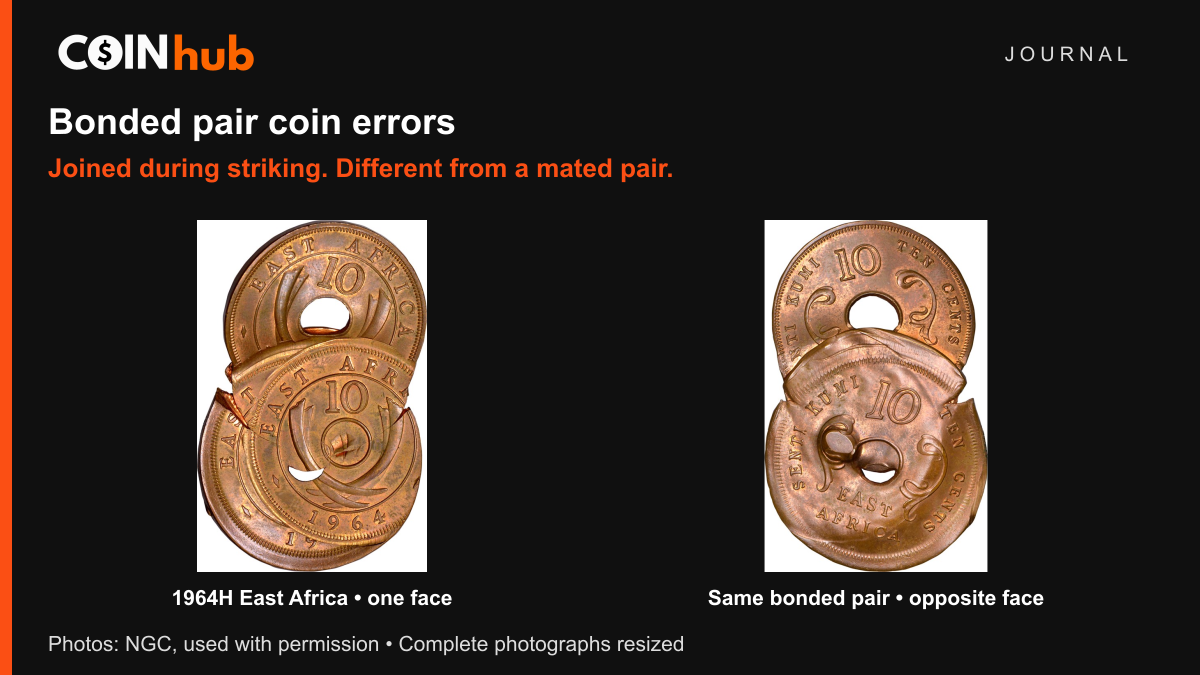
Read the pictured error before naming the parts
The photos show opposite faces of the same 1964H East Africa ten-cent bonded pair described by NGC. NGC identifies it as struck three times and grades it MS 64 RB. Those details describe this specimen only. They do not grade or name the error on another pair.
Look at the repeated lettering, overlapping outlines and displaced holes in the photos. Several impressions are visible, but the source identifies a pair, not three separate coins. This is a useful example of why counting circular shapes in a photo can give the wrong answer.
NGC explains one route to this result: an ejection or feeding problem leaves a struck piece in the press when another planchet enters. Further striking can crush and join them. The pictured object preserves a complicated result; a single front view does not explain every movement it made.
Bonded, mated and matched do not mean the same thing
For a mated pair, the relationship between two separate pieces is the key. The evidence must link them to the same strike. Error-Ref distinguishes a genuine mated pair from a merely matched pair: two errors that look as if they fit are not necessarily partners from the same press event.
- Bonded pair: The pieces remain joined as a result of striking pressure.
- Mated pair: Separate pieces can be linked to the same striking event.
- Matched pieces: A visual fit alone does not establish that shared origin.
- Later join: Glue, solder or another after-mint joining method is not a bonded mint error.
Other error terms describe different evidence. A brockage involves a recessed, reversed design transferred by a struck coin. An indent involves a planchet impression. Neither word by itself says that two pieces remain bonded together.
Keep the join intact while recording it
Do not pull, pry, heat or soak the pieces to see whether they separate. That would change the piece you are trying to study. Set it on a stable surface and take photos of both outer faces. Add side views showing the join and the full thickness, without forcing it into a flat position.
Keep two notes: what you can see and what someone has claimed. “Two overlapping discs; repeated date digits; edge views saved” is an observation. “Bonded pair struck three times” is a label that needs evidence. A seller's label should not silently become your own finding.
Ask an error specialist to assess the complete object if the cause remains unclear. Photos may not reveal the material at the join, the sequence of strikes or later work. A dramatic shape is a reason to look closer, not proof of a mint origin.
Identify the error before comparing prices
There is no single bonded-pair price. The denomination, error combination, condition and quality of the label all affect a useful comparison. A sale for a different pair cannot value an unidentified object. Preserve the exact description, sale date and fee terms when recording a comparable result.
For broader background, Blake Alma's The CoinHub: An Ultimate Guide to Coin Errors is an optional next read. Blake is the book's author. Use a general guide to learn the vocabulary, then let the evidence from the actual coin support the answer.
References checked October 11, 2026. Photos: NGC, used with permission; complete photos resized in the CoinHub layout. The pictured error is a reference specimen, not CoinHub inventory.