
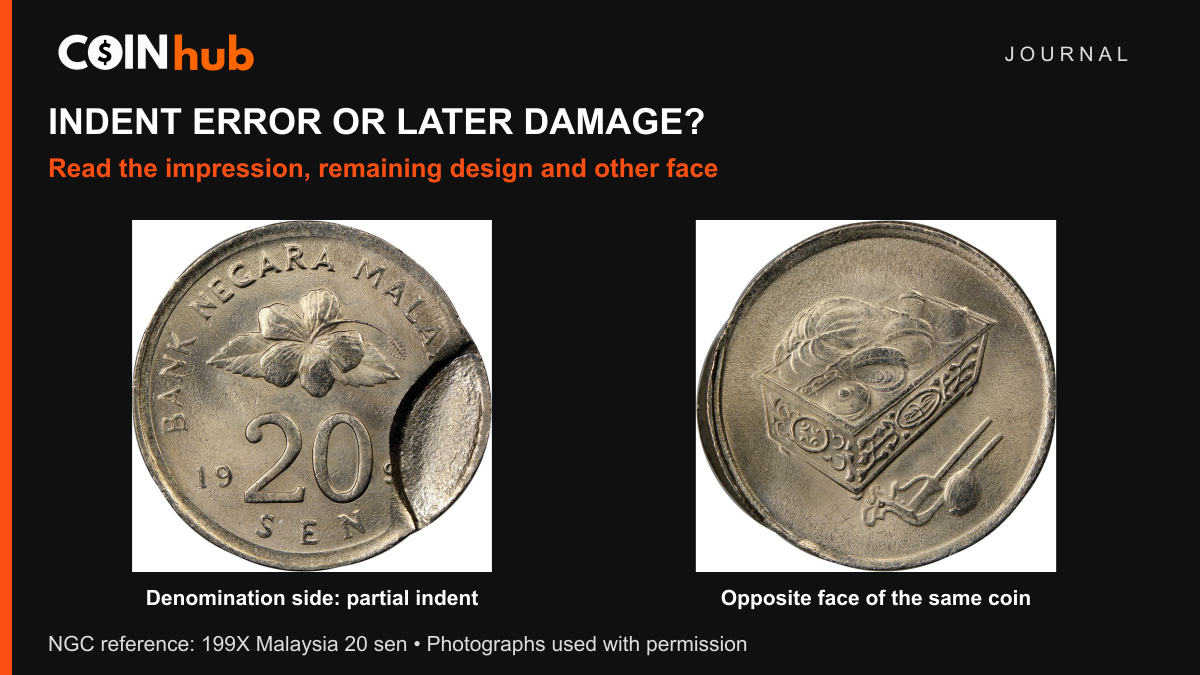
A curved depression needs a minting explanation
In error collecting, “indent” has a narrower meaning than “dent.” It names a particular event in the press. A planchet is the prepared metal disc intended to become a coin. When another one gets in the way, it can block part of the die and leave its own impression instead.
The first task is to describe the whole coin. Do not start with the assumption that every rounded hollow was made at the Mint. A sound explanation must explain the hollow, the parts of the design that remain and the other face together.
Read the documented example from both sides
The photographs above show an NGC-certified Malaysian 20-sen coin described as a 199X reverse indent, graded MS 66. The final date digit is not supplied by the source. On the denomination side, a large curved impression interrupts the right-hand edge of the design. The opposite face retains its original design.
Keep that description with this pictured coin. It does not establish the date, grade or error of another coin. The example also shows why a close-up of just the hollow does not tell the whole story: the remaining lettering, rim and opposite face help explain what happened.
What another planchet does during the strike
In the basic partial-overlap case, the dies reach the exposed portions of the metal. Where the extra planchet gets in the way, the normal design cannot form in the same way. The result depends on where the pieces overlap. PCGS describes this two-planchet interaction in its discussion of early-cent minting errors.
An indent need not be an isolated error. A coin can move and receive another strike. Error-Ref illustrates a 2001 cent with an indent during its second strike. Do not force a complex coin into a one-word label when several events may be involved.
Indent, brockage and uniface: keep the terms separate
| Term | Key distinction | Next observation |
|---|---|---|
| Partial indent | An unstruck blank or planchet blocks only part of the face. | Record the impression and the surrounding die-struck design. |
| Brockage | A struck coin transfers a recessed, reversed design. | Look for identifiable mirrored details, then examine the whole piece. |
| Full uniface strike | Planchet contact blocks a complete face from normal die contact. | Check the full face rather than assuming a partial hollow qualifies. |
| Other struck-through error | Material other than an extra planchet interferes with the strike. | Investigate the obstruction instead of naming every impression an indent. |
For the transferred-design case, see our brockage guide. Complete face coverage belongs with uniface strikes. Specialist Mike Diamond explains the boundaries of these terms in Coin World’s discussion of indents and uniface strikes.
Build a record before deciding whether it is damage
Take a clear photo of each side, with the whole rim in view. Add an angled view of the hollow and edge views around that area. Change the light direction, not the surface of the coin. Keep the first images. Do not smooth or sharpen them with filters.
Write down what you see before you name the cause. For example: “Curved recessed area beside the denomination; normal lettering survives outside it; edge and opposite face photographed.” Keep a seller’s attribution or holder description in a separate field. That makes it clear which details you observed and which claims came from someone else.
Do not scrape, polish or press the coin to test a theory. If marks, displaced metal or an irregular edge are visible, include them in the photographs. An error expert may need to see the coin in hand to tell a mint error from later damage.
Identify the error before comparing prices
A large impression is not a price tag. Once you know what the coin is, compare the denomination, error combination, condition and similar completed sales. Save the sale date and fee terms. A listing’s asking price or a spectacular result for a different coin is not an appraisal of yours.
For a broader introduction to the subject, Blake Alma’s The CoinHub: An Ultimate Guide to Coin Errors is an optional next read. Blake is the book’s author. A general guide still cannot prove that a coin is genuine from a cropped photo.
References and specimen description checked October 10, 2026. Photographs: NGC, used with permission; complete images resized in the CoinHub layout. The pictured coin is a reference example, not CoinHub inventory.