
The marks can be older than the design
A scratched-looking early silver coin presents a difficult question: did the marks come from manufacture or from later handling? The answer changes how the coin should be described. It cannot be settled by calling every line on an old coin “original to the Mint.”
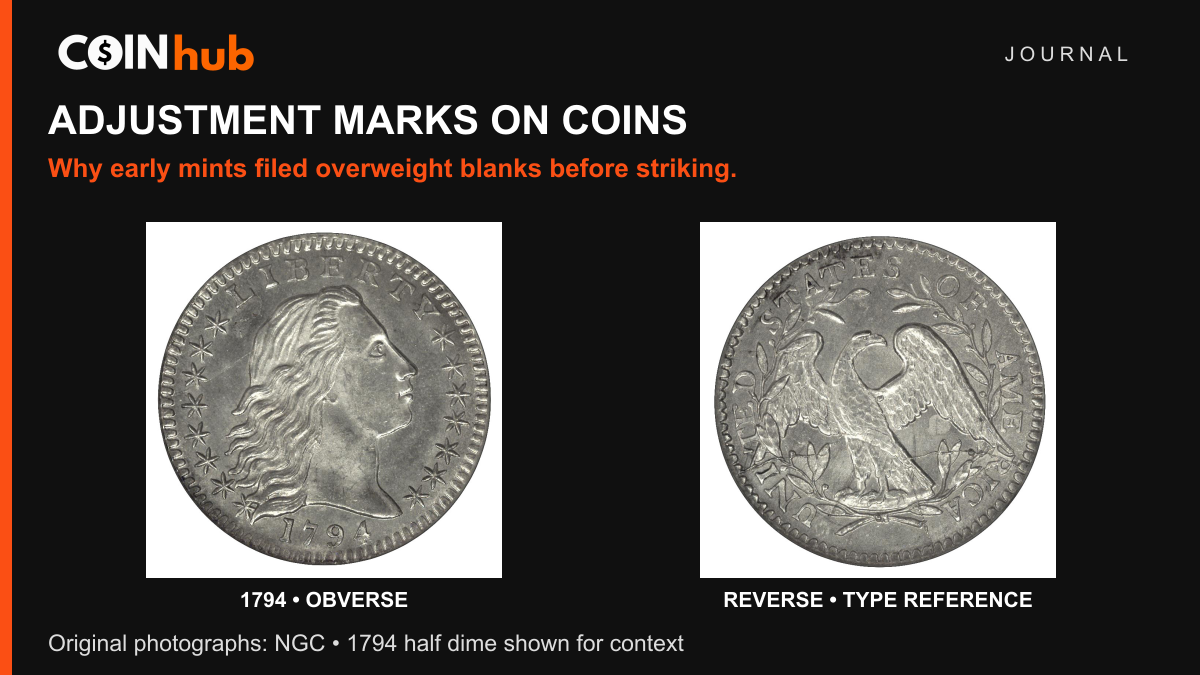
The photographs above show an NGC reference example of a 1794 Flowing Hair half dime, an early U.S. type discussed in the literature on planchet adjustment. They provide period and design context. They are not a close-up diagnosis of adjustment marks on that specimen.
Blank, weight check, filing, strike
The key is the sequence. A blank that contained too much metal could be brought down to the required weight before the dies impressed the design. A file left grooves in that blank. During striking, metal moved and the dies compressed the surfaces; depending on the location and depth, some filing evidence remained visible.
NGC's Flowing Hair half-dime guide discusses this preparation method and explains why adjustment marks can survive. The PCGS glossary likewise treats adjustment marks as pre-strike metal removal, particularly associated with early gold and silver coinage.
This is not a method for “fixing” a coin today. Filing a finished collectible would remove metal and damage it. Historical mint preparation and later alteration belong to entirely different stages of the object's life.
Three terms worth keeping separate
| Term | What happened | Why the timing matters |
|---|---|---|
| Planchet adjustment marks | Metal was removed from an overweight blank before striking. | The subsequent strike can affect or partly obscure the marks. |
| Post-strike scratch | The finished coin was cut or scraped. | The mark damages a surface that already carries its design. |
| Press or die adjustment | Mint equipment was set or changed for striking. | A pressure setting is not the same act as filing an overweight blank. |
Search results sometimes use similar words for different processes. When reading a listing, ask which physical operation the writer actually means. “Adjustment” by itself is not a complete description.
How to assess a possible example
Begin with the coin's identity and a reliable reference for its series. Early gold and silver provide the relevant historical setting, but age alone is not evidence that a groove predates the strike. A genuinely old coin can also have recent scratches.
Inspect how the marks relate to the struck design. Record whether they remain clear, become faint, or appear affected by the flow of metal. Photograph both sides and close views under more than one light direction. A single photograph may not reveal the sequence confidently, particularly on worn or previously cleaned surfaces.
Do not rely on parallel lines as a verdict. Parallel scratches can have other causes. Fine lines associated with die preparation and later cleaning are discussed in our die-polish versus hairline guide; the surface mechanism needs to fit, not merely the shape.
For a purchase where the distinction affects the price, ask an early-coin specialist to examine the piece. Keep any seller attribution separate from what you have personally observed. A useful record might say “seller describes pre-strike adjustment marks; attribution not independently confirmed.”
Do adjustment marks lower the grade?
There is no fixed deduction that applies to every coin. NGC notes that shallow adjustment marks may not lower a grade. PCGS's discussion of difficult-to-grade early coins explains that prominent marks can nevertheless detract from eye appeal and influence assessment.
Those points can both be true. A manufacturing origin does not guarantee that a distracting feature has no effect on desirability. Conversely, a small surviving mark should not automatically be treated as equivalent to severe later damage. Depth, placement, visibility and the rest of the coin matter.
Compare the whole specimen, including wear, strike and surfaces. A numerical grade or a brief auction description does not replace looking at the actual coin. If a holder identifies a separate surface problem, read that wording carefully; our Details grade guide explains the distinction.
A sensible next step for a collector
- Identify the denomination, date and series before naming the marks.
- Save full photographs and the exact wording of any holder or listing.
- Keep pre-strike manufacture separate from possible later scratches or cleaning.
- Use comparable specimens with similarly visible marks when evaluating desirability.
- Preserve the surfaces and seek specialist review when the sequence is uncertain.
Common questions
Are adjustment marks automatically mint errors?
They can record an intentional weight-correction step in manufacture. Do not assume that the word “marks” means an accidental rarity or a premium error.
Can I identify them just by weighing the coin?
No. Present weight does not establish when a particular surface line was made. Attribution requires the coin's context and examination of the marks.
Should the marks be polished away?
No. Polishing would alter the evidence and the collectible's surfaces. Leave the coin as it is.
Sources: NGC's Flowing Hair half-dime grading guide, PCGS glossary, PCGS difficult-to-grade coins part four and PCGS's 1794 silver-dollar reference, consulted September 24, 2026. Original contextual coin photographs courtesy of NGC; CoinHub layout.