
A higher number can describe a less attractive coin
Place an attractive AU58 coin beside a heavily marked MS60 example and the numbers can feel backward. The AU coin may have cleaner fields, pleasing color and stronger visual appeal. The Mint State coin may look rougher. The explanation is that a numerical grade is not simply a ranking of how pretty two coins look.
The central difference: AU58 allows slight wear, generally visible on the highest points. MS60 belongs to the Mint State range and has no wear, but it can have many contact marks, an unimpressive strike or dull-looking luster. AU58 can therefore be more appealing to a particular collector without becoming Mint State.
Wear and marks answer different questions
Wear is the loss or alteration of surface detail and texture through friction. Contact marks are dents, nicks or abrasions from contact. A coin can acquire marks without developing the wear that takes it out of Mint State. Conversely, a largely clean-looking coin can have slight high-point friction that places it in About Uncirculated.
That distinction is why “uncirculated” should not be read as “untouched and perfect.” It also does not reconstruct every event in the coin's history. A holder reports a grading assessment; it does not tell you who handled the coin or exactly where each mark originated.
| Question | AU58 | MS60 |
|---|---|---|
| Is wear allowed? | Slight wear, especially at the highest points | No wear |
| Can it have attractive surfaces? | Yes; minor wear can coexist with strong appeal | Yes, but the low Mint State grade may reflect substantial shortcomings |
| Are contact marks possible? | Yes | Yes, and they may be numerous or distracting |
| Does the number settle the price? | No; issue and individual quality still matter | No; issue and individual quality still matter |
Use the reference photographs for the right purpose
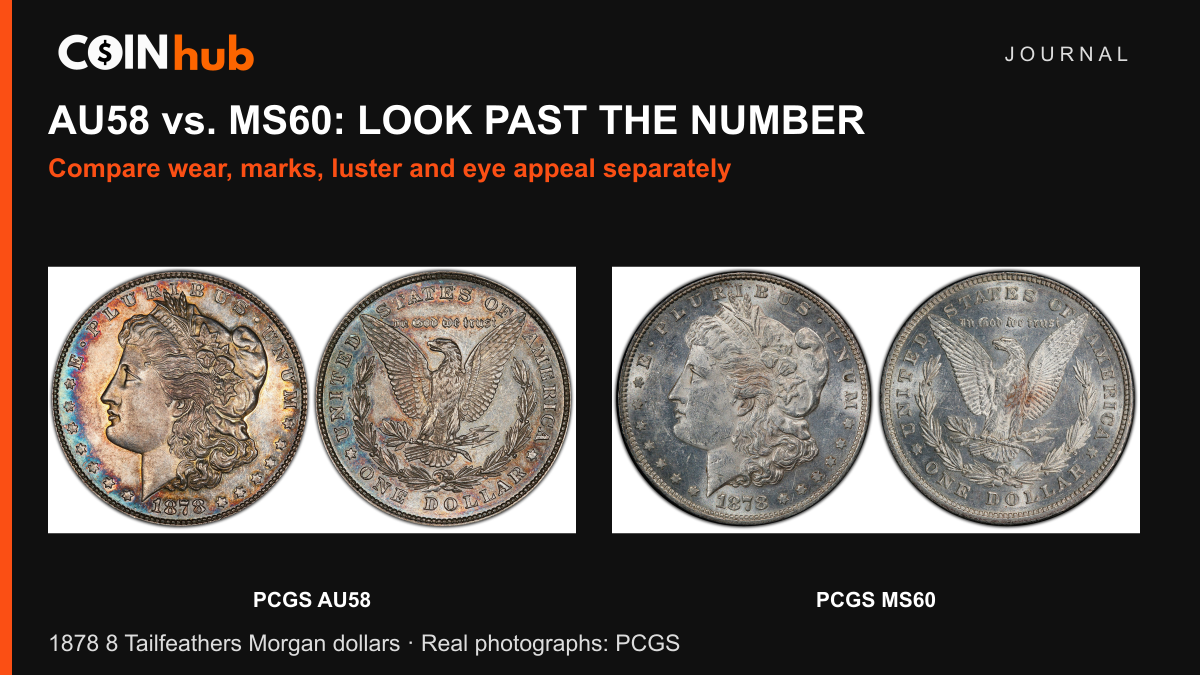
The graphic shows two 1878 8 Tailfeathers Morgan dollars that PCGS identifies as AU58 and MS60. Each specimen includes both sides. The pair illustrates how different the surfaces can look across this boundary; it is not a template for assigning a grade to every Morgan dollar with similar toning or marks.
PCGS's AU58-versus-MS60 explanation describes the high-point friction that can keep an attractive coin out of Mint State. A still image cannot reproduce the changing reflections seen when a coin is tilted under suitable light. Photography can also hide a mark in glare or make one look more severe with harsh lighting.
Do not confuse weak detail with wear
A weak strike can leave some design details incomplete before a coin ever enters use. Wear can flatten or disturb those same areas afterward. The two possibilities need different evidence. Grading requires attention to surface texture and luster as well as the apparent sharpness of a portrait or feather.
Use our weak-strike-versus-wear guide for that diagnostic question. NGC's Morgan dollar grading guide also discusses the challenge of nearly uncirculated pieces. Neither a sharp design nor a soft one automatically decides AU58 versus MS60.
A four-line comparison worksheet
When evaluating two listings, first confirm that they show the same date, mint and relevant variety. Comparing unrelated issues can make a grade discussion look like a value conclusion. Obtain clear photographs of both sides and the complete holder label where one exists.
- Wear: Record what the holder says and which areas are visible clearly enough to study. Keep an uncertain photographic observation separate from the assigned grade.
- Marks: Note the most distracting marks and where they fall. A mark on a central portrait may affect your enjoyment differently from one near the rim.
- Luster and strike: Describe what the available views show and what they leave unresolved. Ask for another lighting angle when a single photograph hides the surface.
- Eye appeal: State which coin you prefer and why. Color, balance and surface cleanliness can influence that preference without changing the grade category.
This short record forces a useful separation between evidence and taste. “I prefer the AU58 because its cheek is cleaner” is a defensible preference. “The prettier one must be Mint State” skips the question of wear.
Compare prices after comparing the coins
There is no universal rule that an AU58 will cost less, or that buying one guarantees better value. Look at completed sales for the same issue, variety and grading context, then examine the actual specimens behind the results. Exceptional appeal and surface problems can complicate a simple grade-price ladder.
A numerical-grade comparison also should not absorb coins carrying a problem designation as though their labels were equivalent. Our Details-grade guide explains why cleaning or other problems change the comparison. Keep those qualifiers visible in your notes.
Should you expect an AU58 to upgrade?
No. An attractive AU58 remains an AU58 assessment unless a qualified service determines otherwise. Do not base a purchase on a promised upgrade from a seller or your own interpretation of one photograph. Buy a coin whose present identity, surfaces and price make sense to you, and keep any uncertainty explicit.
Sources checked September 18, 2026: PCGS's AU58/MS60 comparison, NGC's grading scale and NGC's Morgan dollar grading guide. The reference grades belong to the pictured specimens. This article does not grade a reader's coin or guarantee a market result.