
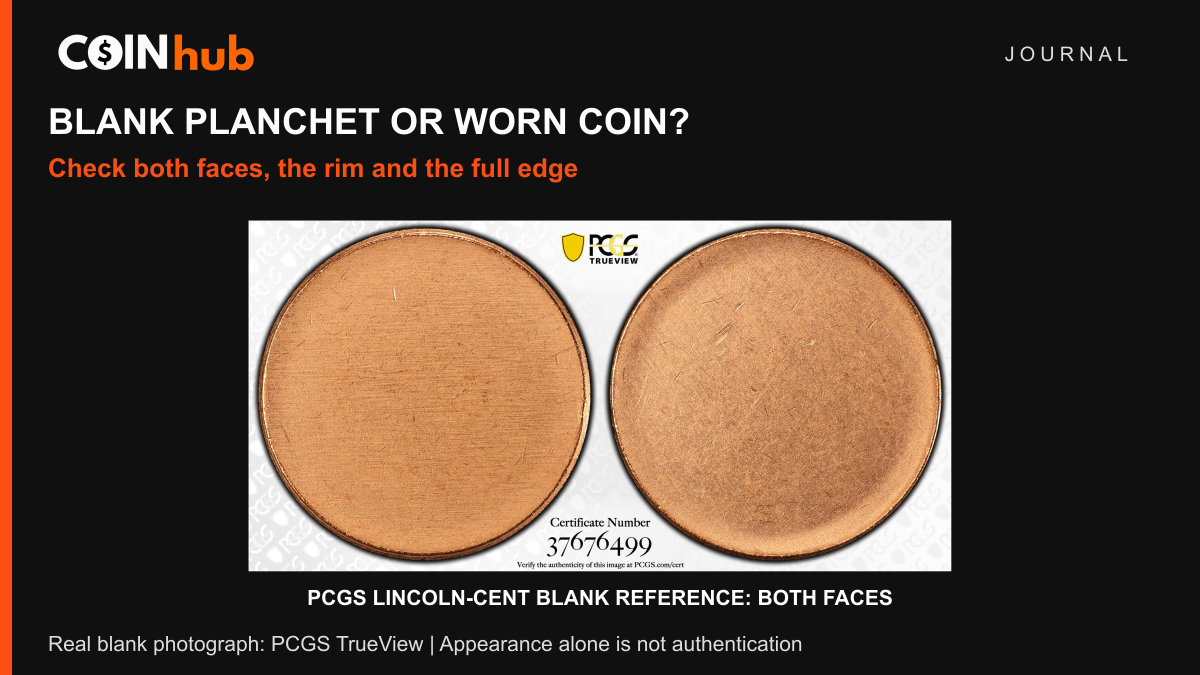
An unstruck blank has not received the normal coin designs on either face. A prepared blank with a raised rim is often called a planchet. But a smooth metal disc is only a candidate: wear, grinding and other objects can resemble one.
Start with photographs of both faces and the complete edge. Then describe the rim and any remaining design. Do not begin with a price or assume a blank-looking object came from the Mint.
Blank, planchet, rim and edge
A blank is a metal disc cut for coin production. Before striking, an upsetting machine can squeeze its edge and raise a rim around each face. A die is the tool that impresses the coin design. The rim borders a face; the edge is the narrow surface around the outside.
Collectors often use Type 1 for a blank without an upset rim and Type 2 for a prepared planchet with that rim. PCGS’s 2007 lettered-edge dollar report, for example, uses Type 2 for a raised-rim planchet. That shorthand is not the only naming system.
Why Type 1 and Type 2 labels can confuse
NGC’s illustrated Planchet Forming article separates three stages. Its Type 1 blank is the newly punched disc. Its Type 2 blank has been softened, washed and dried but has not yet had its rim raised. NGC then calls the rimmed piece a planchet.
That is why “Type 2” alone can be ambiguous. Specialist Jon Sullivan also notes the confusion and points readers to NGC’s definitions. Read the full holder or listing description and look for the physical stage being described.
| Physical stage | NGC’s illustrated terminology | Useful observation |
|---|---|---|
| Freshly punched disc | Type 1 blank | No upset rim; cut-and-tear texture may remain at the edge |
| Softened and washed disc, before upsetting | Type 2 blank | Surface treatment changed, but the rim has not been raised |
| Rim raised, ready for striking | Planchet | A raised border around both faces |
These are descriptions of production stages, not three tests that prove an object genuine. NGC’s article is a historical account. Its processing details do not establish how every denomination or supplier operates today.
Check both faces before naming the error
The PCGS reference photograph above shows a real blank intended for a Lincoln cent. Neither face carries the familiar struck portrait or reverse. Surface marks are still visible; an unstruck piece need not look like a polished mirror.
If one face has a clear coin design, the piece needs a different explanation. A uniface strike can leave a face without normal die detail because contact was blocked. A split planchet can expose an interior surface. Neither is simply a fully unstruck blank.
A very worn coin may retain faint letters, part of a portrait or a trace of its rim. Light the surface from several angles and record what survives. A ground or polished object may show scratches, flattened borders or lost metal. Those clues raise questions; one mark alone does not settle the cause.
Record the rim and the whole edge
A face-on photograph can hide the feature that matters most. Take a separate edge view and turn the piece gently so its full circumference can be seen. Do not file, scrape or bend it to expose fresh metal.
Note whether a rim appears on both faces and whether its shape is consistent around the disc. Keep observations literal: “raised border on both faces” is more useful than an unsupported “rare Type 2 error.” A seller’s label should not replace the evidence.
Do not assume a plain edge proves the piece is wrong. Raised face rims and edge details form at different stages. The historical PCGS dollar example even received edge lettering without receiving its normal face designs. That unusual documented piece is not a rule for ordinary cent blanks.
Use measurements as supporting records
Record the weight in grams and the diameter in millimeters, along with the instrument’s precision. Keep packaging off the scale; leave a certified holder sealed. An undated blank may not reveal the year or issue for which it was intended.
The CoinHub Coin Weight & Size Checker compares measurements with nominal references for its listed coin types. Nominal means the reference value, not a complete manufacturing tolerance. Select a type only when there is evidence for that comparison.
The worksheet does not identify a blank’s alloy, mint or date. Its finished-coin references also cannot establish whether upsetting or later alteration explains a disc’s dimensions. Matching a number is not authentication, and a mismatch alone does not prove an error.
Preserve the evidence before seeking a value
Keep the piece uncleaned in a suitable holder and save the original photographs. Note where it came from without treating a roll, bag or seller’s story as proof. A useful record includes both faces, the edge, measurements and the exact wording of any certified attribution.
Ask an error specialist whether the object merits an in-person examination or certification. Confirm the service’s current process before paying a fee. Establishing what the piece is comes before using sale prices for comparison.
For broader error-learning context, CoinHub founder Blake Alma’s The CoinHub: An Ultimate Guide to Coin Errors is an optional resource. It is CoinHub’s own book; the practical checks here do not depend on buying it.
References: NGC’s Planchet Forming; Sullivan Numismatics’ terminology discussion; PCGS’s January 16, 2026 blank-planchet article and March 13, 2007 lettered-edge dollar report, checked October 14. Historical examples do not establish a current value, service fee or a date for an unknown blank.
Photograph: PCGS TrueView, both faces of its documented cent-blank reference. Original image resized in full with CoinHub text and branding added; no coin detail altered. No source endorsement is implied.