
Ask when the metal separated
The word “split” can suggest a coin broken into two semicircles. This error instead involves separation into thinner layers. The distinction matters when examining a light coin or a face that appears rough or nearly blank. Those observations start the investigation; they do not establish its cause.
Before the strike: thin metal meets the dies
In a before-strike split, the surviving portion enters the striking operation with less metal than intended. ErrorRef's specialist description explains that the exposed interior can show striations, although striking can flatten that texture. Design strength varies with the piece and the strike.
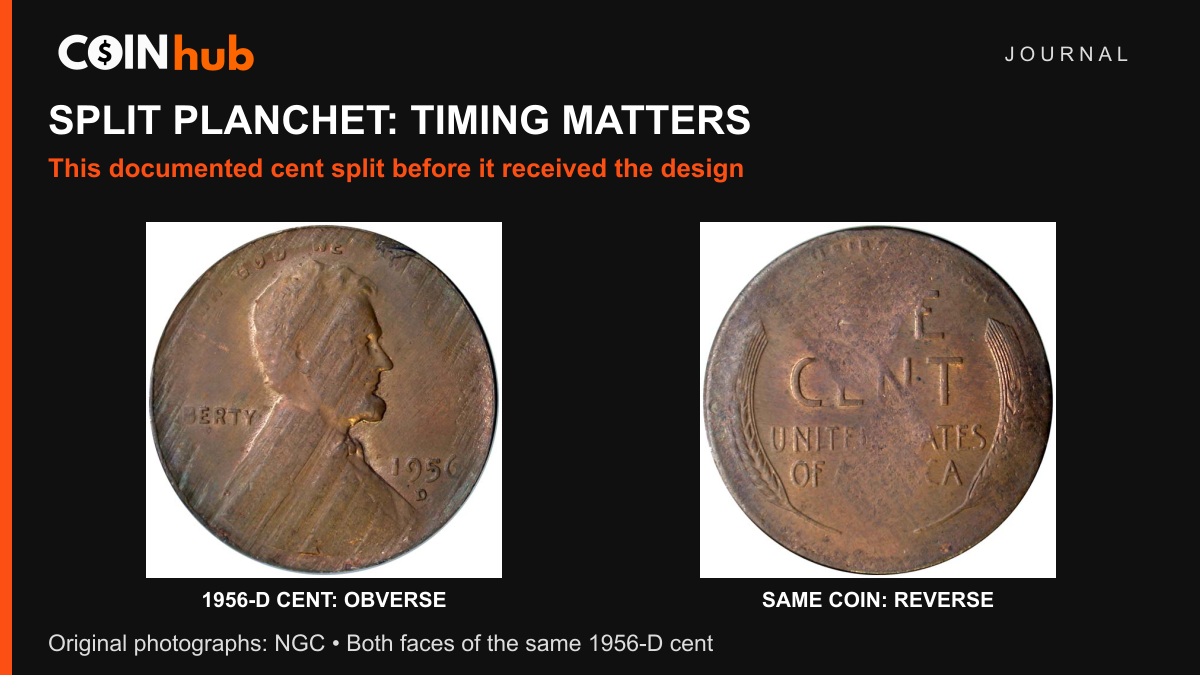
The photographs here show both faces of one 1956-D Lincoln cent from NGC's documented example. NGC identifies it as struck on a split planchet. Its weak detail illustrates why this error can resemble other weakly struck pieces. The left image is not a normal coin used for comparison, and the right image is not an after-strike split.
After the strike: the interior becomes a new face
When separation occurs after the design has been struck, one surface of a resulting piece can retain the normal die impression while the other exposes the metal's interior. ErrorRef's after-strike examples show that faint ghost design can remain visible on the exposed surface. “Completely blank on one side” is therefore too rigid a rule.
Keep the interpretation attached to the actual surfaces. If a faint feature is visible, photograph it under more than one lighting angle instead of deciding that it must disqualify a split. Conversely, do not turn every uneven or scratched face into evidence of internal separation.
| Timing | What happened | Evidence to compare |
|---|---|---|
| Before striking | A thinner portion received the strike | Design on both faces, possible weakness and remaining interior texture |
| After striking | An already struck piece separated | Retained struck face versus exposed interior, possibly with ghost detail |
| Timing unresolved | Appearance alone is insufficient | Both faces, edge, measured weight and specialist examination |
A split does not have to produce equal halves
Each separated portion has less metal than the intact planchet, but do not demand exactly half the normal weight. The separation need not run through the precise midpoint. A scale reading also cannot tell you whether metal was lost during minting or removed later.
Record the measured weight, scale resolution and the specification used for comparison. First confirm the denomination, date and composition. Our coin-weighing guide covers the measurement process; a number should support the physical evidence rather than replace it.
Separate related error names
Specialist split-planchet terminology concerns separation within a solid-alloy planchet. It should not be applied automatically to a missing layer on a clad or plated coin. NGC treats lamination and missing clad layers separately. Composition is part of the diagnosis.
A smaller peeling or flaking area may raise a lamination-error question. A face whose die contact was blocked raises a different uniface-strike question. Grinding or other later alteration also needs to be excluded before accepting a mint-error attribution.
Build an evidence record before seeking a value
Photograph both faces square-on, the whole edge and the unusual texture at a second light angle. Keep the coin uncleaned and handle it by the edge. If two matching pieces are present, keep their provenance and photographs together; do not try to force, glue or polish them into a pair.
For a potentially significant example, ask a qualified error specialist whether examination or certification is appropriate. Submit the observations without announcing a grade or a price. The useful question is whether the proposed minting sequence explains all the evidence.
References checked September 22, 2026. The NGC photo example is historical; no old auction result is presented as a current value for another coin.