
Start with a record of the spot
A small mark can look alarming against a bright gold field. The immediate temptation is to make it disappear. A better first question is whether you understand what is on the surface and what any attempted treatment might change.
Why a gold coin can show reddish spots
Gold coins are not all made from the same alloy. Many include copper, and localized concentrations can react differently from the surrounding surface. NGC's conservation guidance identifies these copper-rich areas as a cause of reddish spotting.
In its 2016 discussion of gold-coin conservation, NGC also documents spotting on modern gold coins. A recent date therefore does not exclude the problem. Nor should a photograph of a red mark be used to calculate a coin's fineness: appearance is not an assay.
Read the before-and-after example carefully
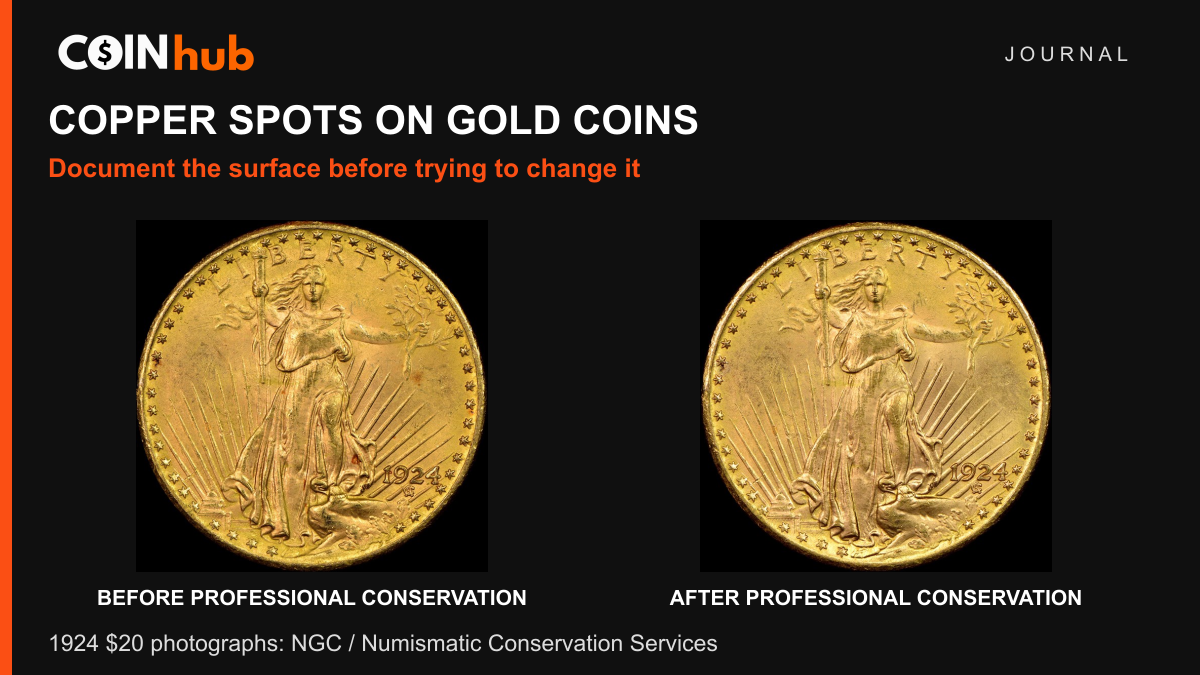
The photographs above show the same 1924 Saint-Gaudens twenty-dollar gold coin before and after professional treatment by Numismatic Conservation Services. Look near the lower right of Liberty's drapery, above and to the left of the date, for one of the conspicuous reddish areas in the untreated photograph.
This is a documented conservation example, not a promise that every similar-looking coin can achieve the same result. It also does not demonstrate a home treatment. The original photographs are reproduced without retouching; the difference records the professional work described by the source.
A red surface mark can have another cause
The same NGC article distinguishes copper spotting from a thick, opaque red-to-orange residue. That distinction matters because two marks of similar color may represent different surface conditions. Other storage-related residues can also occur on gold coins.
| What you observe | What to record | What remains uncertain |
|---|---|---|
| A small reddish area | Location, size and appearance under steady light | Whether it is alloy-related spotting or another condition |
| An opaque patch or film | Its outline and whether it covers nearby design details | The substance and condition underneath |
| A mark visible through a holder | Views from several angles, without opening the holder | Whether the mark is on the coin or the holder |
| A change from an older photograph | Both dated images and known storage conditions | The cause of the change |
These observations help an evaluator; they are not touch tests. Do not probe a raised-looking area to see whether it comes off. If soft plastic storage or green residue is involved, our PVC guide addresses that separate concern.
Do not turn identification into an experiment
Rubbing with an eraser, polishing with a cloth or applying a flame changes the object you are trying to assess. A mark that becomes less visible has not necessarily been removed without damage. You may also lose the original evidence of what the spot looked like.
NGC's Details Grading guidance explains that improper cleaning, scratches and other surface problems can prevent a numeric grade. The practical lesson is to avoid experimenting on a collectible coin merely because a short video makes the treatment look easy.
Prepare useful photographs and notes
Take a full image of each side and a closer view of the affected area. Keep lighting and white balance consistent if comparing images over time. Note the coin's date, denomination, any holder certification, when you first noticed the spot and whether the packaging has changed.
A phone image with heavy color correction can exaggerate orange tones or conceal them. Keep the original files and avoid filters. Our coin photography guide offers a straightforward way to capture the surface without cleaning it first.
Conservation is an evaluation, not a guaranteed upgrade
A professional conservator can assess whether treatment is appropriate. Before submitting a coin, review the provider's current terms and total costs, including shipping and grading where applicable. An old article's service price should not be treated as a current quote.
NGC states that conservation does not provide a grade guarantee and cannot reverse wear, scratches or existing corrosion. Removing a residue can reveal a problem that was already underneath it. Ask about the likely benefit and the limitations for your particular coin, rather than assuming a cleaner-looking surface must mean a higher grade.
A spot alone cannot authenticate a coin or establish its market value. If a purchase depends on the coin's metal content, originality or condition, have those questions evaluated directly. Preserve the coin and its evidence until you have enough information to make that decision.
Sources and photographs: NGC's September 13, 2016 gold-conservation case study, current conservation guidance and Details Grading guidance, reviewed September 29, 2026. Before-and-after images show professional NCS treatment of one documented specimen.