
A design fragment needs an explanation
The sequence matters. The collision changes the tools; the later strike carries the evidence onto a coin. That is different from assuming that two finished coins collided in circulation or that every doubled-looking feature came from the same cause.
Use this real Silver Eagle as an orientation example
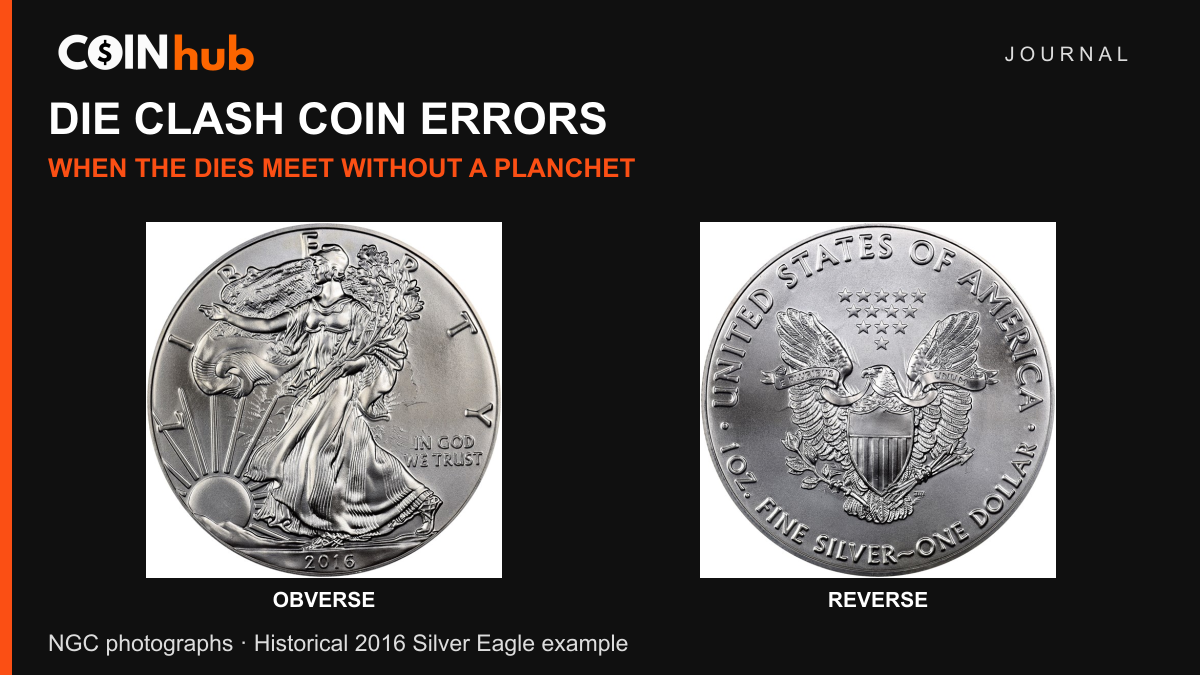
The hero shows the two faces of a 2016 bullion Silver Eagle that NGC reported in May 2018, graded MS 69 with the Clashed Dies Mint Error notation. NGC identifies transferred eagle-feather detail on the obverse, along with portions of reverse lettering.
Study the complete obverse first: distinguish the intended Liberty design from the additional detail NGC describes. Then compare the reverse. Open the source for a larger view. Its separate lettering close-up is inverted and turned upside down for readability; our main graphic preserves the two ordinary full-face photographs.
This is a historical reference specimen. The 2018 report’s statements about discovery and uniqueness are not a present-day census. Nor does its grade describe another coin with a vaguely similar mark.
Keep nearby explanations separate
| Possible explanation | Question to investigate | Useful next evidence |
|---|---|---|
| Die clash | Can the extra detail be related to the opposing die’s design? | Both complete faces and an issue-specific reference |
| Brockage | Was an already-struck coin involved in transferring an impression? | Orientation, recessed detail, opposite face and edge |
| Doubling | Is the claim about duplicated elements of the normal design? | Sharp lettering/detail views and the exact attributed variety |
| Later damage | Does a disturbance need to be explained before assuming a Mint origin? | Uncropped surface and edge views under different light |
This table is a way to organize an inquiry, not a photograph-based grading service. Our brockage guide explains that different striking sequence. For a named clash variety with its own diagnostics, use the 1955 Bugs Bunny Franklin guide rather than transferring the Silver Eagle’s appearance to a half dollar.
Build a photo set another collector can use
- Identify the ordinary coin. Record its denomination, readable date and mintmark before naming an error.
- Save complete face views. A tight crop may show a line clearly while hiding where it belongs in the design.
- Mark the area in a separate copy. Keep the unannotated original. Describe its location relative to a letter or device rather than “that mark at the side.”
- Change light direction. Save another exposure when glare hides the surface. Do not sharpen until a vague patch resembles a desired letter.
- Write what remains uncertain. “Possible transferred detail near Liberty; opposite face attached” is more useful than an unsupported rare-error declaration.
When comparing a reference, keep track of image rotation. A transformed image should be labeled as a comparison aid. Never replace the evidence file with a mirrored version and later mistake it for the original photograph.
A clash is not a guaranteed service attribution
NGC’s die-error reference says clash marks need to be pronounced and unusual to qualify for its mint-error recognition. That boundary matters when deciding what question to ask a service. Evidence of the mechanism and eligibility for a particular label are separate conclusions.
Before paying for an attribution, check the service’s current terms and ask a knowledgeable examiner whether your photographs justify further review. Do not assume that a submission fee guarantees the requested notation.
Does every clash add a large premium?
This guide makes no such claim. An actual comparison needs the issue, extent of the clash, condition, attribution and documented sale context. A dramatic coin from another series is not a price estimate for your example.
Should I clean the area to make it easier to see?
No. Improve the lighting and documentation. Preserve the surface and seek help if the evidence remains unclear; do not scrape a suspected diagnostic.
Primary references and Google/Bing results checked September 16, 2026. The inspection workflow is CoinHub editorial guidance, with no current rarity count or grade assigned to a reader’s coin.