
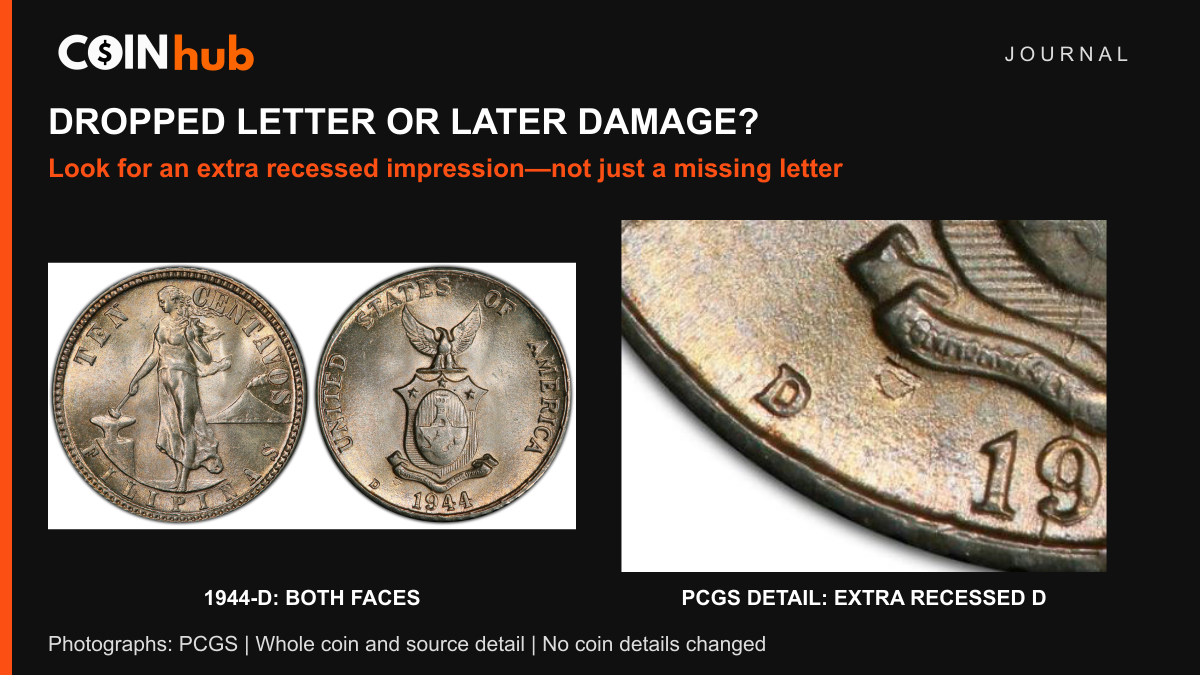
A dropped letter coin error can leave an extra, recessed letter-shaped mark on a coin. A plug of compacted material falls from a die and gets pressed into a blank during the strike. The mark is a clue to that process, not proof by itself.
The name can be misleading. It does not mean a normal letter fell off the finished coin. Nor does it mean every missing letter is this error. Start by asking whether the odd shape sits below the surface and whether it fits a letter from the coin's design.
How a die filling becomes an extra letter
A die is the tool that stamps a coin. Its recessed letters normally make raised letters on the coin. Dirt and other material can pack into one of those recesses. That packed plug can take the shape of the letter.
If the plug comes loose and lands in the striking area, the next blow can press it into the coin. NGC's illustrated dropped-letter account explains that the material may then fall away or stay attached. The resulting impression is incuse, which means sunk below the surrounding surface.
The broader term is a dropped filling: a plug need not come from a letter. The key idea is a loose piece formed in a die recess, then struck into a coin. A shape that merely looks like an alphabet letter still needs a sound explanation.
Read the two D shapes in this real example
The photograph shows a 1944-D United States Philippines 10 centavos coin documented in PCGS's September 2021 error highlights. On the eagle-and-shield face, the normal D mintmark remains near the lower left. A separate, recessed D-shaped impression lies below the ribbon.
The companion detail makes that extra impression easier to see. It is a source-supplied close view of the same example. Do not call the pair a doubled mintmark just because two D shapes appear. Their height, location and proposed cause matter more than the letter count.
Does the extra letter have to be backward?
No. Error-Ref's dropped-filling explanation describes both normal and mirror-image impressions. The result depends on which die supplied the plug and whether the plug turned over before the strike.
That makes “it is backward” a poor stand-alone test. Compare the shape with plausible source letters, then consider its position and the surrounding surface. A plug can also flatten or distort. A slightly changed size does not settle the question either way.
Separate a missing letter from an extra impression
| What you see | What to investigate | What it does not prove |
|---|---|---|
| A weak or missing normal letter | A filled die or another cause of lost detail | That a plug dropped onto this coin |
| An extra recessed letter-like shape | A possible dropped filling and its source | That the mark formed at the Mint |
| Extra raised design beside a letter | A different cause of apparent doubling | A dropped-letter error |
A grease-filled die can fail to form a normal letter. That is different from a loose filling making an extra impression elsewhere. If foreign material remains in place, the wider retained struck-through category may also be relevant.
Make a record before naming the mark
Take clear photographs of both faces, the whole edge and the odd mark. Move the light, not a sharp tool, to show whether the shape is raised or recessed. Record the date, mintmark and exact location. Keep the coin uncleaned and do not pry at material that remains attached.
Compare with an unaltered coin of the same design. A later punch, dent or tool mark can also sink into the surface. Sharp displaced metal, scratches or an unrelated shape may raise questions, but a photograph cannot resolve every cause.
The CoinHub Error or Damage Checklist can help organize surface and photo observations. It cannot authenticate a dropped filling. Ask an error specialist to assess the whole coin before using that label or a price comparison.
For more error-learning context, CoinHub founder Blake Alma's The CoinHub: An Ultimate Guide to Coin Errors is an optional resource. It is CoinHub's own book; the checks here do not depend on a purchase.
References and photographs: NGC, PCGS and Error-Ref, checked October 15, 2026. Both faces and the separate detail are PCGS photographs of its documented 1944-D example, reused under CoinHub's saved permission. Complete source images resized with labels and branding added. No current price or authentication of a reader's coin is implied.