
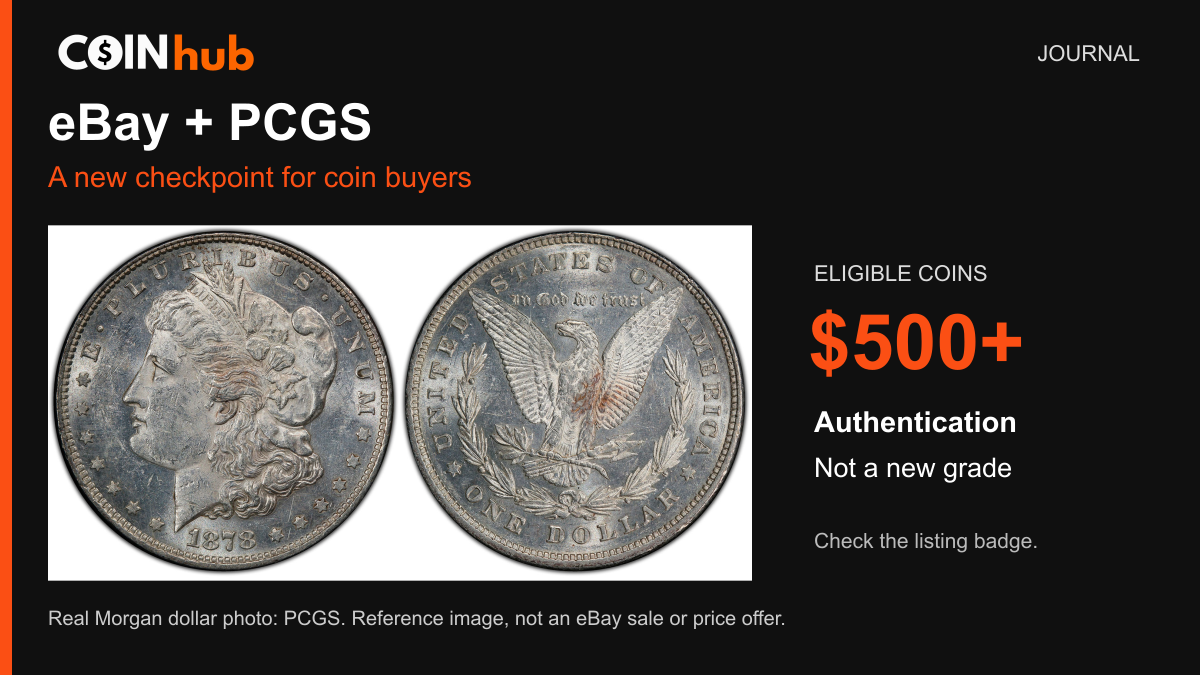
A major change in online coin buying, with an important distinction
Buying a valuable coin on eBay can now include a stop at PCGS before the package reaches your door. That is a meaningful change for collectors weighing a purchase from photographs: an eligible transaction gets a physical inspection between the seller and the buyer.
But this is not free automatic coin grading. eBay's Authenticity Guarantee authenticates eligible purchases. It does not routinely assign a numerical grade, upgrade an existing grade, or turn a raw coin into a newly PCGS-graded coin.
Why this matters for the coin market
eBay announced the rollout on August 18, 2026. A September 18 article on PCGS's website, written by eBay's Heather Kline, put the partnership back in front of collectors. This is a recent program, not an announcement first made today.
The significance is where the inspection happens. Instead of a buyer receiving a questionable coin and then arranging an expert opinion, an eligible sale passes through a specialist first. For an honest seller, that also creates another documented checkpoint before delivery.
Our view: this could make unfamiliar sellers easier to evaluate, but it does not make every listing equally attractive. Authentication answers a different question from whether a coin is worth the asking price, whether its surfaces appeal to you, or whether it belongs in your collection.
Which eBay coins qualify?
Start with the individual listing, not just the cart total. eBay's seller eligibility guidance distinguishes these groups:
| What you are buying | Current program treatment |
|---|---|
| One raw U.S. coin | Can qualify at $500+ in the eligible U.S. coin category. |
| One graded U.S., Canadian or world coin | Can qualify at $500+ with an accepted grading service. |
| A raw world or Canadian coin | Not included in the stated raw-coin eligibility. |
| Bullion-category listings, sets, rolls or multi-coin lots | Not included in this coin program. |
The accepted graders are PCGS, NGC, CACG, ANACS and ICG. Having an eligible NGC or CACG holder inspected does not mean that PCGS is converting it into its own grading product.
The buyer and seller FAQs currently describe U.S.-to-U.S. transactions on eBay.com. The detailed terms also mention restricted Canadian-seller eligibility, so international buyers or sellers should not assume coverage. Check the badge, destination and current order terms. Paper money, medals, tokens and local-pickup transactions are outside the listed coin coverage. Full coin eligibility and exclusions.
The $500 detail that can change an order
The coin price is measured before tax and shipping. A $480 coin does not reach the threshold merely because the checkout total exceeds $500.
There is an important exception to the simple price shorthand: eBay says an otherwise eligible listing with a Buy It Now price of at least $500 can remain eligible when a lower Best Offer or auction price is accepted. Its coin seller FAQ specifically addresses that case. For an auction without that qualifying Buy It Now price, the sale must meet the program threshold. Always confirm the order's actual program status.
What PCGS checks, and what it does not
For a raw coin: the inspection considers authenticity and whether the coin and its condition agree with the listing. That does not supply a new numerical grade for your collection record.
For a graded coin: the process checks the holder and label, including evidence of tampering, and compares the item with the listing. It is not a second grading opinion on the number already printed on the label. eBay explains the two inspection paths in its coin-specific process guide.
That distinction matters on a purchase described as a potential upgrade. A seller's suggestion that an MS63 coin might make MS65 is still a suggestion, not a grade promised by this program. Compare what is actually certified with what the seller hopes the coin could become. Our PCGS and NGC label guide helps separate the label's facts from sales language.
eBay's terms contain a narrow provision allowing re-slabbing and a new certification in certain counterfeit or tampered-holder situations where the underlying coin is genuine and uncompromised. That is not an optional grading service available with every purchase.
What happens after you buy
The seller sends an eligible order to the authentication facility rather than directly to you. After a successful inspection, the package travels onward to your delivery address. eBay's launch announcement describes a tamper-evident e-tag with a unique QR code on the protective packaging, providing access to authentication information.
Build the extra shipping leg into your expectations. The coin FAQ describes inspections typically taking one to two business days after receipt, followed by tracked shipping. The broader seller help page currently warns that some Authenticity Guarantee orders can be delayed by seven days or more. Treat delivery estimates as estimates, especially for a time-sensitive gift.
Authentication is currently covered by eBay, but its coin page calls the no-charge offer limited-time and reserves the ability to change fees. That does not erase the listing's normal purchase, tax or shipping charges. A signature is required for delivery from the authenticator on items valued at $1,500 or more. See eBay's buyer guide and the coin-specific terms before checkout.
Read the return policy before bidding
Authentication is not an unlimited trial period. A seller's stated return policy still matters, and some authenticated purchases are final sale. If an eligible return is opened, the item goes back through authentication for a condition and identity check before returning to the seller.
If authenticity cannot be confirmed or the item fails the listing comparison, eBay generally refunds the buyer rather than forwarding the failed item. Its buyer guide also describes contacting the buyer about certain minor discrepancies. Monitor eBay messages, and handle any problem through the order itself.
For a damaged coin delivery, act promptly: the coin terms specify a three-calendar-day reporting window when the seller does not offer returns, or the seller's stated window when returns are offered. Read the current coin terms rather than assuming the familiar return rules for another product category apply.
CoinHub's five checks before a $500-plus purchase
- Verify the badge. Save the listing and order details showing whether Authenticity Guarantee applies.
- Study the actual coin. Ask for clear photographs of both sides, the edge when relevant, and the complete holder label. A stock image cannot answer every condition question.
- Price the stated grade. Compare relevant sales, not an optimistic future upgrade. Our price guides versus auction results explainer shows why those numbers can differ.
- Separate authenticity from preference. An authentic coin can still have unattractive toning, distracting marks or an asking price you should decline.
- Keep the evidence. Retain photographs, invoice, packaging and authentication information. Use our coin collection records checklist to keep them together.
This is a welcome additional checkpoint for online collectors. The strongest approach is to use it alongside research and careful buying, not in place of them.
Frequently asked questions
Will PCGS grade my raw eBay coin for free?
No. The included service is authentication. Do not buy a raw coin on the assumption that a new PCGS numerical grade and holder are included.
Does every coin above $500 qualify?
No. The listing, category, coin type, grading service and transaction location matter. Look for the program badge and confirm the order details.
Can I skip authentication to receive the coin sooner?
eBay's current seller guidance says eligible items are automatically included, with no opt-out. Plan around the additional inspection and shipping step.
Sources and scope: Researched September 26, 2026 using eBay's August 18 announcement, the September 18 PCGS-hosted update and eBay's current coin, buyer and seller guidance linked above. Program terms can change. CoinHub sells coins on eBay; this article explains eBay's program and does not promise that every CoinHub listing qualifies. Reference photograph courtesy of PCGS, showing an 1878 Morgan dollar; it is not presented as an eBay transaction or a $500 offer. No coin details were retouched.